
Jean ‘Binta’ Breeze (1956-2021)
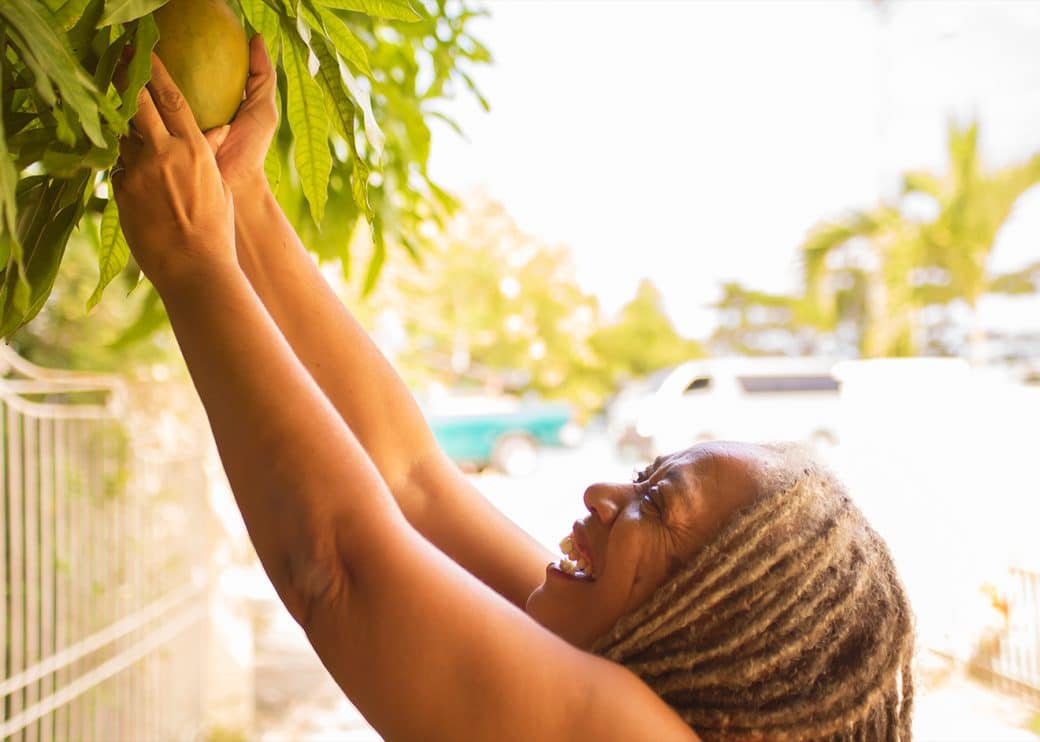
Commemorating the pioneering Jamaican poet
Hannah Lowe
I first heard of Jean ‘Binta’ Breeze in the list of names below the 2004 photograph ‘A Great Day in London’, in which fifty writers of colour were photographed on a flight of stairs inside the British Library, in homage to the iconic 1958 photograph of jazz musicians in Harlem.
(https://www.theguardian.com/books/2004/sep/18/featuresreviews.guardianreview33)
This assembling of writers – some of whom might have never met before, but might well have known each other through their literary work – reminds me of the importance of a literary community, and echoes through the words I’ve read about the passing of Jean ‘Binta’ Breeze in these last few days. Younger writers have expressed her importance as a nodal point in a shared literary heritage. Kei Miller posted an obituary online, telling the story of Breeze’s encouragement of him as a young poet. ‘You’re the real thing,’ she says to him backstage at a poetry festival. Elsewhere, she is called a poetry ‘mother’, her candour and generosity of spirit warmly praised. Her presence, like that of Jamaican women writers such as Olive Senior and Lorna Goodison, reminds me that there were others before me, and in whose footsteps many of us poets tread.
Breeze was well aware of the importance of a female literary lineage, citing her mother as a source of poetry from her early years in rural Jamaica: ‘My mother knew all these poems. I don’t know where she got them from. There were never any books; she just has them all in her head. In old time Jamaica, and even now in Jamaica, children have to learn poems by heart and everybody in Jamaica knew a Miss Lou poem, everybody.’
(Contemporary Women’s Writing 12:1, p4)
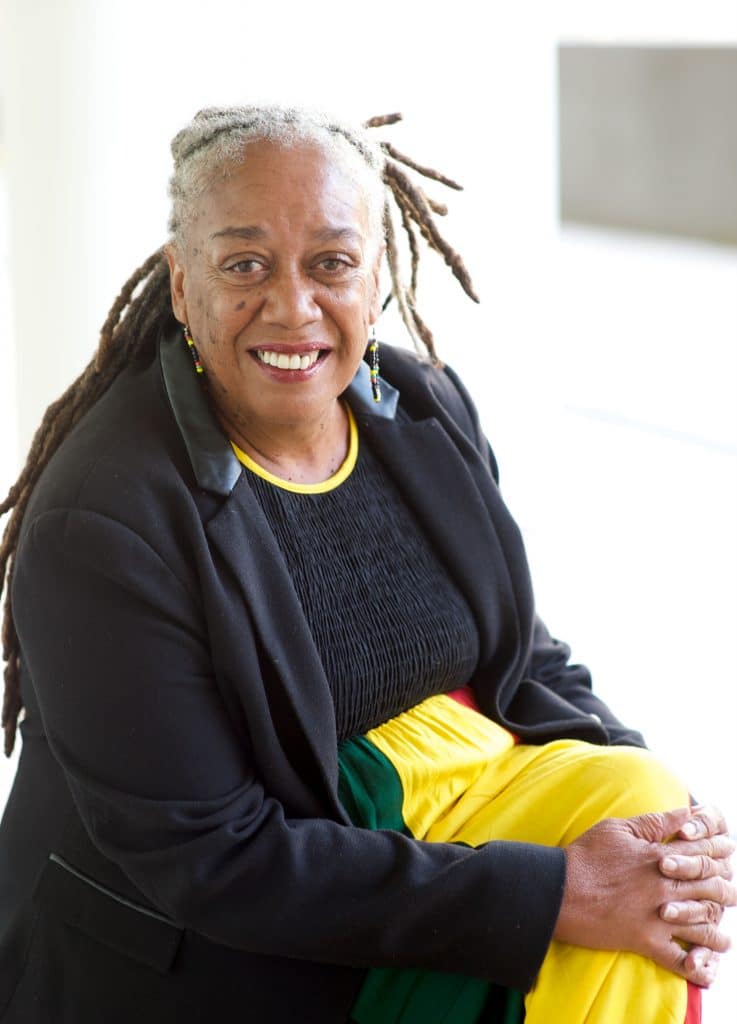
Photo by Hayley Madden and Poetry Society, courtesy Renaissance One
Breeze trained at the Jamaican School of Drama and began writing poetry in the 1970s, arriving in England in the 1980s at the invitation of Linton Kwesi Johnson. There she became a visionary poetic voice on the male-dominated dub poetry scene, the first woman to write and perform in that genre. Her blending of patois and ‘Standard English’ echoes the poetic manifesto of ‘The Garden Path’: ‘I want to make words music, move beyond language into sound’ (The Arrival of Brighteye and Other Poems).
But Breeze’s determination to write ‘a woman’s voice’, which ‘couldn’t just stick to the beat’, also bought explorations beyond reggae.
(Contemporary Women’s Writing 12:1, p4). She fused poetry with freer forms of jazz and blues, creating new hybrids. She toured across the globe and was a captivating performer of her work – ‘a one-woman festival’.
Thematically her work ranges broadly, from explorations of the everyday experiences of Caribbean women – her ‘domestic dub’ – to poems that call for third world resistance and offer a searing critique of neo-colonialism. She was perhaps ahead of her time in writing about mental illness. But the schizophrenia she suffered through much of her life is also defiantly claimed in perhaps her most famous poem ‘Riddym Ravings’:
I is de red rebel
woman
accepting I madness
declaring I song
(Riddym Ravings and Other Poems)
Migration is also a central theme, depicting the communal experience of migration to Britain, the unmothering ‘mother country’. In ‘The Arrival of Brighteye’ (2000), the child speaker laments her mother’s absence:
My mommy gone over de ocean
My mommy gone over de sea
She gone dere to work for some money
An then she gawn send back for me.
words music, move beyond language into sound.’
(The Arrival of Brighteye…)

Her final collection, Verandah Poems (2016), is a book of reflection, and among other themes, ruminates on the sense of dislocation inherent in the migratory experience. In ‘A Visit from Scotland’ the speaker’s experience of living between Britain and Jamaica leaves her ‘Trying to remember where I am coming from / And how to get back home.’ The verandah is positioned as both communal and solitary space, ‘the centre of folk life and oral culture’ – where passers-by stop by to tell tales, the bar opposite pumps out an all-day reggae soundtrack, and the poet-speaker closely observes the lives of those in her community and the environment.
(Contemporary Women’s Writing 12:1, p4). This poem, taken from that collection, aligns Jamaica’s socio-political history with the simplicity of the blackbird’s song, and roots the poet in a world of sound, back in the landscape and people she grew up with.
Tweet Tweet
There’s a blackbird
in my mango tree
and I think of Marley
and singing songs of freedom
I have followed birds
from hills
to home
and back
wondering where was Zion
but now I am content
on this verandah
the blackbirds come to my mango tree
and sing
home is always
where it’s meant to be
I am sure
that’s what blackbirds sing
Jean ‘Binta’ Breeze (1956 – 2021) published ten books of poems and stories, and released five albums of her work. She occupied multiple roles in her working life, as artist, theatre director, choreographer, actor, teacher and poet. Breeze was featured in Sonic Vibrations, a WritersMosaic guest edition.
References
Breeze, Jean ‘Binta’, The Arrival of Brighteye and Other Poems (Bloodaxe, 2000).
Breeze, Jean ‘Binta’, Riddym Ravings and Other Poems (Race Today, 1988).
Levy, Andre, ‘Made in Britain’, in Guardian 2004. https://www.theguardian.com/books/2004/sep/18/featuresreviews.guardianreview33
Marshall, E.Z., ‘Writing the Woman’s Voice: On the Verandah with Jean “Binta” Breeze’ Contemporary Women’s Writing, Volume 12, Issue 1, March 2018

Hannah Lowe
Hannah’s work, mainly as a poet, centres around migration histories, multicultural London and the complex legacies of the British Empire.
WritersMosaic monthly
Get new writing in your inbox
One email monthly, unsubscribe anytime
Complex antihero: an interview with Arthur Hughes
Unravelling Authur Hughes' Richard III
Marlon James: a Jamaican reckoning
'A return to a home I barely knew'
The name of this wallpaper is ‘Childhood’
A luminescent bubble of memory


The Disappearers
A sprawling visceral experience that drops you in head first
The Lady Imam
Is the world ready to catch up with amina wadud?
Pressure
What's missing from the latest 'untold story behind D-Day'?



Illuminating, in-depth conversations between writers.
Listen to all episodes
SpotifyApple Podcasts
Amazon Music
YouTube
Other apps

The series that tells the true-life stories of migration to the UK.
Listen to all episodes
SpotifyApple Podcasts
Amazon Music
YouTube
Other apps
WritersMosaic interrogates the notion of ‘staying in your lane’ by asking writers how they attempt to think beyond the parameters of their cultural identity.
Listen to all episodes
SpotifyApple Podcasts
YouTube