
For the Unnamed
Fred D’Aguiar
(Carcanet, 2023)
Review by Eve Grubin
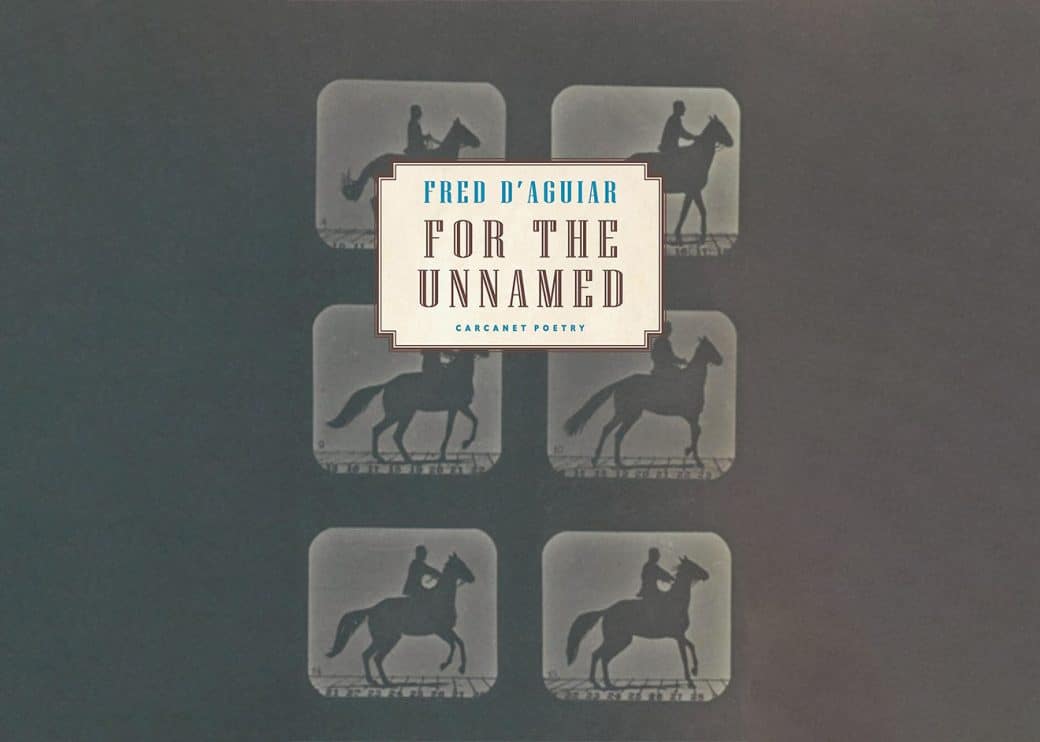
Originally, Fred D’Aguiar titled his new book of poems from Carcanet (2023) For the Unnamed Black Jockey Who Rode the Winning Steed in the Race Between Pico’s Sarco and Sepulveda’s Black Swan in Los Angeles, in 1852. This lengthy title provides the basic information about the narrative from which the poems emanate. However, in the end, D’Aguiar chose to cut the bulk of the description. What’s left is a snippet: For the Unnamed. This fragment places a strong emphasis on the idea of unnaming, and suggests that the subsequent poems are a dedication to anyone who has been unnamed, unacknowledged, unrecognised – anyone whose essence has been ignored. But the words are also a dedication to the particular historical figure who the reader will soon encounter in the poems.
The narrative which was removed from the title begins to be revealed on the book’s opening page: we are presented with ‘The Players’ as if we are about to read a playscript. In the poems, through this cast of characters, D’Aguiar retells the story of the most famous horse race in California history. The reader enters the inner lives of the horses (Black Swan and Sarco), the horses’ owners (Pico and Sepulveda), jockeys, horse trainers and other characters, such as ‘Moon’ (who represents the ‘Voices of All Inanimate Things’), and is swept up in a narrative about two kinds of race: the great 1852 horserace and race in America before the Civil War.
The central player is Black Jockey (B.J.) who remains unnamed throughout. This namelessness is highlighted by the fact that all of the other ‘players’ are given names. While based on an actual historic event, the characters’ internal worlds are imagined and certain aspects fictionalised; and yet D’Aguiar does not invent a name for the black jockey, a freed slave, who rode Black Swan to victory in a race that made some staggeringly rich and impoverished others. B.J. ’s unnaming re-evokes ‘the glaring omission by his times’, as the narrators tell the reader in one poem.
The narrators or ‘Narrators, Out of Time’ (as defined in ‘The Players’ list) are named ‘Call’, ‘Calling’ and ‘Called’ and they voice some of the most moving lines in the book. They appear much like the Chorus in a Greek tragedy; Call announcing in the opening poem, ‘We gather for him:/ hundred-strong choir’. These narrators bear witness, describe events and beg the audience of readers to empathise with what they are about to observe: ‘raise him, claim/ him from some unknown/ grave that kept him lost/ in history, stranded outside/ time, banned from his name.’
Although B.J. ’s name is ‘banned’, lost to history, D’Aguiar gives a voice back to the jockey, who shocked observers when they discovered his race. D’Aguiar imagines B.J. unified with the horse, Black Swan, an animal who exists outside of politics and racism: ‘I, meaning we, train in the dark so no one/ sees our black skin trembling with effort’. Somehow, B.J. imagines, if he loses himself in the horse, they can run together as one, run away from how they are viewed, and self-actualize, embrace authenticity and make history: ‘we must become each other/ run from how others see us/ if we’re to be true to ourselves.’ These poems are not only about B.J., an historic event, or an indictment of the times for repressing the name of the winning jockey; they also invite readers to look into themselves, to train in the darkness, to turn inward, trembling with effort. Can we run from how others see us? How can we be true, be authentic, embrace who we really are?
https://www.carcanet.co.uk/cgi-bin/indexer?product=9781800173415
WritersMosaic monthly
Get new reviews in your inbox
One email monthly, unsubscribe anytime
Pressure
What's missing from the latest 'untold story behind D-Day'?
A Trial
An examination of theatre’s complicity in post-truth politics

The Complex
The unraveling of a dynasty


Marlon James: a Jamaican reckoning
'A return to a home I barely knew'
The name of this wallpaper is ‘Childhood’
A luminescent bubble of memory
What’s in a feminist? Holding on to Gloria Steinem
Is Gloria Steinem's feminism still relevant today?



Illuminating, in-depth conversations between writers.
Listen to all episodes
SpotifyApple Podcasts
Amazon Music
YouTube
Other apps

The series that tells the true-life stories of migration to the UK.
Listen to all episodes
SpotifyApple Podcasts
Amazon Music
YouTube
Other apps
WritersMosaic interrogates the notion of ‘staying in your lane’ by asking writers how they attempt to think beyond the parameters of their cultural identity.
Listen to all episodes
SpotifyApple Podcasts
YouTube