
On Snow
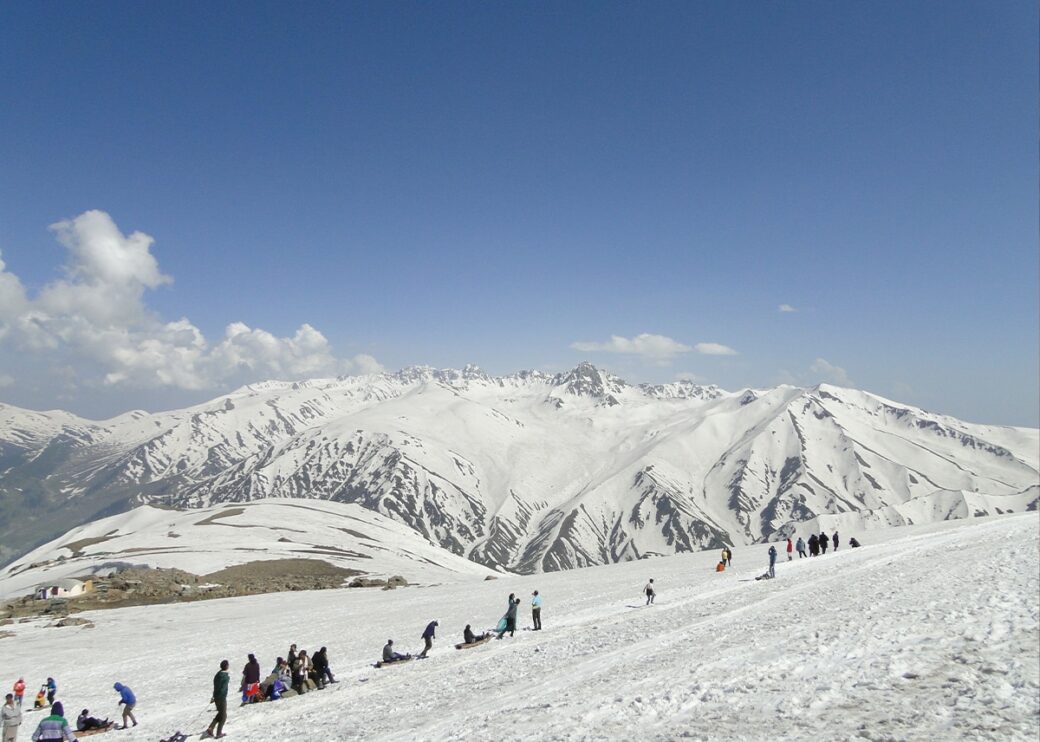
Depictions of snow in popular culture often rest on the idyllic – white expanses of nature’s beauty, the earth restored to a certain pureness – or on descriptions of the cold, rituals, warm interiors, people staying in cosy closed spaces, stories by the fire. There’s perhaps a natural tendency to romanticise the transformation of our landscape, our gardens and mountains, meadows and valleys into a white sameness, colours of summer and autumn flattened into something immaculate. In folklore and literature, estimations of beauty and purity too lean on metaphors of snow. Two new books on Kashmir, one about disappearing snows and the other about what snow conceals, suggest a fresh story.
What is sometimes overlooked in our celebrations of winter is the hardship and misery faced by those who do not have the resources, or the facility of idle time, to enjoy snow. The arrival of winter makes poverty a daily cruelty; those who cannot afford adequate heating, warm clothing, winter foods, may not look forward to snow as some of us do. People scrambling for charcoal before the advent of chilla-e-kallan, the deep winter in Kashmir, or those worried about worn old pherans, a leaking winter shoe, a broken window, spending meagre savings on warm clothes for their children before they can think of themselves – they have no time for the spectacle.
In my own recollection, I see snowball fights, the translucence of icicles hanging from the edge of the roof, the backyard a gently undulating white sheet, vegetable patches draped over, the path outside flattened under feet, and berms of snow perched delicately on walls, on sloping roofs, and the surgical layers on power lines that ran parallel to the road outside. On the morning after a big snowfall, the neighbourhood lay quiet under a foot of snow, sometimes much more. The light all around was dazzling, the cold piercing through gaps in doorways and windows, the frost beginning to take over water pipes, and the walkway to the outer door buried. So the first activity the adults undertook on those December mornings was to dig a path through the layers, before it all turned into hard crystal edifices. A measure of how much snow there was to deal with was whether the Hari Parbat Fort in the distance was entirely covered in white or parts of its brown ramparts still visible.
People had to go out for their daily bread, for prayers at the mosque, so volunteers cut paths in the snow, a lane kept dry by shovelling spadefuls onto the edges. Soon, real and imagined worries about dwindling supplies would dominate street conversations. A line on the radio about the national highway being closed for traffic and people started queueing frantically for rations, kerosene, pulses. You had to hoard basic amenities in case the highway remained shut for weeks. I queued up at the local fuel dealer’s store for several winters, freezing despite the kangri in one hand.
With the hardship, the snow season also brought peculiar charms: the ice lollies we made by mixing fresh snow with stolen milk, the makeshift slides on snow mounted high at one end in the garden, the potatoes or eggs we baked in the hot ash of a kangri, the indoor games with walnuts, the endless carrom, the gossip; and of course the winter delicacy of harissa one bought – those who could afford it – early mornings from the lone harissa shop in the main market. We kept the freeze of the chilla-e-kallan at bay with these things and with one another, for the long season also meant one stayed close to one’s siblings and visiting cousins, and chatted with friends by woodfires in the alleyways or the orchards.
*
All these memories were brought to mind as I unexpectedly came into possession of these two books, which directly and indirectly deal with snow in Kashmir, both remarkable and unique in their own ways. One is a memoir and travelogue, The Snows of Kashmir, by British-Kashmiri writer Iqbal Ahmed, a journey both in time and place as he visits his childhood home, recounting past and present travels as well as his memories.
The other is a book of photography by Indian photographer Sohrab Hura, who, having photographed Kashmir across five winters, comes to a new understanding of the place and people. Hura’s Snow is breathtaking in its singular focus on the spare, haunting beauty of the valley in winter, though it’s clear he deploys snow as a lens to reveal the illusion of normality in Kashmir.
Ahmed goes back home to his family and the snows he remembers from his childhood in the 1980s in Srinagar; he visits the diminishing ski slopes of Gulmarg, treks to the highest battlefield in the world, the Siachen Glacier, and in doing so weaves in climate change, his personal history of growing up in Kashmir, and being an immigrant in London for 30 years. Ahmed’s register is that of a traveller with foreknowledge but never without curiosity.
Ahmed looks at snow through people’s everyday lives, food choices, the preservation of tradition, in the modes of employment, but also in recording the lessening of the snows. Now the snow doesn’t arrive on time – the ski slopes are sparse – or it’s not enough, disturbing the old rhythms of seasons. Elsewhere in the book, Ahmed gives a brief account of the changed political reality in Kashmir since the revocation of its autonomy in 2019, and it felt to me as if the two, climate and politics, mirror the trauma in Kashmir.
He finds snow at home in Kashmir and on the borderlands of Ladakh and Kargil, going as far as, or shall we say as high as, Siachen, a vast icy desolation where Indian and Pakistani soldiers battle extreme temperatures to hold ground, their armies stationed there since the 1980s, the two countries spending millions in a senseless face-off. The short section on Kargil dwells eloquently on the absurdity of militarism. ‘No one ought to set up a stall where blood had been spilt.’
On his way to Siachen, Ahmed, restless, visits the snow-capped valley of Nubra, a habitation cut off culturally from the world though not from the military – it has an army base and a small air strip. Life may be hard in Nubra but it is pristine in its aloofness, something we will see less and less of in a fast-changing climate.
Even his journeys through the arid cities of the Indian plains, where the book lingers a little longer than needed, read like preparation for a return home. A sense of forever return pervades it, perhaps echoing a more universal emigrant dislocation.
*
Sohrab Hura, by contrast, looks at Kashmir as an outsider. Born in West Bengal and living in Delhi, he visited over five winters, recording the texture of life under snow. His photographs are haunting, hypnotic and ‘different’. Individually, some of the pictures leave an unforgettable after-effect, lingering in the mind like art may. But I suspect Hura is after something more – aware of his outsider’s gaze, he knows the real story of Kashmir is buried somewhere, given the sweeping clampdown on free expression in the region, so he chooses to keep the stills as they are, there’s no attempt at a ‘reveal’. It’s perhaps for this reason that he doesn’t provide any text with the photos. When you see the photos together, traversing the three phases of the Kashmiri winter, from the forty days of chilla-e-kallan through the shorter chilla-e-khurd to chilla-e-bachha, you begin to detect a subterranean current, a snowed-under valley pointing to the larger silence in Kashmir, the deep silence of its tragedy and suffering. Some of the photographs are bold: blood of slaughtered animals, a crimson pool in the winter soil; others of life’s fleeting beauty, happiness and reflection; a few capture the necessary beauty of everyday winter life (a boy pulling a red LPG cylinder with rope on thick snow); and others still, portraits of faces bearing unfathomable sorrow. All this is of course a subjective reading, possibly coloured by my own engagement with my homeland, but it may also be true that this is precisely what Hura’s intent is: to trigger a connection, an association with time and life in a land where old injuries are, for now, forcibly buried.
One of my enduring memories of growing up in Kashmir is that of light, the clear kind that comes off the surface of the lake near which I grew up, or the smoky winter twilight in the old city as many homes used to light up their clay ovens and prepare braziers for the night, or indeed of almond blossoms in spring. During trips to Kashmir, the mind inevitably seeks a reenactment of the teal light I associate with home. Hura’s photographs capture the essence of this luminosity like no other photographer has. Perhaps the late Raghu Rai’s work shows glimpses of this essence but Hura mines plenty of it, the effect strangely rapturous. A couple on a boat in a waterway in the lake amid pale winter reeds, a line of white clouds skirting the Zabarwan mountains in the background reflected in perfect clarity, the man standing, gazing in the distance and the woman with her oar mid-movement in the water. A moment, a life, a story, or part of a story, in one frame.
Hura’s pictures also deal with the mundane, with the rough and dirty business of survival. We see a farmer digging potatoes from under the snow, his (or her?) face leaning into the ground, a woman leading an older relative, hands held firmly, across a deep and desolate snowscape in the countryside, the intent in their careful movement captured perfectly. A solitary electrician atop a ladder probably trying to fix an electricity connection, the house behind him half buried in whiteness; in the photo beside it a naked bulb alight, hanging off flimsy wires. There’s light, there’s fire, and the residue of fire in the snow.
Hura zooms in on children, women and men against the dazzling whiteness of the winter in the countryside; these are lives caught in play, in congregation and in solitude, stills of faces of laughter, suffering, living. I was reminded of a hard winter in my childhood. We lived in a mountain town and the snowfall that year was so heavy that my younger sister was buried under berms that slid from the roof, only the top of her head visible, wisps of hair on the ice. I remember people from the village came together in an instant and dug her out with their bare hands. She was lost, then found in snow.
Waterstones: Snow and The Snows of Kashmir: A Journey Through the Himalayas
WritersMosaic monthly
Get new writing in your inbox
One email monthly, unsubscribe anytime
Marlon James: a Jamaican reckoning
'A return to a home I barely knew'
It’s being published I get paid for; the writing I would do for free
‘Any advance [...] for your novel is to compensate you for the horrors of being published'

Complex antihero: an interview with Arthur Hughes
Unravelling Authur Hughes' Richard III






Death of the Soccer God
The 'uneven' novel on the disappeared Haitian footballer, Joseph Edouard Gaetjens
Haunting the Black Air
Poetic freedom across space and time
The Disappearers
A sprawling visceral experience that drops you in head first



Illuminating, in-depth conversations between writers.
Listen to all episodes
SpotifyApple Podcasts
Amazon Music
YouTube
Other apps

The series that tells the true-life stories of migration to the UK.
Listen to all episodes
SpotifyApple Podcasts
Amazon Music
YouTube
Other apps
WritersMosaic interrogates the notion of ‘staying in your lane’ by asking writers how they attempt to think beyond the parameters of their cultural identity.
Listen to all episodes
SpotifyApple Podcasts
YouTube