
The chain murders of Iran
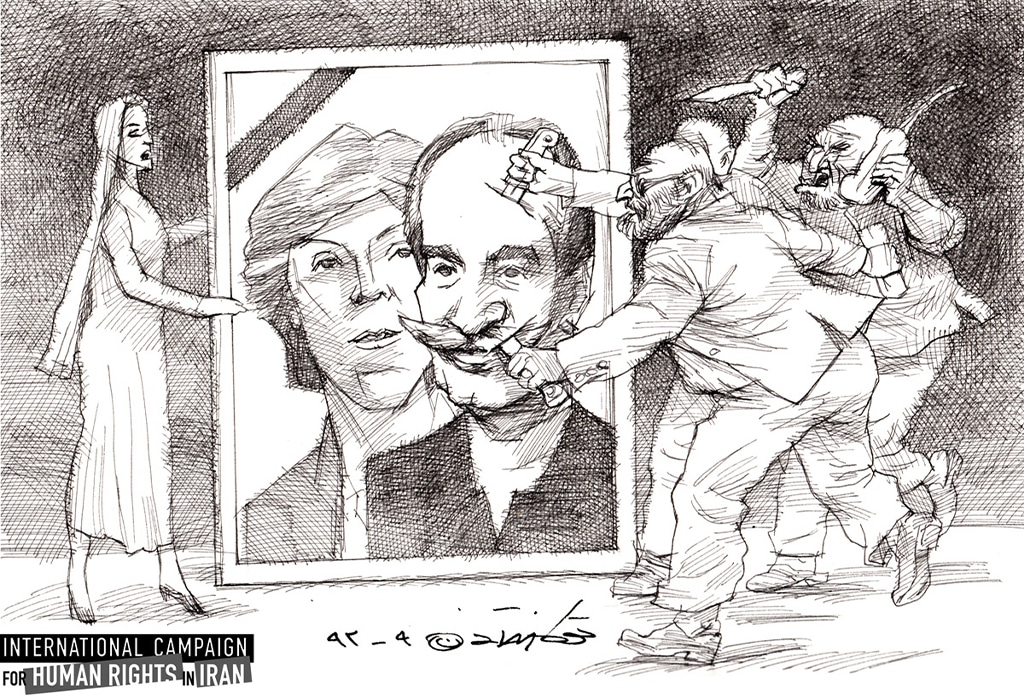
Recalling four murders of open critics of the Islamic Republic
Sana Nassari
Any phenomenon that has the potential for killing is likely to be utilised by dictators to eliminate dissidents and discipline the society. It is no accident that Iran’s previous Supreme Leader described the eight years of bloody war with Iraq as a blessing. Covid-19, too, became a deadly weapon in hands of the Islamic Republic. Baktash Abtin, the Iranian poet, filmmaker and board member of the Iranian Writers’ Association has died due to delay in hospitalisation after contracting Covid 19 for the second time in Tehran’s notorious Evin prison.
In a conversation with one of his closest friends while temporarily out on bail, Abtin asserted that next time he would not come out of prison alive. With his unique brand of humour in both daily life and writing, he was a symbol of liveliness and vitality for his friends and readers, but was realistically lethargic in the last few months of his life. Knowing that the authorities employ killer prisoners to eliminate dissidents, how he could stay optimistic? A few weeks before Abtin’s medical furlough, a prisoner murdered another detainee in the next cell. However, his prediction did not exactly come true; the next time that he was let out of Evin prison, he was put into an induced coma. Abtin died on the 8th of January 2022, a few months after receiving the 2021 PEN/Barbey Freedom to Write Award, with five years of his sentence left to run. The death of Baktash Abtin is widely considered a continuation of the so-called ‘Chain Murders of Iran’ – the systematic murder of dissidents, beginning more than two decades earlier.
In Iranian literature, autumn is a season recalling the most tragic events. In the autumn of 1998, not just the Iranian intelligentsia, but the whole nation experienced a shock when four murders of open critics of the Islamic Republic were reported in less than a month. Crystallising a series of more than 80 political murders, kidnaps and disappearances of Iranian opposition figures, including writers, translators, poets and artists who had outspokenly stated their dissent against the Islamic Republic, these brutal murders had not previously been recognised as linked – chain murders – until that bloody autumn of 1998.
The pattern of murders began with the slaughter of Dariush and Parvaneh Forouhar on the evening of 22 November 1998 in their home in the south of Tehran. The murderers managed to enter by introducing themselves as journalists and university students, whereupon the couple were stabbed to death. These murders of Parvaneh, 59 years old, political activist and poet, and Dariush, 70 years old, leader of the Nation Party of Iran, a small opposition party with a few hundred members, confirmed the notion that the regime had zero tolerance towards any political opposition or dissent.
Less than two weeks later, the writer and poet Mohammad Mokhtari was kidnapped. Missing for seven days, he was finally found strangled to death at the age of 56, having left home that afternoon to shop for groceries. He had published seven poetry collections as well as three books of translation.
Next to Mokhtari’s headstone in Imamzadeh Taher cemetery is a very similar black headstone bearing the name of his friend Mohammad Jafar Pouyandeh. The 44-year-old writer, leftist, sociologist, translator of the Universal Declaration of Human Rights and 25 other books, was abducted on the way back home from his office. Allegedly, when arrested, he told passers-by: ‘I am Pouyandeh. They are kidnapping me. They will kill me.’ Pouyandeh’s body was discovered a few days later, outside of Tehran. He, too, had been strangled to death. Both Pouyandeh and Mokhtari were active members of the Iranian Writers’ Association, Kanūn, an independent body of authors promoting freedom of expression and fighting against censorship.
But these were not the first murders of writers and intellectuals in that cold season. Hamid Hajizadeh, poet and literature teacher, and his 9-year-old son, Karoun, were stabbed to death two months prior to the murder of the Forouhars. Despite denial by the Ministry of Intelligence, Hamid’s sister, Farkhondeh Hajizadeh, was told off the record that they had been killed ‘by mistake’. It is necessary to mention that Hamid and Karoun’s bodies were dismembered in the course of this ‘simple mistake’.
The body of Majid Sharif, a 47-year-old writer and translator missing since 20 November, was found on the side of a road in Tehran. Pirouz Davani, a leftist activist, was ‘disappeared’ on 22 August the same year. His status is unknown, but widely considered to be a forced disappearance. The Islamic Republic’s Ministry of Intelligence has never accepted responsibility for the murders and disappearances of many other dissident writers and translators over the years, including Ahmad Miralaee, Ghafar Hosseini, Ahmad Tafazzoli, Ebrahim Zalzadeh (the list goes on…). The regime tried to limit the number of linked murders to four cases (Dariush and Parvaneh Forouhar, Mokhtari and Pouyandeh), despite there being 80 suspicious and unsolved cases, excluding some failed attempts. One of the most famous failed attempts was a pre-planned ‘bus accident’ involving 21 members of the Iranian Writers’ Association on a trip to a literary conference in Armenia in 1996. The bus driver twice attempted to swerve the bus off the road while rescuing himself by jumping out at the very last second. Both attempts were failures. After being kept in detention for one day, all the members of the group were asked not to speak out about this incident.
Although the systematic nature of these assassinations was obvious to the public, the organisational context has never been investigated. Neither have the main instigators behind the Chain Murders been punished. Under pressure from public opinion and the press, which were experiencing a period of openness during Khatami presidency (1997-2005), the Ministry of Intelligence finally admitted in a short press release that these criminal activities were carried out by its own staff, but the main responsibility was shifted to undefined undercover rogue agents. Saeed Emami, Vice-Minister of Intelligence, was arrested as the mastermind and main perpetrator of the murders. However, it was soon announced that he had committed suicide in Evin prison. According to lawyers for the victims’ families, his confessions were erased from the trial case. Eventually, a few staff members of the Ministry of Intelligence, who confessed in interrogation that ‘physical elimination’ was in their job description, were convicted and sentenced to prison, but then released after a few years.
One assumption about the reason for these horrific murders was that they were intended to make an example of the victims. In practice, despite the initial shock, awareness of the chain murders as a project did not seem to stop dissidents from speaking out. In his speech at Mokhtari’s burial, the celebrated Iranian writer, Houshang Golshiri, fearlessly uttered: ‘Your message was received clearly: “We strangle”’. Contrary to intentions, many started to speak out about their experience of terror; for instance, it was after the tragic deaths of Mokhtari and Pouyandeh that the passengers of the bus to Armenia revealed their story. Voices which the regime tried to strangle echoed in many other forms: in poems written by Reza Baraheni, Pouya Azizi, Baktash Abtin and many others to the memory of the victims; in scholarly books such as Censorship of Literature in Post-Revolutionary Iran: Politics and Culture since 1979 by Alireza Abiz; in fiction, including The Golden Cage by Shirin Ebadi, Nobel Peace Prize winner and lawyer for the victims’ families in the Chain Murders trial of intelligence agents; in a movie screened in the Cannes Film Festival, Manuscripts Don’t Burn by Mohammad Rasoulof; in artworks by the next generation, Curriculum Mortis by Barbad Golshiri and paintings by the daughter of two of the victims, Parastou Forouhar, winner of the Sophie von La Roche award; and, above all, in the collective memory of Iranians.
Although extrajudicial executions and other forms of oppression, including interrogation, torture and imprisonment (more recently, long sentences for non-crimes such as publishing a book, or even an in-house journal), did not succeed in their initial purpose, they have had a dampening effect in the significant rise of emigration among the Iranian intelligentsia, especially during and after those political and social upheavals when use of the afore-mentioned punishments were intensified by the authorities. An unequal fight of attrition, the Chain Murders, persecution and imprisonment have amplified the collective despair among writers. That said, it is also believed that such shocking deaths could still light the fires of anger in this furious society. Indeed, despite the pervasive repression, there are many courageous, independent writers in Iran who have never retreated, though no one seems to be secure from the immanent shadow of terror. At the moment, in addition to numerous known and unknown jailed dissidents, Two members of the Iranian Writers’ Association, Reza Khandan Mahabadi (former Board members, co-awarded the 2021 PEN/ Barbey Freedom to Write Award) and writer-translator Arash Ganji, are in Evin prison. Keyvan Bajan (former Board member, co-awarded the 2021 PEN/ Barbey Freedom to Write Award) has been recently released upon parole.
In our correspondence, my editor at WritersMosaic asked me whether I am a survivor. This question preoccupied my mind. Clearly, I am not a victim, nor a member of a victim’s family; but neither am I a disinterested witness, any more than those passers-by who heard Pouyandeh’s last words: ‘I am Pouyandeh. They are kidnapping me. They will kill me.’ So yes, I am a survivor so long as it is me and my generation who inherit this legacy of speaking out.

WritersMosaic monthly
Get new writing in your inbox
One email monthly, unsubscribe anytime
It’s being published I get paid for; the writing I would do for free
‘Any advance [...] for your novel is to compensate you for the horrors of being published'
Complex antihero: an interview with Arthur Hughes
Unravelling Authur Hughes' Richard III
Marlon James: a Jamaican reckoning
'A return to a home I barely knew'




Haunting the Black Air
Poetic freedom across space and time
The Disappearers
A sprawling visceral experience that drops you in head first
The Lady Imam
Is the world ready to catch up with amina wadud?



Illuminating, in-depth conversations between writers.
Listen to all episodes
SpotifyApple Podcasts
Amazon Music
YouTube
Other apps

The series that tells the true-life stories of migration to the UK.
Listen to all episodes
SpotifyApple Podcasts
Amazon Music
YouTube
Other apps
WritersMosaic interrogates the notion of ‘staying in your lane’ by asking writers how they attempt to think beyond the parameters of their cultural identity.
Listen to all episodes
SpotifyApple Podcasts
YouTube