
Donald Locke
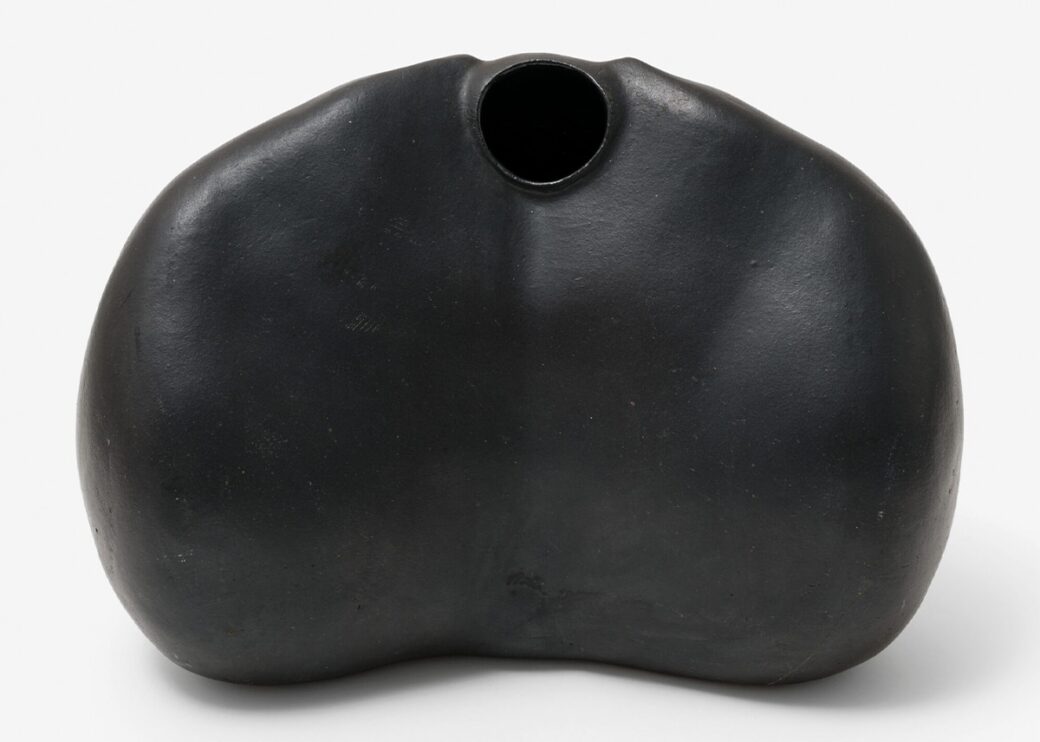
Donald Locke: Resistant Forms
Ikon Gallery, Birmingham
1 October 2025 – 22 February 2026
‘One of the challenges of putting together a survey exhibition of Donald’s work is the fact that he was truly omnivorous, in terms of the subjects and materials that he was working with throughout his life.’ So says Robert Leckie, introducing the exhibition Resistant Forms, which features more than 80 works by Donald Locke, dating from the mid-1960s through to the early 2000s.
Born in the then colony of British Guiana in 1930 and raised in a village located between two sugar plantations, Locke enrolled at Bath Academy of Art on a British Council scholarship in 1954 before returning to the South American country to make and teach art. Two years later, he returned to the UK to study at Edinburgh College of Art, and then spent the next 15 or so years living and working between Georgetown and London. In 1979, he relocated to Arizona, having won a fellowship in sculpture, and later he moved to Atlanta, Georgia, where he died in 2010. Perhaps a reflection of his refusal to settle, either geographically or artistically, this is the first survey show Locke has enjoyed outside of the United States.
The sense of challenge referred to by Leckie, who curated the exhibition (previously at Spike Island in Bristol and now at Ikon Gallery in Birmingham), is apparent from the opening room. On one side is ‘Barracoon 1’ (1978), a dark canvas on which thin squares of black cloth come together to form an unyielding grid, small steel tacks marking the boundaries of each zone. One of Locke’s so-called ‘Black Paintings’, produced while he was living in London in the 1970s, is black in mood as well as subject matter, evoking the plantations that the artist said ‘dominated the sky…dominated your life from beginning to end’, where he grew up. On the other side sit eight ceramic pieces, mostly from the 1970s, whose soft edges and curves are inviting, embracing. Buttressed by titles such as ‘Folded Seed with Clip’ and ‘Two Forms’, they speak back to the strict, singular lines of the canvas, which are all the more stark against the gallery’s white walls.
This tension – between an artist’s media and their visions of the world – runs through Resistant Forms, whose very title invites us to consider things in the plural. But it is productive rather than frustrating, in that it brings out the impetuses that drove Locke at different moments in his career. Later rooms on the first floor of the gallery present works that dwell on domination and submission, such as ‘The Cage’ (1976-77) and ‘Trophies of Empire’ (1972-74). In the former, glossy strands of dark fur seek to escape through two steel grilles in an otherwise impregnable canvas, which again carries carefully demarcated squares, albeit in black paint rather than fabric. The latter consists of a cabinet of more or less uniform black bullets whose ornamental casings aim to soften their violence somewhat.
Meanwhile, the dark, contorted ceramic figures in ‘Plantation K-140’ (1974), named for an estate in Guyana, stand tightly packed in three short lines, thin metal bars hemming them in. Part of Locke’s broader ‘Plantation Series’ – which he described as ‘sculptural metaphors where forms are held in strict lines’ in order to evoke the economic and political subjugation of one group of people by another – the work’s chain gang formation channels slavery’s afterlives.
These works are sombre in more ways than one and they have a power, to be sure. Yet the highlight of the exhibition comes upstairs, on the second floor. Here, bigger, dynamic and dramatic canvases, produced by Locke once he had moved to Georgia, let the light in: they are not fully painted over, darkness has been restrained. These ‘Atlanta Paintings’ also complicate readings of history by having public and private narratives collide, as in ‘Plain Tales of Raj#2’ (1990), where images of an open-mouthed lion, Queen Victoria and a sculpture of Sarah Baartman, the so-called ‘Hottentot Venus’ who was put on display for Europeans in the nineteenth century, interact with thick brushstrokes and silhouettes recalling the phallic ceramic ‘bullets’ downstairs. (Oddly, although ‘Pomona Blue’ (1985-86), the sculpture of Baartman, is immediately in front of this painting, the wall text refers to her only as a ‘Venus-like figure’, which feels misleading.)
As if to underscore how the stories we tell can be retold, ‘Trophies of Empire#2 (The Cabinet of Billy Mick Miller [Altar Piece of Hernando Cortez])’ (2006-08) stands proudly against a wall in the final room. Its title directly evokes ‘Trophies of Empire’ downstairs. But here the curiosities are multiform: big, small, now humanoid, now talismanic, and made of bronze, wood, hair, found objects and ribbon. Some even sit above the wooden structure built to house them. Crucially, not all of the cabinet’s spaces are occupied. Unlike the bullets that have so often marked the beginning and the end of imperial power, here there is room to add to the collection. Room to remake. Room to resist.
Franklin Nelson
Franklin Nelson works for the Financial Times, commissioning and writing on UK politics, the economy and society as well as books and the arts.
WritersMosaic monthly
Get new reviews in your inbox
One email monthly, unsubscribe anytime
The Disappearers
A sprawling visceral experience that drops you in head first
The Lady Imam
Is the world ready to catch up with amina wadud?
Pressure
What's missing from the latest 'untold story behind D-Day'?
Complex antihero: an interview with Arthur Hughes
Unravelling Authur Hughes' Richard III
Marlon James: a Jamaican reckoning
'A return to a home I barely knew'
The name of this wallpaper is ‘Childhood’
A luminescent bubble of memory


Illuminating, in-depth conversations between writers.
Listen to all episodes
SpotifyApple Podcasts
Amazon Music
YouTube
Other apps

The series that tells the true-life stories of migration to the UK.
Listen to all episodes
SpotifyApple Podcasts
Amazon Music
YouTube
Other apps
WritersMosaic interrogates the notion of ‘staying in your lane’ by asking writers how they attempt to think beyond the parameters of their cultural identity.
Listen to all episodes
SpotifyApple Podcasts
YouTube