
Shoot the People
Directed by Andy Mundy-Castle, 2026
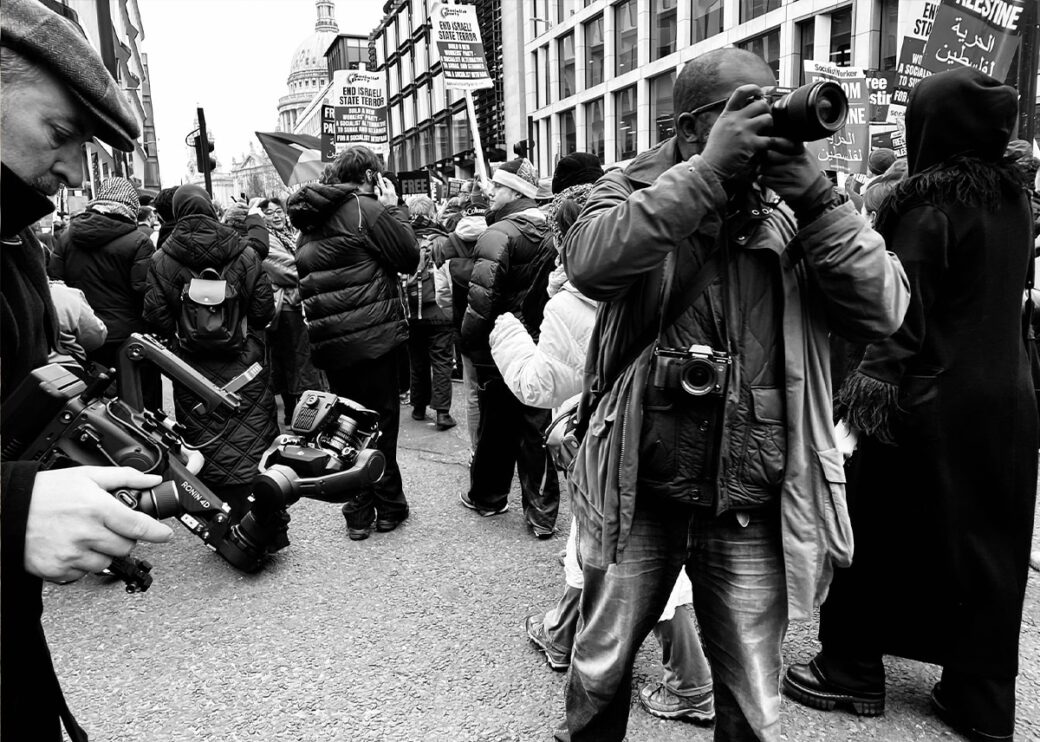
In Shoot the People, the feature film producer and director Andy Mundy-Castle follows renowned activist and photographer Misan Harriman as he travels across the world, documenting social justice movements and amplifying the message of protest to the masses. Shoot the People examines Harriman’s recent work as an artist and activist, but it also offers a historical overview of protest movements and protest photography since the 1960s. The film both utilises and reflects on the artistic gaze as an act of resistance; it explores how creativity can open up an avenue to more empathy and more political engagement. This is a film that is a direct response to our current time, in which the image is more disseminated than ever, and therefore the act of documentation is more needed than ever.
Shoot the People’s introductory montage establishes the background of our current period of political violence and right-wing authoritarianism and the protest movements that have emerged in response. Harriman travels to document various protests, from Black Lives Matter protests to student protests against genocide in Palestine. He interviews ordinary protestors, leaders of justice organisations, and even US politician Ilhan Omar. Harriman also looks back in time, interviewing Martin Luther King III, as well as a colleague and friend of the famed South African activist photographer, Peter Magubane, intercutting these interviews with archival footage and photographs of civil rights protests in the US and in South Africa.
As Mundy-Castle follows Harriman, the film observes Harriman in the act of documentation, and also mirrors his photographic lens. There is much similarity between the techniques he uses in his celebrity and activist portraiture. He doesn’t pose the subjects he photographs; his striking black and white photographs are contrasted with in-the-moment footage of protests, social media images, news reels, and archival footage. As he witnesses protest, Harriman also turns what he sees into an artist’s interpretation of the moment. With his celebrity portraits, he balances intimacy and glamorisation of the individual. In his protest photographs, Harriman balances an intimate, specific moment for the individual protestor with the larger spirit of resistance.
Shoot the People’s narrative is neither a pure biopic nor a straightforward examination of protest movements. It is an ambitious examination of the artistic lens as a means to provoke the collective consciousness. The story weaves between Harriman, modern protests, the history of protest photography, and the dissonance between celebrity and activism; with its wide scope, the documentary can’t delve into specificity on each of these elements. It takes a broader, and sometimes simplified, view. Viewers may be frustrated if they are seeking a more in-depth examination of Harriman himself, an artist working within and against the systems of capitalism and celebrity. Recently, Harriman was embroiled in controversy over several political statements, leading to him step down as Chair of Southbank Centre; the controversy expanded, with a counter-reaction of support from progressive figures and accusations of censorship. The documentary, filmed before these events, doesn’t delve into the complexities of an activist as a public figure in the social media age. The internet forces Harriman, and anyone else using social media, into a degree of self-aggrandisement. The film suggests, but does not necessarily grapple with, the contradictions in the use of images on social media platforms that attempt to manipulate attention, even if the content is intended to educate and motivate the masses.
What the film does understand, deeply, is that the photograph can reach a public that has been worn down and anaesthetised. In highlighting Harriman’s footage, and utilising new footage of protests, as well as historical archives, Shoot the People uses the artistic lens to re-vitalise our sense of empathy and inspire a belief in change.
When racism, violence, and inequality are documented through photography, these events are witnessed, acknowledged, and visualised for the public and for history. We might hope that the photograph proves events and resistance are real, yet the use of photographs as proof has been questioned for over 100 years. The photographic image is even more threatened with AI and the use of social media to spread misinformation through manipulated images. Human suffering, resilience, and courage are transformed into art by the photographer, allowing the viewer of the photograph to empathise with the subject, and be galvanised to action.
Mundy-Castle and Harriman want to convince the viewer of the power of art and of their ability to effect change. They want their viewer to know their frustration and anger are valid, to feel moved by the plight of others, and to still feel empowered to seek change.
Gil Scott-Heron said, ‘the revolution will not be televised’. He believed that revolutionary thinking and insight must be experienced and processed on a deeper level than a consumerist culture and television media could inspire or capture. This documentary references the famous song, suggesting that photographs of such intimacy and power might in fact capture the spark of revolution within the protestor, and convey that spark to the viewer of the photograph. This documentary understands that the revolution must be televised.
WritersMosaic monthly
Get new reviews in your inbox
One email monthly, unsubscribe anytime

At Sea
Bearing witness in the face of dismissal
Ai Weiwei: Button Up!
A journey through the dangerous world of human tragedy
Do You Love Me
To love a city is to know it deeply
My tomorrow is today
'I clasped my hands together, not in prayer but to stop them from shaking'
Ballet Black at 25
Cassa Pancho: 'It’s a miracle that we are still here in some way'
From Fruity to Raffell
A retreat of solitude, community and creative stimulation

Free Will
Will Harris reads his poem, 'Free Will'. Directed by Matthew Thompson and commissioned by the Adrian Brinkerhoff Poetry Foundation.

Half Written Love Letter
Selina Nwulu reads her poem, 'Half Written Love Letter'. Directed by Matthew Thompson and commissioned by the Adrian Brinkerhoff Poetry Foundation.

Illuminating, in-depth conversations between writers.
Listen to all episodes
SpotifyApple Podcasts
Amazon Music
YouTube
Other apps

The series that tells the true-life stories of migration to the UK.
Listen to all episodes
SpotifyApple Podcasts
Amazon Music
YouTube
Other apps
In the first series of poems commissioned by Hannah Lowe, six poets explore how ritual gives meaning to our lives.
Listen to all episodes
SpotifyApple Podcasts
YouTube