
Death of the Soccer God
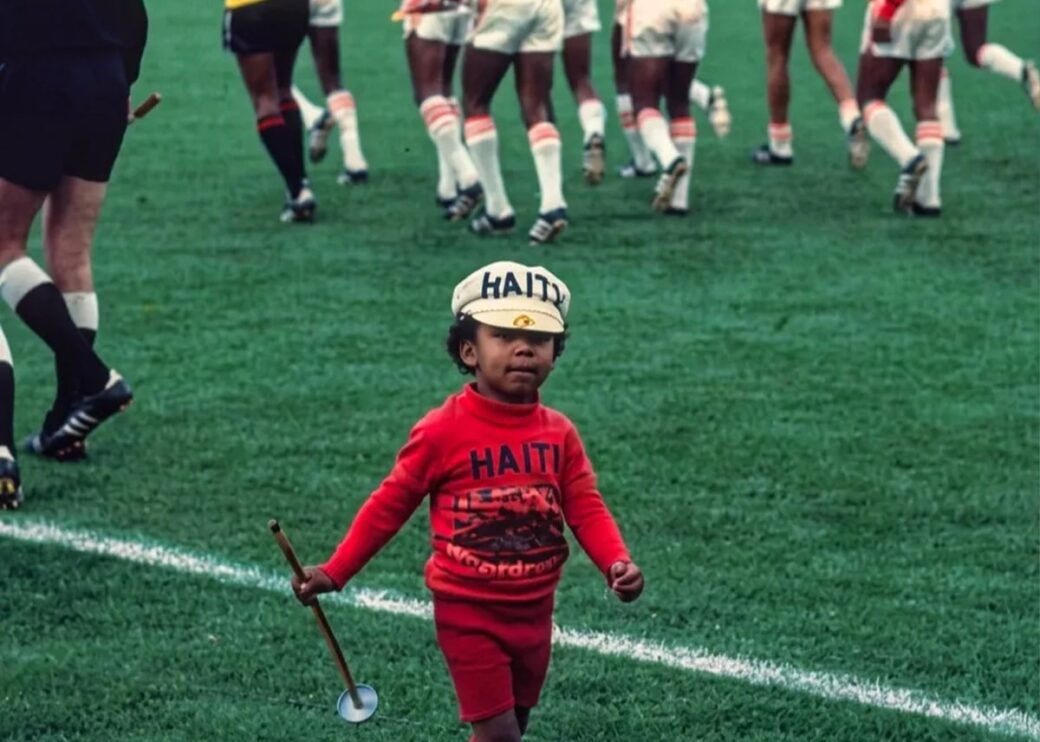
Death of the Soccer God: A Novel
Dimitry Elias Léger
MCD, 2026
Dimitry Elias Léger – a Haitian journalist and advisor to the United Nations – came to literary attention with God Loves Haiti (2015), a poetic novel that depicts the country following the devastating earthquake of 2010.
Over a decade later, Léger has published Death of the Soccer God – a novel based in part on the public life of Joseph Edouard Gaetjens (1924-64), a high-society Haitian who scored a historic goal for the USA against England at the 1950 World Cup. Despite his fame and lack of political involvement, Gaetjens was subsequently disappeared by Haiti’s infamous dictator, François Duvalier.
Death of the Soccer God begins with the protagonist, Gilbert ‘Gil’ Chevalier, facing a firing squad. From the middle of the prison yard football pitch, where Gil is ‘standing and shaking in place’, Léger presents the two sides of his character. There is the reflective Gilbert, who ‘saw death, his death, coming, and tried to reconnect with God’, and the cocksure Gil who ‘felt and lived like a god among men’.
The opening also introduces the novel’s two narrative perspectives. There’s the well-disposed but clear-eyed third-person narrator, who writes in long, rhapsodic sentences, and the cool, sometimes sardonic protagonist:
‘What the fuck?! Why is Haiti doing this to me? I never hurt anybody! Or broke a law other than the lightweight numbers of the Ten Commandments. So, what the fuck, God? Jesus! Please talk to Your father and get me out of this mess […] Jesus, save me. Please, holler at your boy, soften my enemies, bribe the devil. Halt my crucifixion.’
After the firing squad, Léger turns to Gilbert’s late adolescence, when his dreams of playing professional football clash with his father’s ambitions for the family business. At 18, after the end of the Second World War, he marries a German girl, Elizabeth – the daughter of repentant Nazis who, instead of following the ‘ratlines’ to the Southern Cone of South America, have re-located to Haiti. It’s a society wedding attended by three former presidents, and a future one – Dr Duvalier. Despite being attracted to each other, both the bride and the groom have their eyes on other people. Gil falls for Aurélie – a would-be nun from the rougher side of Port-au-Prince – and Elizabeth falls for the medic-come-megalomaniac.
The newlyweds part ways naturally and informally when – at his father’s behest – Gil leaves to study accounting at Columbia University in New York. There, he complains of the winter and the narrow staircases and writes melancholic letters to Aurélie. Things change when he meets his housemate, a young musician called Miles Davis, who introduces him to the jazz crowd in Harlem. After spotting other immigrants playing football in Central Park, he rekindles his sporting aspirations and joins the semi-professional team Brookhattan.
Gil’s performances earn him a spot in the USA team, which is about to travel to Brazil for the 1950 World Cup. As Gil is not a US citizen (and thus not legally able to play in the tournament), the US Federation know this risks the team being thrown out of the tournament. However, the gamble pays off, and Gil scores the goal in a 1-0 victory over England.
Around the world, the press hail Gil as a kind of anti-colonial hero. President Harry Truman tries to call and, unable to get through, sends a grateful letter to the family. However, when Gil returns to Haiti, Duvalier is in power and insecure. The dictator sees Gil not so much as a love rival (he already has Elizabeth at his side), but as a celebrity whose popularity presents a threat. Death of the Soccer God may not be much about football, but it often has the nuance of a typical footballer’s autobiography. Gil says things like, ‘Football was my jazz,’ and ‘It was showtime.’ However, there are some good lines, and the tone can be reminiscent of Yunior – the macho yet witty narrator of Junot Díaz’s The Brief and Wondrous Life of Oscar Wao (which Léger alludes to at the start of his novel). For instance, at the altar, about to marry Elizabeth, Gil muses: ‘What’s a Nazi when you’ve already fought Christopher Columbus, Napoleon, and the troops of Woodrow fucking Wilson?’
But Gil’s company is only sometimes, or perhaps occasionally, enjoyable. Death of the Soccer God has inventive flourishes but – unlike God Loves Haiti – they are overpowered by brashness and cliché. The novel, rather like its protagonist, is uneven.
His duality is understood by Aurélie: ‘She preferred to think of him as Gilbert, the courteous boy who was unexpectedly and definitely the love of her life, and not Gil, the spoiled brat of the football pitch and high society.’ Death of the Soccer God has some panache, but it has more than enough Gil, and not enough Gilbert.

WritersMosaic monthly
Get new reviews in your inbox
One email monthly, unsubscribe anytime
The Lady Imam
Is the world ready to catch up with amina wadud?
Haunting the Black Air
Poetic freedom across space and time
The Disappearers
A sprawling visceral experience that drops you in head first





On Snow
'The mind inevitably seeks a reenactment of the teal light I associate with home'

It’s being published I get paid for; the writing I would do for free
‘Any advance [...] for your novel is to compensate you for the horrors of being published'
Complex antihero: an interview with Arthur Hughes
Unravelling Authur Hughes' Richard III






Illuminating, in-depth conversations between writers.
Listen to all episodes
SpotifyApple Podcasts
Amazon Music
YouTube
Other apps

The series that tells the true-life stories of migration to the UK.
Listen to all episodes
SpotifyApple Podcasts
Amazon Music
YouTube
Other apps
WritersMosaic interrogates the notion of ‘staying in your lane’ by asking writers how they attempt to think beyond the parameters of their cultural identity.
Listen to all episodes
SpotifyApple Podcasts
YouTube