
The Story
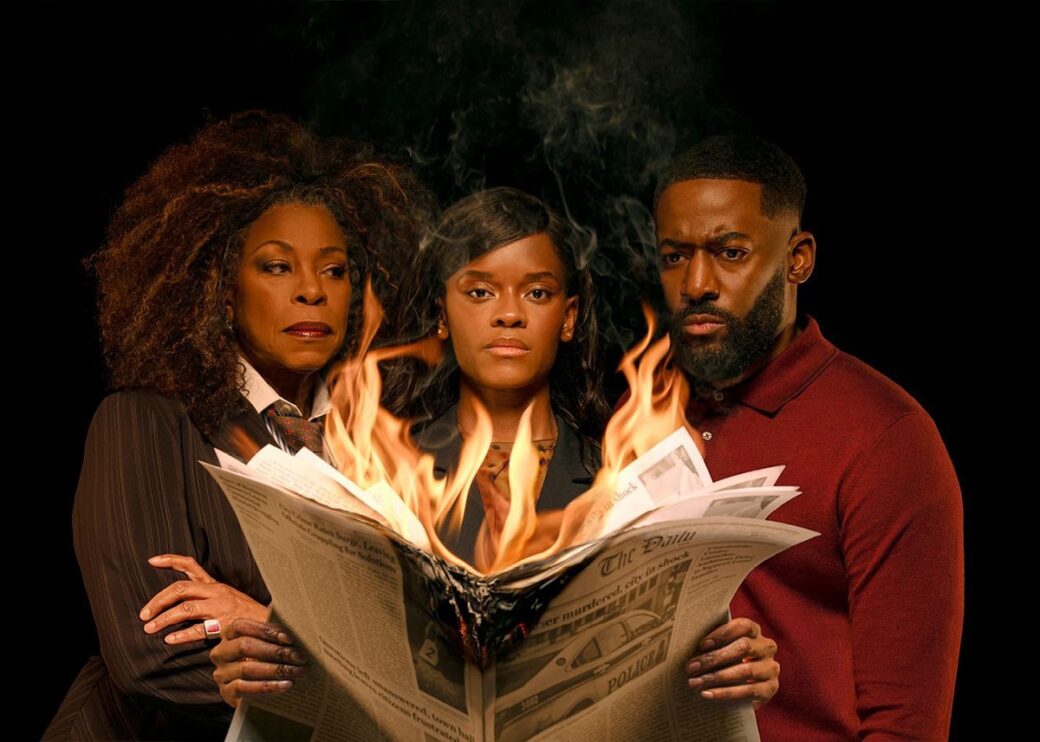
Almost two hundred years ago, Freedom’s Journal, the first black-owned and operated newspaper in the US, was founded by activists opposed to slavery, who announced their bold mission to challenge how black people were written about and viewed: ‘Too long have others spoken for us [such that] our vices and our degradations are ever arrayed against us, but our virtues are passed unnoticed […] too long has the public been deceived by misrepresentations.’ African American newspapers – for black people, by black people – attracted a loyal readership over the next hundred years, and their mass circulation peaked between the 1930s and ‘50s with popular titles such as the Chicago Defender and Pittsburgh Courier.
At the start of The Story, written and set in the early 2000s by US playwright Tracey Scott Wilson, black newspapers have mostly vanished and those that remain are struggling. Vanguard, the setting for much of the play, is a deliberately under-resourced, black-run section of a mainstream newspaper, The Daily, that depends on the fickle goodwill of its proprietor. Vanguard may see itself in the honourable tradition of Freedom’s Journal, but its allegiance to the truth, even if uncomfortable for its black readers, is tested by the terrible, senseless murder of a conscientious ‘Teach for America’ white educator, Tim Dunn.
Driving while white and being well-meaning but hapless in an impoverished urban (black) neighbourhood can get you killed in the US, or so it seems from The Story. The same outcome could conceivably be true if the driver happened to be black and hapless. But that wouldn’t make the news, or much of an impression in the national media. So, how are you going to report this if you’re the editor of Vanguard? Well, you’re going to hope that at this inflection point, Jeff (Wilf Scolding), the new, ‘spoiled, unqualified, trust-fund baby’ editor of The Daily, and a descendant of the original founder, is not going to parachute a twenty-something-year-old, Harvard-educated black woman, with whom he’s having a clandestine affair, into Vanguard.
Vanguard is short on firepower, having been reduced to a handful of staff writers and an editor. Lorraine Toussaint gives a powerful performance, simmering with fury, as Pat, an overlooked, battle-hardened reporter and editor who has never left the trenches. She is tasked with delivering an unsentimental education to the Ivy-League graduate Yvonne (Letitia Wright), an irrepressibly sassy back-talker. Wright snaps and fizzes through every scene, as does Toussaint’s character, always giving more than she gets. Initially reluctant to take up a position in what is considered a backwater in journalism, Yvonne tells Pat that Vanguard is not actually as bad as she imagined. That’s only ‘because of all the fuckery I put up with,’ says Pat, ‘just so you can stand in front of me now telling me how it’s not that bad here.’ Yvonne heralds the swift decline of print newspapers but in 2003, it hasn’t yet fully arrived. Still, for Pat, Yvonne is the embodiment of the threat: ‘Every idiot with a computer thinks they’re a reporter now with their blogs filled with half-assed theories and gossip.’
Directed with brio by Clint Dyer, each scene of The Story is short and propulsive and is played on an open stage that, at first, seems to be an indoor basketball court. Set designer Anna Fleischle cleverly conjures city life with minimal props: the stripped back teacher’s car, suggested by front seats, a steering wheel and rearview mirror, emphasises Tim and his pregnant wife Jessica’s vulnerability as they traverse a landscape imperceptibly transformed into a scary complex of unlit streets in the ‘hood. The pervasive atmosphere of imminent violence is further evoked in the near hysteria of 24 hour news bulletins broadcast throughout the play on huge TV screens.
The racial tensions and assumptions by the Dunns in the unnamed city are subtly revealed as facets of character. In a police interview about the night of the schoolteacher’s murder, his widow recalls noticing a black man at a gas station playing classical music on his car radio and adds, ‘which surprised me.’ Similarly,Yvonne muses about the black students she meets on a tedious assignment at a community centre with ‘perfect baby skin. Smooth, unblemished coca-colored perfection. But underneath, they’ve not only seen the war, they’re in it.’
Yvonne is enthralled by her profession and wants nothing more than to be solely identified by it. She uses the phrase ‘my story’ as John Proctor in The Crucible uses ‘my name’. Without her story, what is she? Nothing. In the ‘hood, she meets a teenage girl, Latisha, who, but for a lack of opportunities, could well have been Yvonne. Aliyah Odoffin, as Latisha, ably switches as her mood changes from charming innocence to menace. Latisha is in, but not of, the ‘hood; she’s witty, ironic and, like Yvonne, speaks four languages. Unguardedly, Latisha lets slip that she’s also in a girl gang, the AOBs, who dress like guys and resemble ‘any other brother’. Yvonne views the girls through the prism of journalism, not as victims in a failed sociological experiment of managed decline, but rather as potentially colourful accessories to a crime story which, for a canny reporter, has a Pulitzer Prize written all over it.
The Story, though undoubtedly a serious play, is laced with comedy. Its co-protagonists’ quick-fire, rapier-like exchanges are reminiscent of The Front Page; and its style of delivery is as important as the content. Verbally jousting with Yvonne, Neil (Ashley Thomas) excels as Pat’s loyal deputy, easy-going but also marked by a dog-with-a-bone determinism. He characterises Yvonne as a self-hating, ‘uncertain sister’ who lacks insight into her own motivations and ambitions. Yvonne answers in kind: ‘And brothers like you are a dime a dozen. You grow up around white folks your whole life, stumble across one quote by Malcolm X and start calling yourself a radical.’
The tempo of duelling scenes is set by percussive industrial sounds and stage lighting that flicks between Pat and Neil’s conversations, and between Yvonne and Jeff’s. Its pace is unrelenting; the first act ends dramatically with Yvonne setting off into the dark for an unscheduled meeting with an informant and a hospital nurse subsequently calling Pat at Vanguard to find out if she has any information about Yvonne’s next-of-kin.
Has Yvonne’s ambitious pursuit of journalistic glory led to tragedy? It’s a possibility that especially resonates in British culture today. The National Theatre’s production of The Story comes at a time when some black journalists in the UK have been called out for allegedly putting the excitement of the chase to clinically and factually report on the story of Professor Jason Arday before any consideration of compassion. Black critics argue that as fellow black Britons, the journalists should have known better with their deep understanding of the historical hounding and undermining of black individuals.
In The Story, when a scoop falls into Yvonne’s lap that the girl gang is responsible for the murder of the teacher, Pat helps the rookie write the front page feature, ‘Confessions of a Girl Gang Member’. Later, when interviewed on a black radio station, she is unapologetic about the heavy-handed police response in the roundup of suspects resulting from Vanguard’s scoop. ‘I have an obligation to follow the story wherever it leads,’ says Pat in a voice weighted with sorrow.
Pat’s titanic certainty, it transpires, is a front that begins to crumble as holes appear in the violent girl gang narrative that she has helped Yvonne to compose. As well as increasing scrutiny over the veracity of Yvonne’s account of Latisha’s confession, the young protégé’s own story is also being investigated by Neil, whose suspicion of Yvonne is fuelled by resentment of her growing influence at Vanguard. And as the code of journalistic conduct that binds them all begins to break down, Pat unashamedly pleads for compassion from Neil for her own choices.
The Story is a tale of validation: of self validation and of the sought-for approval of others. Vanguard, as the name suggests, may have ambitions to be a pioneering newspaper, but a job as a reporter there is not of significant value to Yvonne; it’s just a stepping stone to the heady heights of The Daily’s News desk. This is an almost mythical place for Yvonne, emblematic of her drive to be accepted not by the black also-rans but to be inducted into a club that, as Yvonne is surely bound to find out, wouldn’t honestly want her as a member. Her unseen detractors, personified by Jeff, Vanguard’s nepo-baby editor, are waiting in the wings for her to be found out. They’re unlikely to have long to wait.
There’s a growing sense as the play progresses that Yvonne’s fortunes are twinned with Latisha’s. The girl gang member is Yvonne’s ace in the hole. Never mind being faithful to your race, this is America; first is first and second is nowhere. Two hundred years on from Freedom’s Journal, where does Yvonne’s allegiance lie? How far will she go in reinforcing age-old notions of black degradation to secure her ascent in the world of mainstream, white-run journalism? Have a guess.
A version of this feature is published in the TLS.
WritersMosaic monthly
Get new reviews in your inbox
One email monthly, unsubscribe anytime
On Becoming a Guinea Fowl
A sharp, layered study of patriarchal privilege
Death of the Soccer God
The 'uneven' novel on the disappeared Haitian footballer, Joseph Edouard Gaetjens

Some Sacred Harbour
As much a book of joy as of anger
Ladies of the Rachmaninoff Eyes
The impact of space between what is happening on and off the page
On Snow
'The mind inevitably seeks a reenactment of the teal light I associate with home'
It’s being published I get paid for; the writing I would do for free
‘Any advance [...] for your novel is to compensate you for the horrors of being published'


Illuminating, in-depth conversations between writers.
Listen to all episodes
SpotifyApple Podcasts
Amazon Music
YouTube
Other apps

The series that tells the true-life stories of migration to the UK.
Listen to all episodes
SpotifyApple Podcasts
Amazon Music
YouTube
Other apps
In this second series of poems commissioned by Hannah Lowe, six poets explore the theme of surveillance.
Listen to all episodes
SpotifyApple Podcasts
YouTube