
What a Beautiful Cloud, I Thought

In the Name of Sunland’s Girls, 2022 by Maryam Firuzi
Maryam Firuzi
Translated by Sana Nassari
I come from a family for whom war never ended.
That sentence opened my recent interview with Art Unity. At the time, I was watching the sunset over Tehran from Tabiat Bridge – unaware that the legacy of war I had inherited would become my own just a few hours later.
My home is near Palestine Square – the political heart of Tehran. I’ve always known something has happened when the mosque loudspeakers echo across the square. Because of my work and artistic practice, I spend more than half the year travelling. But this time, my husband had gone to France without me for the first time and I decided to use the solitude to return to a project that had preoccupied my mind for four years. It was an archival, multimedia project on women from the late Qajar and early Pahlavi period. I had invited an old friend to stay with me for a few days to work on it. Akram had been my classmate during my first BA, when I was studying software engineering and teaching calligraphy at the university. She had been my first student, and now – especially in this project – she had become my teacher. On Thursday evening, after long hours working in the darkroom and on the rooftop, I decided to show her Tehran. We went to Tabiat Bridge. I saw the most beautiful Tehran of my life – so calm, so luminous. The bridge was full of travellers from all over the country, taking photographs. Just then, after months of waiting, my video interview with Art Unity was finally uploaded online. The trailer opened with that sentence: I come from a family for whom war never ended.
Akram and I sat on the grass and watched the sun go down. On the way home we had bandari sandwiches. That night, we made a few more sketches for the next day’s work and passed out from exhaustion. The next morning, we woke to dozens of missed calls. Our families were worried. Akram’s family, in Arak, insisted she return immediately. But we dismissed their concern and kept working. We spent the whole day experimenting on the rooftop and in the darkroom. The piece we were practising was based on the only surviving song by Soltan Khanom, a female musician from the Qajar era: ‘Tears, like Parvin; and a sorrowful heart. Otherwise, I’d sit among your admirers…’
We’d even booked cinema tickets for 9pm to see Oktay Baraheni’s film The Old Bachelor. And yet – though the war hadn’t made it into our home or studio – outside, there was chaos. We received a message that our tickets had been cancelled.
That night, we stayed home without internet, heavy with the anxiety brought on by all the missed calls, and the thunder of airstrikes and missile defence systems above our heads. At 11pm, we decided to practise what we called ‘the beautiful art of not giving a damn.’ Akram played a selection of Hayedeh, Mahasti, and Homeyra on the home speaker. I brought out all my makeup and tried different styles on her beautiful face. We laid out all our party clothes across the dining table, put them on, danced, took photos. Hayedeh was singing: ‘Don’t be sad, my dear – life is beautiful.’ Around midnight, we cooked dinner and ate. The bombing was so loud that even when we stepped a little away from the speakers, we could still hear it, despite the music. But we kept telling ourselves: it had nothing to do with us.
For the next two or three hours, we decided to watch films. Around four in the morning, still hearing explosions, we took refuge in our beds. When the sun rose, the bombing stopped. We collapsed for a couple of hours from exhaustion.
That morning, Akram left for the bus terminal to return home. I stayed behind, back in the darkroom and on the rooftop, continuing to work. That night, the bombing started again – but I was so sleep-deprived and worn out from the day that I kept slipping in and out of consciousness. I would wake up to the sound of bombs, fall asleep again, wake again, and then sleep once more, until morning.
I had no intention of leaving my home. The war was outside. My home was the safest place in the world.
My mother called. She hadn’t slept in three nights and begged me to come stay with her.
My husband called from Normandy. All his family had left the city – why was I still in Tehran?
My sister-in-law rang to invite me to their villa up north. A friend said I should come stay at hers and not be alone.
My mother-in-law insisted I leave the city and go to my parents.
Everyone wanted me to leave my home. And the only thing I wanted was my home.
I don’t know which call it was that finally made me decide to go out and fill up the car. I wanted to reassure my mother that I was ready – that I’d fill the tank, and if I ever felt in danger, I’d leave. I threw on an abaya over my house clothes and got behind the wheel. The moment I stepped outside, I realised – this was war. The streets were almost empty, except for the petrol stations. I couldn’t read the emotions on the faces of the few people I passed, but there was a kind of quiet solidarity between us all. I drove to Mirza-ye Shirazi Street and saw the queue at the petrol station stretched endlessly. I circled around for a while and then decided to go home without filling up. But near Valieasr Square, I saw a queue so long it began at Zartosht junction, several blocks away. I decided to join it. The midday sun in Tehran was brutal. I rolled down my windows. A taxi driver, seeing me unveiled behind the wheel, smiled and said, ‘Do you remember the beginning of the revolution?’ I shook my head. ‘No.’ He said, ‘It’s just like now.’
I stayed silent.
I waited in the queue for two hours. I was afraid to turn on the air conditioning in case I ran out of fuel before reaching the pump. I still had two bars on the gauge, but I was scared. I got a jerry can of water from the boot and poured some over myself. Then I got back in. I was just a few metres from the petrol station when the engine suddenly cut out. I tried starting it again and again – until it began to splutter and stall. The light turned red once more. A man got out of the car behind me – handsome – and asked if I’d run out of petrol. ‘No,’ I said. ‘There’s still fuel.’ I stepped aside and let him into the driver’s seat. He turned the ignition and said, ‘Your engine’s flooded.’ My phone had just two percent battery left. I called my brother-in-law. I was praying he was still in Tehran.
He and his brother had just come down from the north to settle some accounts and check on the shop before heading back to their villas. I was standing at the intersection, next to the broken-down car, when they reached me. We called the roadside assistance service and logged the problem. But no one came for three hours. The petrol queue inched forward around me, and the line never seemed to shorten. Then came a series of loud explosions. I’d thought the war was only at night – but now it was clear: the war had no schedule. I looked up. Several defence missiles had hit a small drone, and a blast went off in the sky. Explosions surrounded me from three sides. Someone said Mosalla had been hit – directly northeast of me. Another said Palestine Square. A motorcyclist shouted that it was Keshavarz Boulevard and Valiasr Square. Another voice said Fatemi Square. All of them were right. Strikes had hit near all those places – and I was standing at the intersection, watching thick smoke rise at the end of the street. Smoke rose from the direction of my home. I looked at the sky and thought, what a beautiful, fluffy cloud … then a pang pierced my heart.
I called my neighbour. She said a place very close had been hit – my windows had shattered. I rang the roadside assistance again. One mechanic had cancelled. I shouted down the phone: ‘My car’s broken down in the petrol queue – they’ve bombed this area – I can see the smoke, it’s right by my home – do you understand? Someone has to come and help me.’ At 5pm they finally came. The mechanic said the fuel pump had gone. He didn’t have the part. We had to request a second technician. He suggested I go home and wait. A policeman had been assigned to monitor the intersection. I went over and asked him, ‘Can I leave my car here and come back? Will you watch it for me?’ He said, ‘I saw when it broke down in the queue.’ I asked, ‘If it’s fixed, can you ask the others in line to let me back in – so I don’t have to wait two hours again?’ He replied, ‘If they agree, fine. If not, you’ll have to start over.’ As I was leaving, he added, ‘It’s better if you wear your scarf.’ I flushed red with anger. I opened my bag and showed him – ‘I don’t have one.’ My brother-in-law offered to drive me home, but the boulevard was blocked. I told him to go ahead before the northern roads closed, and that I’d walk the rest of the way.
The city looked war-torn. The boulevard was deserted. I tried to take South Palestine Street, but a row of plainclothes Basijis had blocked it completely – even for pedestrians. I was wearing a sleeveless midi dress under a long reddish abaya. My appearance didn’t match the atmosphere. As I asked for permission to pass, they all turned and looked at me. ‘This area’s just been hit,’ one of them said. ‘You can’t go in.’
I told them it was my home. ‘Please, I live here.’
‘Come back in two hours,’ they said.
I started shouting: ‘That’s my home – I want to go home!’
One of them said, ‘Okay, okay, don’t yell,’ and told a teenage Basiji – 16 or 17 – ‘Ali, take her home.’
Ali walked me to the mouth of my alley and said, ‘You can manage the rest on your own.’ Most of the windows and doors on Italia Street were broken. Everyone was out sweeping up glass from their homes. My home was still standing. Only when I saw it did I realise how violently my heart had been pounding all afternoon. I ran up the stairs. Put the key in the lock. Sat down at my big worktable and burst into tears. War was entering my home. My upstairs neighbour rang the bell and said he was leaving for Bushehr. I asked how. ‘I’ll get a private taxi.’
I’d driven the Tehran-to-south route three times. It was over a thousand kilometres – at least 12 hours without breaks. ‘That’s crazy,’ I said.
‘I have to go. It’s too dangerous.’
He asked if my husband was travelling. I said yes. ‘Are you staying here alone?’
‘I am.’
‘They’ve told people to evacuate. They’ll hit the city again tonight – all night.’
‘This building’s strong,’ I said.
‘And the windows?’ he replied. ‘Don’t sleep near them.’
Then he left.
The roadside assistance rang. The second mechanic was on the way. He asked where I was. I gave the address. He told me to get ready so he could pick me up. But the streets were blocked. He wanted to cancel. I begged him not to. ‘I’ll run the whole way,’ I said. I ran through Italia Street. Through Naderi Street. He was waiting for me at the start of Kabkanian. I got in, and we returned to the car. The new mechanic fixed it. It was 9pm by then. I went to the cars in the queue and asked if they’d let me back in. The first car – a religious family – refused. The woman ignored me when I asked her to roll down the window. When I explained, her husband replied coldly, ‘No.’ I was hurt and angry. Her tone changed the moment she saw I wasn’t veiled. Inside their car were a husband, wife, and two children. I – no husband, no brother, no parents nearby – felt utterly alone.
The war was entering my chest.
I went to the next car. Then the one after. Three men – in separate vehicles – all let me back in, gently, respectfully. Half an hour later, I was driving home with a half-full tank. When I reached my alley, most neighbours were getting into their cars with suitcases and leaving. I still didn’t know whether I was staying or going. I parked. For the first time, I took the hose and started washing the car. It was only 9.30pm but no house lights were on. It was as if everyone had already gone. Even the corner shop – which usually stayed open until after midnight – was dark. The only thing left in the neighbourhood was the sound of bombing. I went upstairs. In the darkroom, I poured chemicals into dark glass jars. On the rooftop, I gathered my developing equipment. I watered the plants. Took the bins out. Emptied the fridge and freezer of ice and water into bottles. Filled a 20-litre container and put it in the car boot. Then I sat, thinking: if I have to leave, what will I take?
I opened the wardrobe: my Balochi embroidered dress, my red sequin jacket, my Brazilian hand-stitched gown, my long African robe, my Uzbek bukharadozi coat.
I felt ashamed. I closed the wardrobe. I put my camera bag by the door. Packed my laptop, a pair of trousers and a shirt. Then I sat in front of the bookshelves that covered every corner of my 200-metre flat. I filled one bag with fifteen books. I grabbed my workout weights and put them in the car.
It was midnight.
The most valuable thing I owned was my unique collection of Gisoo artworks, which I’d refused to sell over the past five years. I locked them in a cupboard. But if the house caught fire, they’d burn. I thought: I should have sold them. At least they wouldn’t be lost to flames. As if the house was already burning. Everything was ready to go – except me. I was exhausted. Alone. The building was empty. The bombing hadn’t stopped. Messages kept coming in – from my mother “Negar”, my husband “Mehdi”, My brother “Alireza”, my friend “Roya”, my neighbour “Amin”… And I still didn’t know – in the middle of all that noise – what the fuck I was supposed to do. I made up a bed in the safest part of the flat. I decided not to sleep in my bed. And I didn’t sleep. I tossed and turned until dawn. At 5am, when the sky began to lighten, I started the car and drove into the streets. Tehran was empty, except for the petrol queues. I took the road to Qom. Then the Persian Gulf Highway. I’d driven those roads a thousand times – alone or with my travel companion. The road had always been freedom. Now it felt like I was carrying a prison with me. I, who had always fled home for the sake of photos and films and adventure was now pounding my chest in grief for my home. I cried for hours in traffic. And under my breath, like a prayer I’d just learned, I kept repeating: ‘God, please give me back my home.’ Now I too had become a war-displaced person – just like my mother and father, like my aunts and uncles, my grandparents, all long gone.
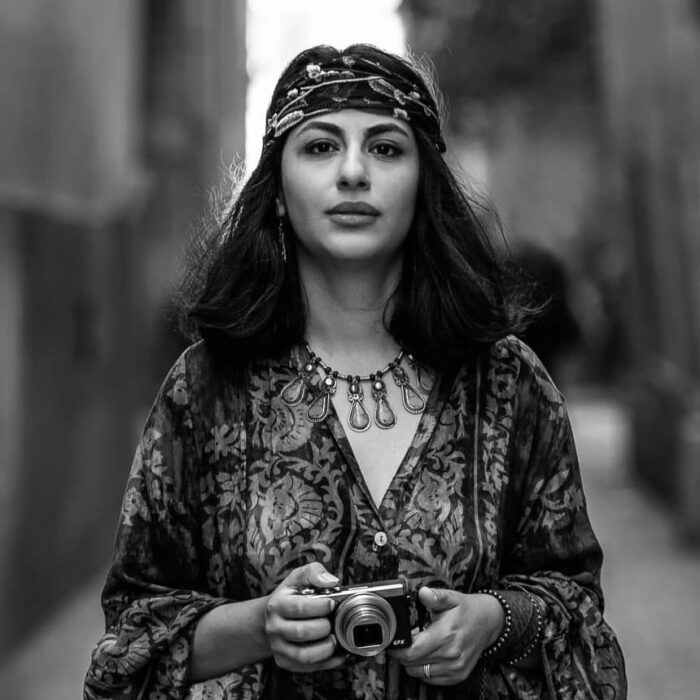
Maryam Firuzi
Maryam Firuzi is an Iranian visual artist with a passion for Persian literature and poetry.
WritersMosaic monthly
Get new writing in your inbox
One email monthly, unsubscribe anytime
It’s being published I get paid for; the writing I would do for free
‘Any advance [...] for your novel is to compensate you for the horrors of being published'
Complex antihero: an interview with Arthur Hughes
Unravelling Authur Hughes' Richard III
Marlon James: a Jamaican reckoning
'A return to a home I barely knew'
Haunting the Black Air
Poetic freedom across space and time
The Disappearers
A sprawling visceral experience that drops you in head first
The Lady Imam
Is the world ready to catch up with amina wadud?


Illuminating, in-depth conversations between writers.
Listen to all episodes
SpotifyApple Podcasts
Amazon Music
YouTube
Other apps

The series that tells the true-life stories of migration to the UK.
Listen to all episodes
SpotifyApple Podcasts
Amazon Music
YouTube
Other apps
WritersMosaic interrogates the notion of ‘staying in your lane’ by asking writers how they attempt to think beyond the parameters of their cultural identity.
Listen to all episodes
SpotifyApple Podcasts
YouTube