
A Choice of Weapons
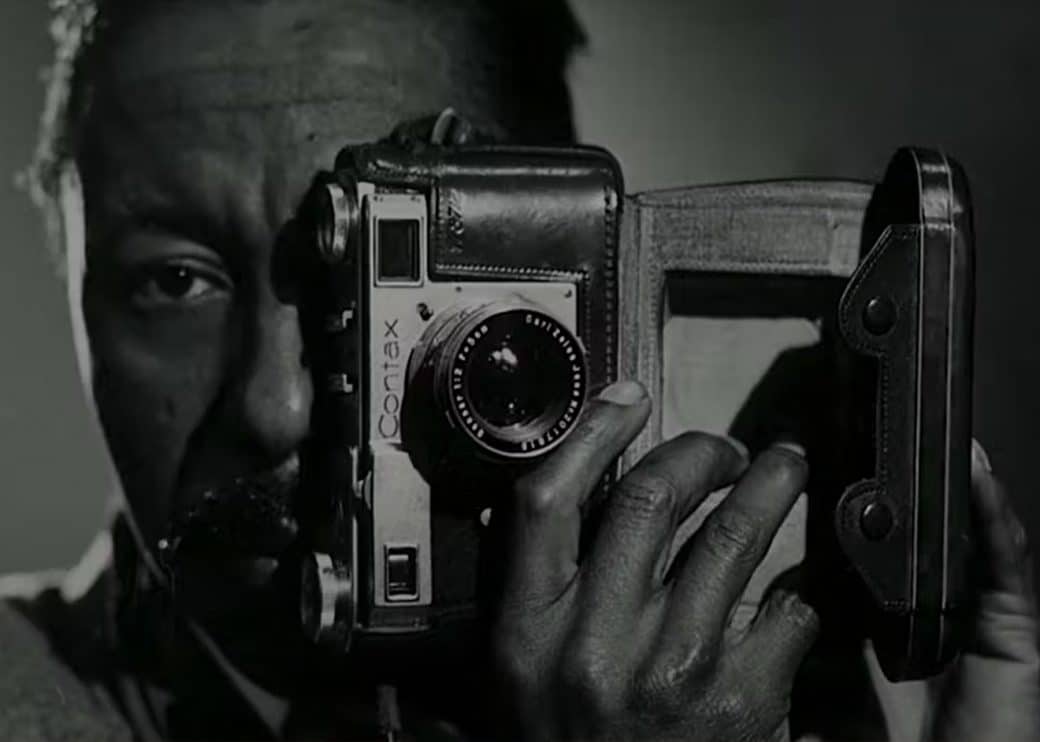
Directed by John Maggio
HBO, 2022
Review by Andy Bay
In the 1950s, photographer Gordon Parks (1912-2006) emerged as a compassionate and formidable chronicler of the seismic cultural shift which enraptured America in the Civil Rights movement. His haunting tableau of young Emmett Till’s lifeless body, the victim of a brutal lynching in the heart of Mississippi in 1955, illuminated the profound societal upheavals unfolding during those epochal years. Parks’ photography presented a rich and nuanced exploration of the African American experience and reflected his intention that his work should be understood and contextualised within the broader tapestry of American culture.
‘I might have turned eventually to the gun or the knife as a weapon to survive,’ Parks says in the film’s introduction, ‘ but by then I had chosen the camera.‘ His camera gave him the power to be seen and the power to be heard. John Maggio’s documentary, A Choice of Weapons, is a riveting journey through Parks’s life and his impact on a new generation of young artists and photographers.
Born in Kansas in 1912 to a family of impoverished farmers who had fled enslavement, he excelled academically with the encouragement of his parents. Parks taught himself photography by reading training manuals and, initially, his kitchen served as his studio and his lights were made from tinned cans. In the 1940s, Parks enrolled on a photography course at the Institute of Design in Chicago, where he developed his distinct visual style, and became a freelance photographer. From early on, Parks’ photographs could capture strong narrative elements within a single frame. His powerful, emotive visual style was instantly recognisable; he often used high contrast and dramatic lighting techniques to accentuate the mood and atmosphere of his compositions.
In January 1942, Parks was awarded a fellowship to work with the Farms Security Administration, a government agency which aimed to combat rural poverty and assist farmers affected by the economic crisis during the Dust Bowl. Along with Dorothea Lange, he joined a unit of photographers and filmmakers who captured images depicting the struggles and resilience of American farmers and marginalised communities. It was a tradition he continued decades later with the photo essay, A Harlem Family, published in Life magazine in 1968. Those photographs garnered widespread attention and propelled African American families living in urban inner cities into the national spotlight.
One black-and-white picture in particular, ‘Untitled, Harlem, New York, 1967’, captures the parents and children of the Fontenelle family, walking with their backs to the camera along the cracked pavement tiles and dirty boulevard, outside their tenement flat in Harlem. They may be impoverished but the Fontanelles walk with a spring in their step, holding their heads high. Parks is evidently moved by their plight. His congenial approach to conjuring his subjects is further evidenced in another portrait of the family, at the desk of the Poverty Board collecting food stamps. Mother and children look tired and hungry but resolute.
Parks was the first African American filmmaker to take the helm of a Hollywood production, making his directorial debut in 1969 with The Learning Tree, based on his semi-autobiographical novel. The Learning Tree gave audiences a rare glimpse into the lives of their black compatriots in rural Kansas, highlighting the importance African Americans placed on educating their children, and depicting the harsh realities of a racially divided society. As a child, we learn, Parks had to walk several miles each day to attend racially segregated schools.
Gordon Parks’s remarkable legacy continues to reverberate through the artistic endeavours of contemporary photographers. It is a testament to his transformative vision that the photographers who appear in the HBO documentary, including Devin Allen, Jamal Shabazz and LaToya Ruby Frazier, draw on Parks’s profound influence in their own navigation of the complexities of African American social dynamics, identity and culture.
Photo courtesy of HBO
https://www.hbo.com/movies/a-choice-of-weapons-inspired-by-gordon-parks
WritersMosaic monthly
Get new reviews in your inbox
One email monthly, unsubscribe anytime
The Disappearers
A sprawling visceral experience that drops you in head first
The Lady Imam
Is the world ready to catch up with amina wadud?
Pressure
What's missing from the latest 'untold story behind D-Day'?
Complex antihero: an interview with Arthur Hughes
Unravelling Authur Hughes' Richard III
Marlon James: a Jamaican reckoning
'A return to a home I barely knew'
The name of this wallpaper is ‘Childhood’
A luminescent bubble of memory


Illuminating, in-depth conversations between writers.
Listen to all episodes
SpotifyApple Podcasts
Amazon Music
YouTube
Other apps

The series that tells the true-life stories of migration to the UK.
Listen to all episodes
SpotifyApple Podcasts
Amazon Music
YouTube
Other apps
WritersMosaic interrogates the notion of ‘staying in your lane’ by asking writers how they attempt to think beyond the parameters of their cultural identity.
Listen to all episodes
SpotifyApple Podcasts
YouTube