
Driftwood
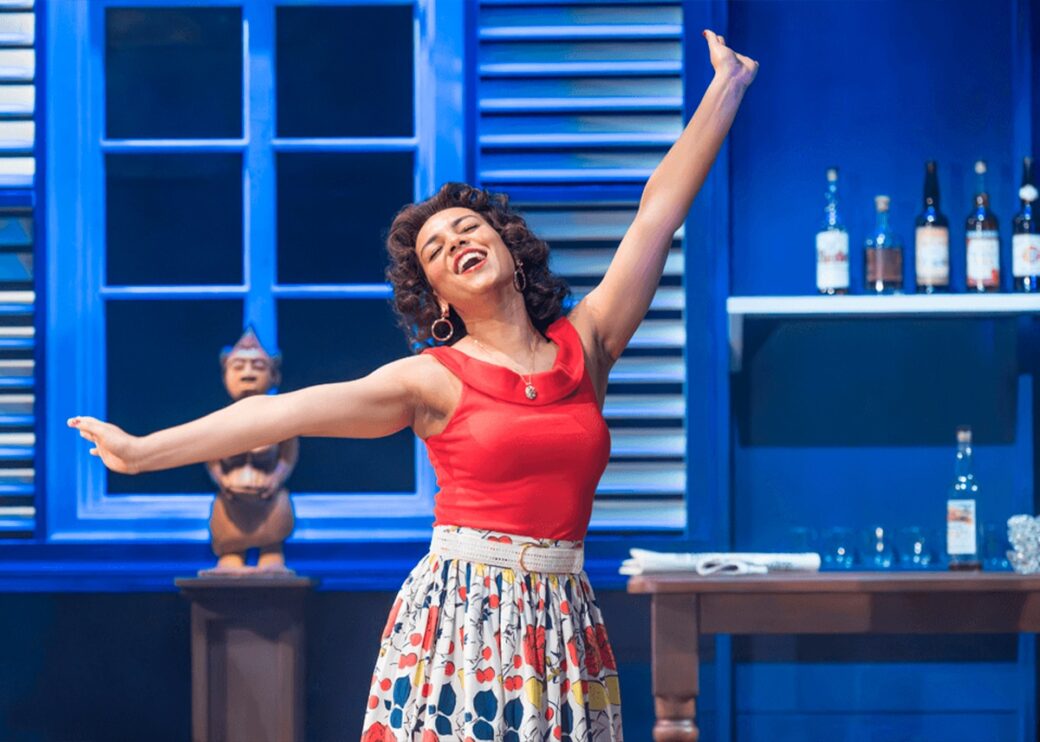
By Martina Laird, 2026
Martina Laird’s debut play Driftwood marks a striking arrival for the Trinidadian-British actor and playwright. It announces a writer attuned to the psychic undertow of empire and the fragile buoyancy of Caribbean self-definition. Rooted in her Caribbean heritage and long engagement with British theatre institutions, Laird is known for her television work (Casualty, EastEnders) and her prolific stage career. Driftwood situates her voice within a lineage of diasporic dramatists who interrogate empire, identity, and belonging.
Set in Port of Spain, 1956, in the dying days of the empire in Trinidad, the play unfolds in a liminal space where the private and political collide. Laird situates her drama in a yard-like microcosm, in one room of Alma, a gentlemen’s club where all the action takes place, where the social and spiritual intertwine. Run by Pearl and her daughter Ruby, the club becomes a crucible for survival and negotiation as independence looms and colonial hierarchies begin to fracture. The arrival of Diamond, Pearl’s estranged son, is the turning point that transforms Driftwood from atmospheric prelude into full dramatic and political confrontation. He is not just the son returning home, he is a symbolic figure, carrying the turbulence of Trinidad’s pre-independence moment. He ignites a volatile family drama that mirrors the island’s political unrest, exposing the fractures of family and nation.
Produced by the Royal Shakespeare Company, the symbolic heart of British theatrical heritage, Driftwood enters a dialogue between Shakespearean tradition and postcolonial revision. The Other Place’s intimacy amplifies Driftwood’s humid atmosphere of desire and disillusion. The RSC’s decision to stage the play in its experimental space underscores a commitment to diversifying the canon and amplifying Caribbean voices within the heart of British theatre. Stratford, Shakespeare’s birthplace, becomes a charged site of reclamation, where empire’s literary legacy meets its descendants’ re-imagining.
The subsequent transfer to the Kiln Theatre in London carried political weight. The Kiln’s reputation for socially engaged global narratives reframed Driftwood as part of a living archive of diasporic voices. Its North London audience, diverse and politically attuned, situates the play within contemporary debates about migration, memory, and decolonisation.
Laird explores generational dissonance between those who remember the island and those who inherit its diaspora; she wields rhythm and silence as instruments of resistance. Her dialogue oscillates between Trinidadian patois and British idiom, exposing the violence of translation that underpins colonial modernity.
Thematically, Driftwood meditates on imperial residue, the persistence of colonial power in everyday textures. Pearl’s pragmatism and Ruby’s opportunism reveal generational tensions between survival and self-determination. The grotesque entitlement of Mansion, the white owner of Alma, completes a triangulation of survival, aspiration, and decay. The club itself becomes a metaphor for the island: a space of spectacle sustained by exploitation.
Critics have noted echoes of Tennessee Williams, yet Laird’s use of Trinidadian patois and Afro-Caribbean song transforms the familiar melodrama into a distinctly postcolonial idiom. There is a dramaturgical tension between the live singing, of voices produced in the room, and the mechanical, imported music from the new radio and record player. This sonic duality is not merely atmospheric; it is central to the play’s politics, its emotional architecture.
Politically, Driftwood intervenes in Britain’s theatrical landscape by insisting that Caribbean independence is not a distant historical event but an ongoing negotiation of identity. The RSC’s staging within its experimental wing signals an institutional reckoning with the colonial foundations of the canon.
Critical reception has been respectful of Laird’s ambition, although the play’s narrative density occasionally obscures emotional clarity. The writing, however, was sharp, brave and daring, the characters well drawn. The performances in Driftwood carry the play’s passion and political weight with remarkable precision. Ellen Thomas’s Pearl is a study of controlled intensity. Cat White’s Ruby moves with quick bright intelligence and her charm edged with vulnerability reveals the cost of ambition in a world shaped by exploitation. Martins Imhangbe’s Diamond brings a restless physicality to the stage and Roger Ringrose’s Mansion embodies colonial bravado with unsettling ease. Together the ensemble creates a tightly woven emotional fabric that sharpens the play’s political stakes.
Driftwood operates through polyphonic layering: voices overlap, songs interrupt speech, and silence becomes resistance. The title encapsulates this aesthetic: driftwood as both debris and vessel, a fragment carried by currents yet bearing the memory of its origin.
Laird joins the continuum of playwrights who speak from the margins to redefine the centre. Driftwood is her first act of redefinition, a piece of theatre that floats, resists, and lands with a quiet revolutionary force, asking institutions to confront their colonial genealogies, not through tokenism but through genuine structural change. Ultimately, Driftwood stands as both artistic testament and political gesture.

WritersMosaic monthly
Get new reviews in your inbox
One email monthly, unsubscribe anytime
The Disappearers
A sprawling visceral experience that drops you in head first

The Lady Imam
Is the world ready to catch up with amina wadud?
Pressure
What's missing from the latest 'untold story behind D-Day'?




Complex antihero: an interview with Arthur Hughes
Unravelling Authur Hughes' Richard III

Marlon James: a Jamaican reckoning
'A return to a home I barely knew'
The name of this wallpaper is ‘Childhood’
A luminescent bubble of memory





Illuminating, in-depth conversations between writers.
Listen to all episodes
SpotifyApple Podcasts
Amazon Music
YouTube
Other apps

The series that tells the true-life stories of migration to the UK.
Listen to all episodes
SpotifyApple Podcasts
Amazon Music
YouTube
Other apps
WritersMosaic interrogates the notion of ‘staying in your lane’ by asking writers how they attempt to think beyond the parameters of their cultural identity.
Listen to all episodes
SpotifyApple Podcasts
YouTube