
Occupy the Streets
Review by Sana Nassari
Since the establishment of the Islamic regime in 1979, the Islamic Republic of Iran’s propaganda machinery has been heavily active in both the institutional art sphere and public space to create the image of its ideal woman who is decent, still and obedient. Independent artists such as Shohreh Mehran try to represent ordinary women who, despite the hegemony of the Islamic regime’s controlled production of meaning, push the boundaries back even slightly.
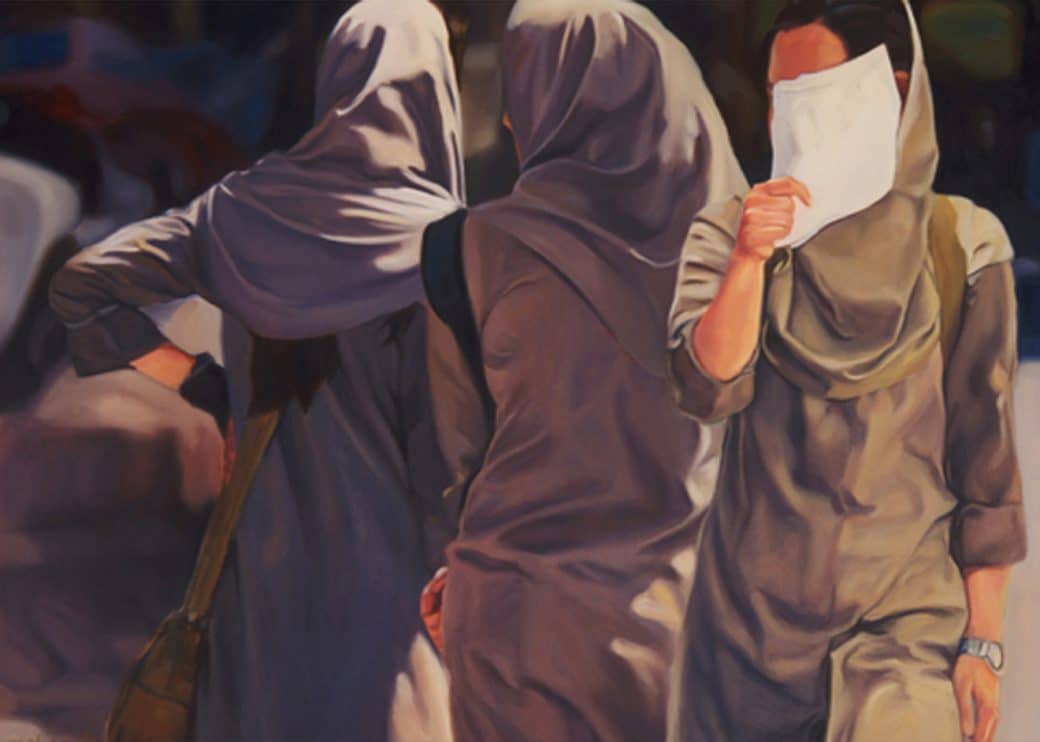
Mehran’s School Girls series (2008 to the present) is a controversial ongoing series of photorealistic paintings which immediately catapulted her to fame both domestically and internationally. In this series, girls are depicted in different simple poses such as walking with intimately intertwined arms, chatting and laughing on the way to or back from school. Seemingly, nothing peculiar catches the onlookers’ eyes on broad canvases depicting anonymous uniform-wearing female figures against a background of ordinary streets. But what the School Girls series brings into view is ordinary subversion.
Despite the fact that they are covered in their long school uniforms, a formless knee-length coat known as roopoosh (the second most favoured form of hijab in the Islamic regime after the black chador full-length veil), their lively presence could be read as an implicit rebellion against the restrictive laws of a fundamental dictatorship. Uniforms that aim to cover individuality and personal characteristics lose their function to the rolled-up sleeves that expose a bit of forbidden skin, to the short formal headscarves which reveal the curve of the bust, to the minor but deniable signs of femininity and, above all, to carefree acts of uncovering a bit of self.
It is impossible to contemplate the image of contemporary Iranian women without considering the issue of the hijab. In post-revolutionary Iran, following the decree of the supreme leader, Ayatollah Khomeini (1900-89), a new dress code was introduced for both men and women, with the hijab becoming compulsory for women. Over the years, different groups of morality police have constantly scrutinised public space to detect any violation of the dictated dress code that includes form, colour, and length of clothing – not only to limit women’s choice but also to limit their movements. The most recent and feared morality police in Iran is called Gashte Ershad (literally, Guidance Patrol), whose presence at the entrances to shopping malls, cinemas, underground stations, parks and so on can turn a normal day into disaster – they are not afraid to use violent force. To avoid the traumatic experience of facing the morality police, women either have to exclude themselves from public space and collective activities or accept their partial absence by covering themselves up and becoming, as required, effaced and invisible.
Mehran is known for her figures without faces. In the early paintings of this series, the heads are cut off by the frame, emphasising an impression that these are real scenes captured in a split second. In the later paintings, faces are mostly covered by the characters’ hands or the wrinkle of headscarves folded up over their faces by the wind. The absence of faces echoes the forced absences of women through gender-based, discriminatory laws. It also implies a crisis of female identity, torn between state-imposed values and restrictions and the promise of a different, contemporary female image. Moreover, this facial absence guides the gaze of the viewer to the motion of the bodies. Marching on the streets, fearlessly, a young generation of Iranian women threatens the old masculine order.
In the paintings in the School Girls series, Mehran intentionally dedicates most of the the canvas to the female figure and depicts other background elements, such as cars, streets and trees, relatively smaller to demonstrate the power of these young girls to occupy the streets. Although captured in dark uniforms, the vivid presence of individuals opposes the will of their conservative rulers to restrict the female body and limit it to private space. No longer tolerating their social exclusion, the marginalised bodies threaten the fixed dynamic of public space in which the share of men is considerably greater than that of women. By reclaiming this denied share, women challenge the status quo and herald more significant changes.
What is happening today in Iran is widely considered a feminist, women’s revolution, not only because it began with the brutal death of Mahsa Amini, a 22-year-old girl, in morality police detention, but also because the number of women actively participating in the street protests is massive and the main aim of the protestors is the emancipation of women, using the slogan, ‘woman, life, freedom’. What began as sporadic protest and resistance transformed into massive civil disobedience with young Iranian women burning their headscarves and calling for regime change.
What I said at the very beginning about the non-eye-catching, anonymous ordinariness of Mehran’s subjects can now be revised. In 2009, only a few months after the completion of her first School Girls painting, the greatest uprising since 1979, and with the significant participation of women, took place: the Iranian Green Movement. This was a series of protests questioning the result of the presidential election and the landslide win for a conservative politician, Mahmoud Ahmadinejad. The Green Movement went further and questioned the legitimacy of clerical rule, but the flame of this movement was extinguished without achieving its goals. Now, in the current demonstrations, women, young and old, cry for their rights and are reclaiming the space they have been deprived of for almost 45 years. For over a decade, Mehran has insisted in her paintings on showing a very different image from the passive woman repetitively shown on television and in other state-sponsored visual structures. She depicts young women whose slight air of disobedience ruptures the masculine hegemony of unwritten social rules as well as written constitutional laws. By depicting scenes of young women’s everyday lives, mingled with their almost ordinary bodily resistance on canvas, Mehran magically brings real doves out of a hat and no onlooker can deny that this is a real collective flight.
Image courtesy of Sharjah Art Foundation
WritersMosaic monthly
Get new reviews in your inbox
One email monthly, unsubscribe anytime
Pressure
What's missing from the latest 'untold story behind D-Day'?
A Trial
An examination of theatre’s complicity in post-truth politics
The Complex
The unraveling of a dynasty

Marlon James: a Jamaican reckoning
'A return to a home I barely knew'
The name of this wallpaper is ‘Childhood’
A luminescent bubble of memory
What’s in a feminist? Holding on to Gloria Steinem
Is Gloria Steinem's feminism still relevant today?




Illuminating, in-depth conversations between writers.
Listen to all episodes
SpotifyApple Podcasts
Amazon Music
YouTube
Other apps

The series that tells the true-life stories of migration to the UK.
Listen to all episodes
SpotifyApple Podcasts
Amazon Music
YouTube
Other apps
WritersMosaic interrogates the notion of ‘staying in your lane’ by asking writers how they attempt to think beyond the parameters of their cultural identity.
Listen to all episodes
SpotifyApple Podcasts
YouTube