
When Secrets Set Sail
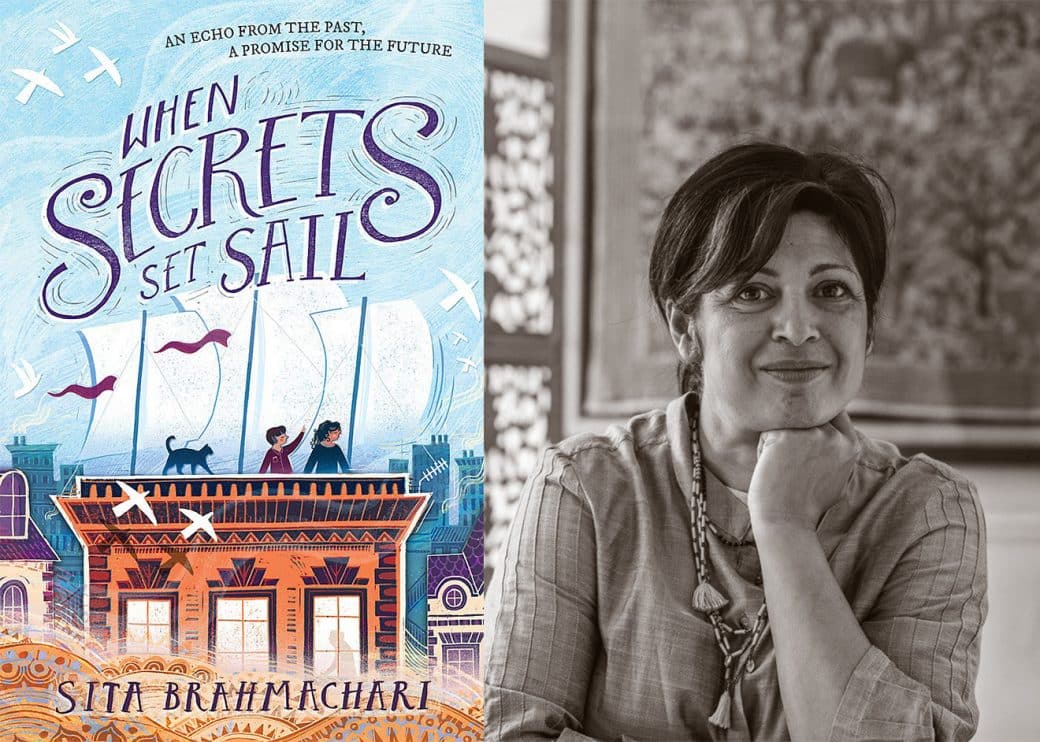
Sita Brahmachari
(Hachette UK, 2021)
Review by Dr Roopa Farooki
First, a confession: I had never read Sita Brahmachari. Despite her numerous plaudits and nominations, including winning the Waterstones Children’s Book Prize. It’s possible her work was just made less visible to me in the bookshops, where names in the children’s section shout loud like brands in a boutique. So, when I was asked to review her latest book, her twelfth in a distinguished career, I was delighted. A book about a bickering pair of South Asian eleven-year-olds (I have two of those at home), a book set in East London (I used to live there, and walk along the canals), a book with a fiery grandmother (my children have one of those, too!), and steeped in a history of the forgotten workers of the subcontinent in the UK, with reference to the first female Asian NHS doctors, this book could have been written for me. And then I felt nervous, afraid that I was already too close to this book; would I be able to do it justice?
I realised, quickly, that this fear was unfounded. This is not just a book for me, but for every child who has ever wondered about their past, who has ever tried to make something right. Imtiaz is brittle and defensive when adopted into Usha’s family; Usha is guilty about her sullen lack of welcome, forced to share her room, her parents and, astonishingly, her ghosts, with this invader. They learn to work together, to settle the ghosts of the recent and long past, to solve the long-standing mystery that has prevented them from moving on and finding peace – a detective trail that has them uncovering the injustice towards the Ayahs who were abandoned, the racism in post-war Britain, the othering of the Roma community, the pettiness of local government. The girls grow stronger together, discover their own hidden courage, reveal their fragilities, and become sisters.
This is a story full of heart, which was always going to have a happy ending, but it is unique in drawing its antagonism from the wrongs of a colonial past. There is no contemporary bad guy here, only a supportive community of family, friends, librarians and academics who help the girls in their quest. The true villain is the racism faced by a sisterhood of women who have been wronged, personified by an unsmiling, cruel Matron and by wealthy relatives keen to whitewash the Indian out of their Anglo-Indian niece. As such, this story does not wear its history lesson lightly; the wrongs of the past provide weight to the plot and, in a refreshing twist, it is the young who can expiate those wrongs. In fiction, and especially in the hopeful place of fiction for children, we can put right what once went wrong. We have that power.
This is a grown-up story for children, full of lyricism, history, redemption, with a song at its heart and, as a symbol of freedom, the ship as its leitmotif. This is one of those stories which should be shared, in schools and communities, to give hope that the young will indeed redeem us all.
https://www.hachetteschools.co.uk/landing-page/when-secrets-set-sail-by-sita-brahmachari/

WritersMosaic monthly
Get new reviews in your inbox
One email monthly, unsubscribe anytime

A Trial
An examination of theatre’s complicity in post-truth politics

The Complex
The unraveling of a dynasty

Disappearing Images
A festival of ephemeral art and the impermanence of our current world

The name of this wallpaper is ‘Childhood’
A luminescent bubble of memory

What’s in a feminist? Holding on to Gloria Steinem
Is Gloria Steinem's feminism still relevant today?
Coats
The unexpected cost of acquiring two Italian leather coats in Rome


Free Will
Will Harris reads his poem, 'Free Will'. Directed by Matthew Thompson and commissioned by the Adrian Brinkerhoff Poetry Foundation.

Half Written Love Letter
Selina Nwulu reads her poem, 'Half Written Love Letter'. Directed by Matthew Thompson and commissioned by the Adrian Brinkerhoff Poetry Foundation.

Illuminating, in-depth conversations between writers.
Listen to all episodes
SpotifyApple Podcasts
Amazon Music
YouTube
Other apps

The series that tells the true-life stories of migration to the UK.
Listen to all episodes
SpotifyApple Podcasts
Amazon Music
YouTube
Other apps
WritersMosaic interrogates the notion of ‘staying in your lane’ by asking writers how they attempt to think beyond the parameters of their cultural identity.
Listen to all episodes
SpotifyApple Podcasts
YouTube
In the first series of poems commissioned by Hannah Lowe, six poets explore how ritual gives meaning to our lives.
Listen to all episodes
SpotifyApple Podcasts
YouTube