
Zineb Sedira
Zineb Sedira: When Words Fall Silent, Cinema Speaks…
Tate Britain, until 17 January 2027
‘I feel an urgency to tell stories…before they disappear.’ So says Zineb Sedira in one of the two films that form the heart – and the soul – of When Words Fall Silent, Cinema Speaks…, this year’s Duveen Galleries commission at Tate Britain in London. The commission, previously undertaken by Dame Phyllida Barlow, Hew Locke and Alvaro Barrington, among others, sees an artist engage with the grand neo-classical space. Sedira’s response, so far as the medium is concerned, is in no sense classical. Yet in its careful intervention into contemporary debates around history and memory, politics and aesthetics, it speaks back to its location in a subtly powerful way.
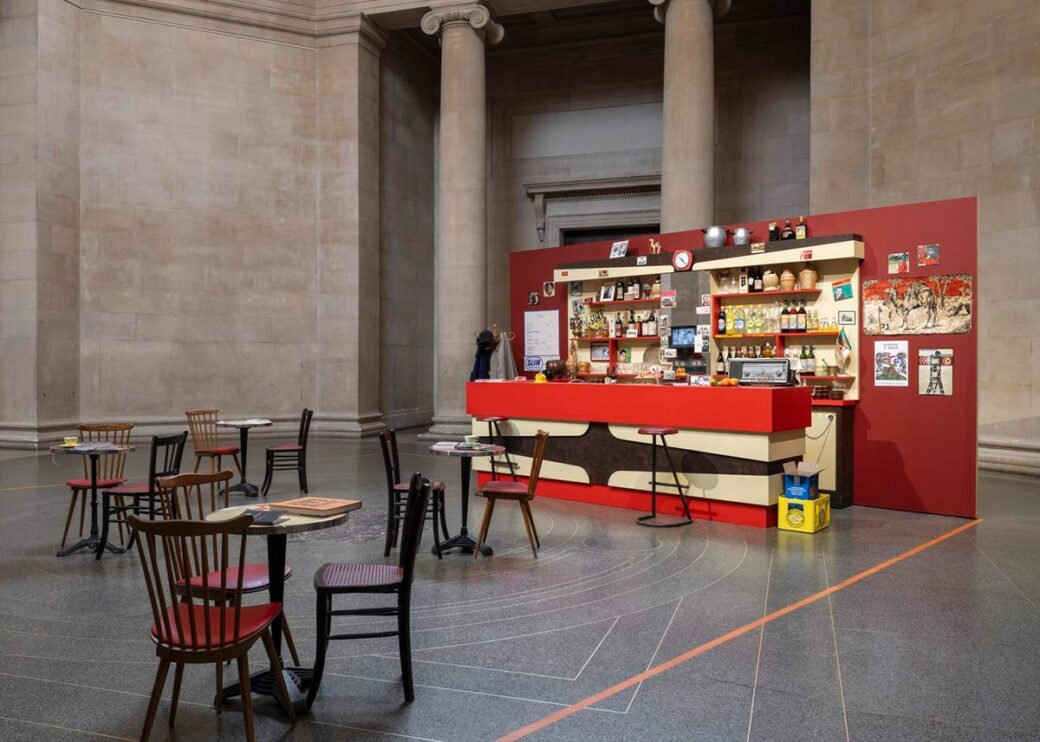
The installation homes in on the story of African cinema in the twentieth century, both as a medium and as a political tool. It looks at the pivotal role played by Algiers, the capital of Algeria, in hosting artists and activists from across the so-called Third World and facilitating connections between them. Bookended by projections of When Cinema Speaks and Narration in Motion, at its centre is a 1960s Parisian cafe. Visitors can sit at small tables and admire the quirky, well-stocked bar and the admirably simple menu du jour (although no food or drinks can be ordered).
They can also leaf through books with titles such as African Cinemas: Decolonizing the Gaze; Maghreb in Motion: North African Cinema in Nine Movements; Revolutions!: Textes et Films Engagés – Cuba, Vietnam, Palestine; and Rogue Reels: Oppositional Film in Britain, 1945-90. These works hint at the link between cafes and intellectual life in France in the last century. They also point to the theoretical underpinnings of this installation, so that a viewer with no prior subject knowledge soon understands this is much more than a colourful escapade into cinema from overseas.
For Sedira, the project is personal as well as political, in the sense of seeking to record the contribution of landmark figures in the history of African film. ‘I’ve done a lot [in my work] with the history of France and Algeria, the colonial history between the two countries,’ she said when we met. ‘I was born in France but my parents lived in Algeria when it was French, and I think I have in my body the traces, or the traumas perhaps, of that colonisation, which was passed on, directly or indirectly, from my parents to me.’
Dreams Have No Titles, Sedira’s exhibition at the Whitechapel Gallery in 2024, similarly brought together her own trajectory with activist cinema of the anti-colonial period. She features in both of the films here. In the 13-minute film Narration in Motion, we hear testimony from the Algerian film director Ahmed Bedjaoui, who talks through the complex history of cinema in the life of Africa’s largest country. After the pro-independence National Liberation Front set up a cinema school during its long war of decolonisation with France, the colonial power transformed cinema into a ‘formidable weapon’ by mandating screenings of propaganda films that presented a decidedly partial view of the experience of empire. Speaking in front of a backdrop that depicts a barren, hilly landscape, Bedjouai is joined at the end by Sedira and colleagues, who sit on floor cushions. Although we cannot hear what they say because music is playing, their presence insists on the spirit of dialogue and community that film in Algeria, in Bedjouai’s eyes, fostered.
The longer film, When Cinema Speaks, also takes one man as its focus: Boudjemaâ Karèche, former director of the Algerian Cinémathèque. Karèche has ‘lost his sight but not his vision’, Sedira tells us softly, before he launches into a riveting personal history of cinema in modern Africa and the role of his institution in disseminating new works to eager audiences. Sedira is evidently an admirer, and she has delivered a worthy homage to the efforts of one man to promote access to film and forge links between filmmakers – from Cuba to Niger, and Brazil to Guadeloupe – at a time when many were beginning to tease out what le septième art might do for a newly independent country.
But her much more extensive presence in this film – we see her on a shoot and editing tape, as well as taking photographs, reading and dancing – also speaks to Sedira’s attempt to map her own place in the history of African diasporic filmmaking. When Cinema Speaks is a film about film in both form and content, although its self-referentiality does not cloy. Rather, it is very watchable. Neatly split into four parts, it blends image and music well, employs a rich colour palette and moves at a good pace.
Sedira, who has been based in Britain since the 1980s, says she hopes a French institution will take the installation after its run at Tate Britain. ‘I always saw myself as someone with a good knowledge of Global South cinema…[but] I’ve learned so much,’ she says. ‘The love of making the work, of making the cinema, was really there. I see this as a homage to all those brilliant filmmakers who had to battle so many things to get their message across.’
Zineb Sedira: When Words Fall Silent, Cinema Speaks… at Tate Britain, until 17 January 2027
Franklin Nelson
Franklin Nelson works for the Financial Times, commissioning and writing on UK politics, the economy and society as well as books and the arts.
WritersMosaic monthly
Get new reviews in your inbox
One email monthly, unsubscribe anytime
The Disappearers
A sprawling visceral experience that drops you in head first
The Lady Imam
Is the world ready to catch up with amina wadud?
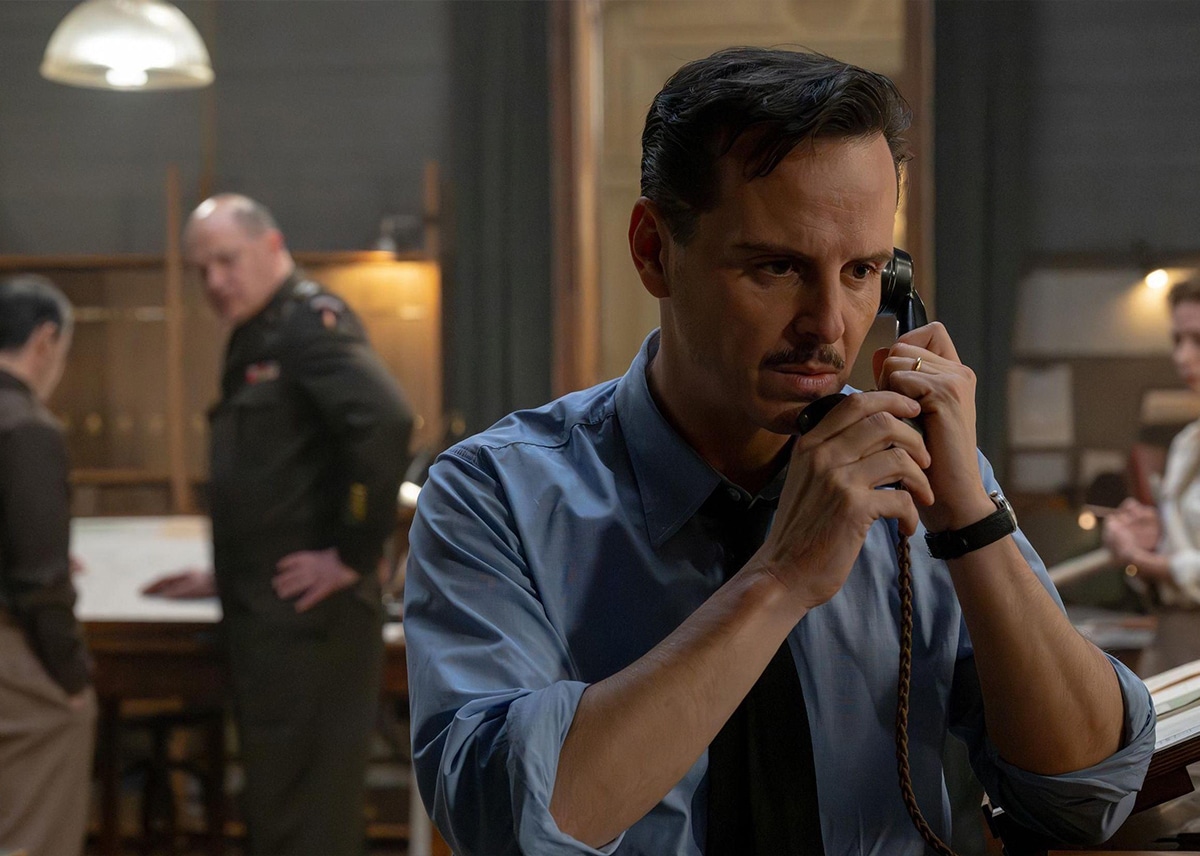
Pressure
What's missing from the latest 'untold story behind D-Day'?
Complex antihero: an interview with Arthur Hughes
Unravelling Authur Hughes' Richard III
Marlon James: a Jamaican reckoning
'A return to a home I barely knew'
The name of this wallpaper is ‘Childhood’
A luminescent bubble of memory



Illuminating, in-depth conversations between writers.
Listen to all episodes
SpotifyApple Podcasts
Amazon Music
YouTube
Other apps

The series that tells the true-life stories of migration to the UK.
Listen to all episodes
SpotifyApple Podcasts
Amazon Music
YouTube
Other apps
WritersMosaic interrogates the notion of ‘staying in your lane’ by asking writers how they attempt to think beyond the parameters of their cultural identity.
Listen to all episodes
SpotifyApple Podcasts
YouTube