
Reflecting on Sutapa Biswas’s Lumen
By Preti Taneja
As I’m writing this today, my mother’s birthday, she would have been 74 years old. I look in the mirror: I have her hands, her smile, her chin. I notice these things in passing, but today I will do things that bring her presence to the fore. I will roast baingan for bharta over a naked flame, buy cut flowers for my house. And I might go to the BALTIC Centre for Contemporary Art, where British Asian artist Sutapa Biswas’s work is being shown until March 2022.
Lumen is Biswas’s first major exhibition since 2004, the year my mother died. This work, so concerned with Indian feminism, matrilineal lines and stories, with womanhood, with the connections of empire, travel, history and memory, so rooted in Partition and its diasporic aftermath, is made at the intersections of trauma and grief: it is alive with a determination to bear witness and to change the archive for future dreamers. It speaks to me on various visceral levels, and has found me here, in my new home city of Newcastle upon Tyne, where I moved in March 2020.
I feel close to my mother’s courageous spirit here; she spent most of my teenage years living in this region, which lies 350 miles away from where I grew up. She gifted me my first knowledge of Northumberland, its diaspora South Asian working-class communities, its wild countryside, and Newcastle: its industrial city heart.
As I moved in, lockdown began, and with it a sense of exile from my former life in the south east, my friends and old home. I knew few people and could not meet anyone. One of the first exhibitions I was able to see was Lumen. Apart from the feeling that Biswas was offering the gift of shared memory – a 1960s and 70s first generation British Indian middle-class life – there was the deeper articulation of the grief and betrayal that growing up inside whiteness saturates such families within: its curation of knowledges, its erasures, its determination to sever us from our histories, our artistic potential and legacies, our mother ghosts, to divide us from each other.
I had a childhood in which art and books, and books about art, were a mainstay. My mother sought out work by and about women artists from Black, brown and Irish backgrounds for me: of particular interest were the myriad expressions of South and East Asian feminist practice. She wanted to put a genealogy around me that she knew I would not get at school or on television, from UK newspapers or magazines. Even then, bringing up her two daughters, working full time to make a name for herself as a chef, cookery writer and later as an entrepreneur, she was only able to access what she could find via reviews in those newspapers and magazines, or more prominently displayed in bookshops on her travels.
There were rarely British Asian women in that mix. While I was wondering how to actually become a ‘writer’ or an ‘artist’, Biswas was already making work. Though she is not much older than me, my first encounter with her art was here at the Baltic, almost three decades later. Moments like this confront the gaps in my knowledge: I experience them as a kind of vertigo. What else have I missed? I learned so assiduously at school, at university and then at work, I visited art galleries in cities from Delhi to Valencia, went to lectures, took part in life. But this was the work I needed most for my practice, which might have grounded me sooner, and accelerated my claiming the right to my own voice. Instead, that has been a long process of excavation, deconstruction, reformation done, in the early years, mostly without true guides. Instead, other brilliant but not-quite-mine writers and artists filled those gaps: Jean Rhys, Nancy Spero, Toni Morrison, Penny Siopis, Georgia O’Keefe, Tacita Dean, Mahasweta Devi.
Something happens when women artists from South Asian backgrounds who’ve grown up in Britain encounter each other’s work. Because there are so few of us who reach mainstream attention – big publishing, national gallery exhibitions, prizes, and so on – there’s a recognition and a sense of release, a sudden confrontation with one’s own sense of isolation and the realisation, again, that it doesn’t have to be this way. This is hopeful; it is motivating. It’s a generative force. It reminds me of the way that, in the 1970s and 80s and even into the 90s, young immigrant South Asians in predominantly white spaces who didn’t know each other at all would gravitate towards each other. I was a child then, and I saw the side-eyed approach in the supermarket, the train station, the library, the school gates. No words would necessarily be exchanged, but there would often be a look, a smile. A flash of solidarity. We are here because we see each other. We can go on.
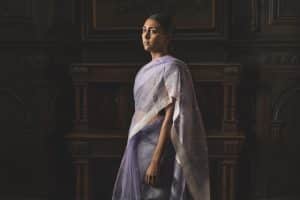
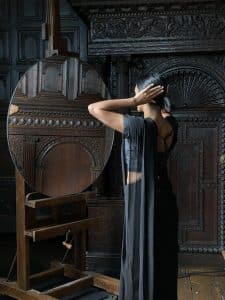
Grief, nostalgia; a dual sense of strength and loss gripped me on encountering Biswas’s work, which among other things captures so poignantly first generation experiences – such as the blue aerogram chitti arriving on the mat, that meant so much to my mother when I was a child. These memories and feelings exist within me as the smell of roast aubergines lingers in my hair. And walking into Lumen, I felt as if I was looking into a mirror at my own writing, as if Biswas had seen every detail of the work I had already done, and was pushing me on to what will come next. My third book (long in wait, as yet unwritten.) My mother-novel. First, there was the Lumen C-print of a woman (modelled by Natasha Patel), in a navy-blue sari; the perfect knot of hair tied at the nape of her neck, her dark eyebrows and brown skin standing in front of a mirror. This was how I had imagined the stern dignity of a young Indian wife regarding her past and present and future in the first piece of fiction I ever had published – Kumkum Malhotra, a novella written in 2010 and eventually published by the not for profit Gatehouse Press in 2014:
Kumkum begins to wind and pleat her sari, looking at herself in the mirror and not down at her hands. She tucks the stiff silk into her petticoat, stands up straight. She slides her fingers between her sari pleats and shakes hard, so they fall correctly to her carefully painted toenails, and flips the pullu over her shoulder, turning to see how it falls down her back…
The rest of Biswas’s show explores the ravages of colonialism in India via the archive in the UK, shuttling between India, diaspora and our histories in image, music and text. Kumkum Malhotra weaves a similar cloth; I had almost forgotten that the story arose from a memory of watching my own mother tie her sari while visiting my father’s childhood home in Nizamuddin, New Delhi (once one of the poorest areas of the city), when I was just five years old. That came back to me in the Baltic that day.
Through Kumkum, I developed the voice and perspective for my first novel, We That Are Young (2017). The book, a translation of Shakespeare’s King Lear to contemporary India, took three years to write, and a further four to find a publisher. Critical of Empire’s legacies in India, of Hindu settler colonialist in Kashmir, of rising billionaire-funded fascism and most strongly, of capitalism’s grip on nature, it was rejected by mainstream UK editors with a sense of ‘how dare she’ (also rewrite Shakespeare.) It was eventually published by the small independent, Galley Beggar Press, known for supporting contemporary high modernist work bigger publishers turn away.
My work, especially in We That Are Young, equally owes its voice to South Asian writers including Tagore, Devi, Manto, Chughtai, Faiz and Kabir. Its intertextuality expresses its core politics linguistically, thematically and in terms of its relationship with both Indian and English literary canons. Intertextuality is Biswas’s method also for work that sits at the intersection of generational and racial grief, trauma, object memory and archival excavation. It is a key concept by which I am coming to understand that what I do in writing is being done, has been done by women artists with British and Asian links across generations: it is a lived intertextuality, as natural to our practice as breathing the same air. As Alina Khakoo writes in her catalogue essay for Lumen, ‘Reading between the Texts: on Kali’, intertextuality ‘punctures the hermetic seal around a work’ and allows it to make unbounded connections beyond aesthetic frames for artists ‘whose everyday reality has always been shaped by racialised and gendered forms of representation’.
What are we making with this kind of cross-referencing? If you need a metaphor, call it a rope, a chunni, dupatta, a shawl, a chaddar, across time, where paper is woven with words. Sandeep Parmar, Nisha Ramayya, Mona Arshi, I and many others – are doing this in writing now. Intertextuality messes things up, makes strange, is honest and offers newness from that. I find it in British South Asian women’s art practice, and I find it in music, too, in the metal sound of Ms Mohammed and in the popular icon M.I.A. I want to understand this as a collective form, a project of feminist hybridity that transcends artistic categories, standing on its own, and separate from the colonised mind, the white gaze or ear.
And yet I continually fear for our work in a majority cultural climate that often frames it as ‘angry’ instead of recognising it as anguished, tender, and hopeful; that palisades it as one-off instead of allowing it to take root in a wider culture and grow into careers that sit alongside our white peers in terms of trajectory, longevity, recognition, reach and those things are tied with financial stability, always. Value is a laden word. I want each generation to make space, to grow it, break out of it, rather than simply inhabiting it, becoming tall trees that disrupt the clouds of silencing that surround them, by spreading, through language and form; by casting shade over the ways in which the British mainstream and our own patriarchal systems operate together to keep us in place.
Discovering Biswas’s work so late (and reading that she was best known for her 1980s series, made when she was a fine art student at Leeds University, Housewives with Steak-Knives, evoking the goddess Kali as emancipation from misogynistic, domestic expectations) feels very close to the bone for me. I was so nearly not published at all, and my own writing doesn’t walk the line either. The contemporary British Asian women artists and writers I admire most cannot walk it; the space we make is more precious for that. I feel there can be no compromise: we have come of age in a time that asks more of us – an insistence on identity as more complex, more intertextually woven with art forms and languages, cultures and genders – that refuses the easy categorisation of the market or the ‘postcolonial’ academy, and becomes its own genre. As Kali, the deity whose spirit features so strongly through Biswas’s work is depicted as a beautiful, powerful, life force, her many arms so busy with creation and destruction towards that creation, we see each other. We are here. We go on.
All photos courtesy of Lumen at BALTIC Centre for Contemporary Art
Lumen is at BALTIC Centre for Contemporary Art until 20 March 2022.
WritersMosaic monthly
Get new writing in your inbox
One email monthly, unsubscribe anytime
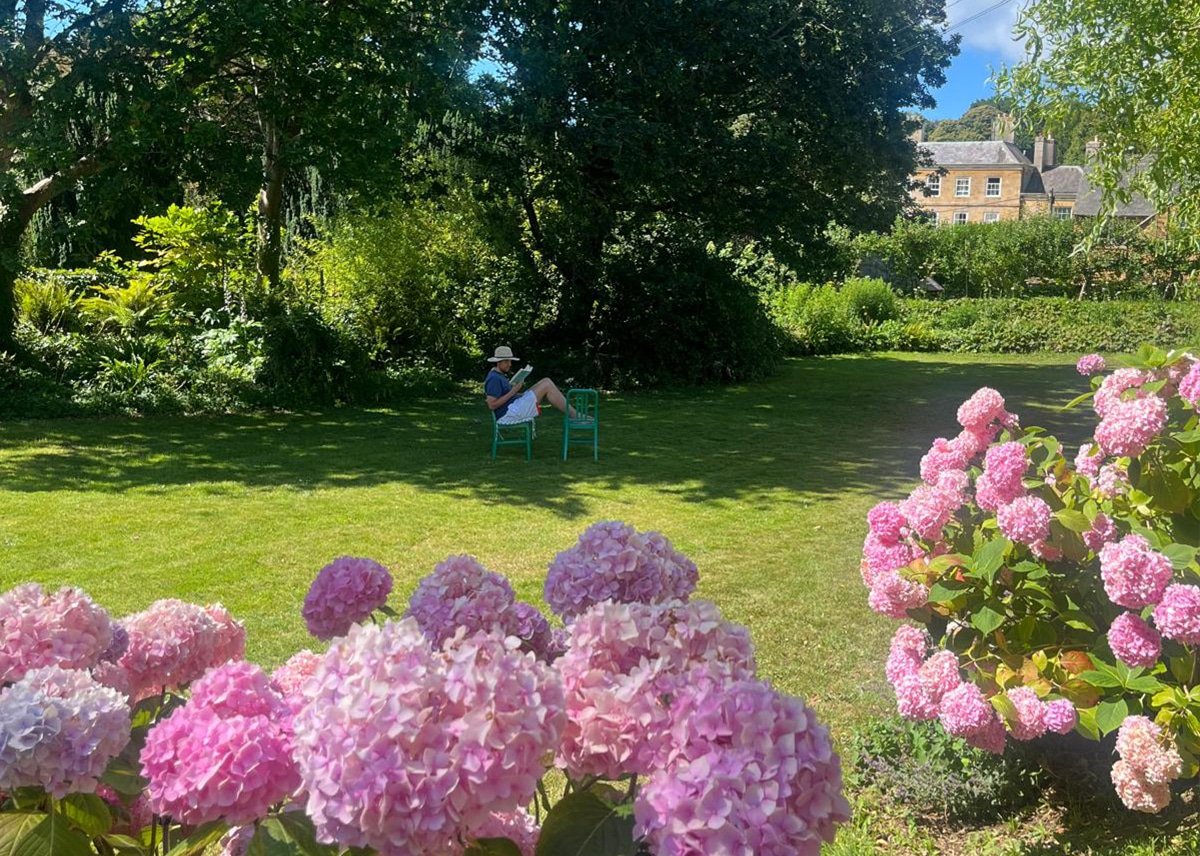
The name of this wallpaper is ‘Childhood’
A luminescent bubble of memory
What’s in a feminist? Holding on to Gloria Steinem
Is Gloria Steinem's feminism still relevant today?
Coats
The unexpected cost of acquiring two Italian leather coats in Rome
A Trial
An examination of theatre’s complicity in post-truth politics
The Complex
The unraveling of a dynasty

Disappearing Images
A festival of ephemeral art and the impermanence of our current world

Free Will
Will Harris reads his poem, 'Free Will'. Directed by Matthew Thompson and commissioned by the Adrian Brinkerhoff Poetry Foundation.

Half Written Love Letter
Selina Nwulu reads her poem, 'Half Written Love Letter'. Directed by Matthew Thompson and commissioned by the Adrian Brinkerhoff Poetry Foundation.

Illuminating, in-depth conversations between writers.
Listen to all episodes
SpotifyApple Podcasts
Amazon Music
YouTube
Other apps

The series that tells the true-life stories of migration to the UK.
Listen to all episodes
SpotifyApple Podcasts
Amazon Music
YouTube
Other apps
WritersMosaic interrogates the notion of ‘staying in your lane’ by asking writers how they attempt to think beyond the parameters of their cultural identity.
Listen to all episodes
SpotifyApple Podcasts
YouTube
In the first series of poems commissioned by Hannah Lowe, six poets explore how ritual gives meaning to our lives.
Listen to all episodes
SpotifyApple Podcasts
YouTube