
The Authenticator
Winsome Pinnock
Royal National Theatre, London, 26 March – 9 May 2026
How can you write authentically about slavery and its impact on the enslaved, who were purposely dehumanised, when there are few records to draw upon?
Almost a century ago, while sitting down with Oluale Kossola to write Baraccoon, Zora Neale Hurston expressed her delight in facilitating Kossola’s testimony, the authentic story of the last African abducted from his homeland and forcibly transported to the US. She was determined to give voice to Kossola’s recollections because too often the stories of the enslaved had been erased and told from the point of view of the enslaver, often from their ledgers listing their human property, yields of crops, punishments and instruments of torture.
The difficulty of evoking and, perhaps, transmogrifying into fiction the stain of that cataclysmic history is particularly challenging when you’re a black British playwright with the intention of memorialising your ancestors. With few published accounts of the lives of the enslaved, black writers must wrestle with scraps of sources and work out how to navigate the indignity suffered by their forebears without unintentionally adding to the ways in which they were degraded.
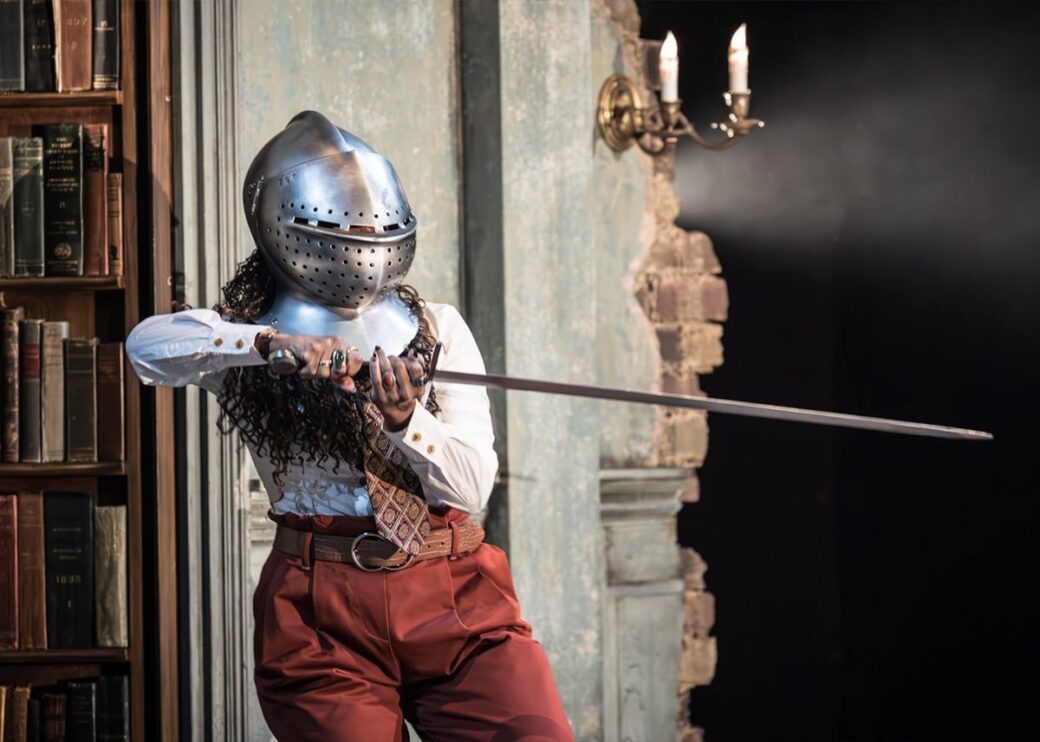
Winsome Pinnock responds to this challenge in her new play The Authenticator, set in the fictional stately home Harford House to dramatise the connections between victims and perpetrators of chattel slavery. Bought in 1763 from the profits of slavery, the stately home had been renovated 70 years later on receipt of the governmental compensation paid to enslavers following Parliament’s passing of the Slavery Abolition Act, but its present owner, Fen (Sylvestra le Touzel) the last of the Harfords, is now struggling with its upkeep.
Six ancient leather-bound journals from Henry Harford’s brutally run estate in Jamaica are key to unlocking the dark secrets of The Authenticator. Pinnock’s play initially explores whether these artifacts are verifiable, but her real concern is to illuminate the story hidden between the lines and in the margins of the journals, making the abstract concrete in conjuring the lives of the enslaved whose names they list. Black Sarah features prominently and unlike Hurston, the playwright must summon forth Black Sarah from sparse and perfunctory entries relating to her in Henry Harford’s ledger.
Fen, Harford’s pompous but exuberant, middle-aged descendant, objects to the labelling of her ancestor as an enslaver. His 18th century plantation was more of a farm in her estimation, and she maintains that Henry Harford was a reformed character, mostly known for his philanthropic donations to abolitionist causes. Sincere perhaps, but Fen’s version of the truth is reminiscent of the British propaganda dressed up as history that 1970s school kids were fed, which foregrounded the triumph of Britain’s role in abolition whilst conveniently skirting over its centuries-old involvement in the slave trade.
Fen’s task becomes more problematic when she recounts Henry Harford’s apparent virtues to two sceptical black archivists, Abi (Rakie Ayola) and her research assistant Marva (Cherrelle Skeete), who arrive on a speculative mission that might result in the private archive of Harford House being handed over to their institution. Charmed by their mismatched enthusiasm (both Ayola and Skeete excel at conveying the researchers’ balancing act of unashamed forthrightness and professional restraint), Fen impulsively appoints the pair as authenticators for her ancestor’s ledgers.
The journals are the primary objects of authentication, but Marva and Abi also seek their own professional authentication. Their careers are likely to be boosted by their work at Harford House. As the weeks of research unfold, even though it’s a regular part of their job, the ease with which the researchers luxuriate in the beautiful grounds and partake of the high teas in the formerly “white space” of the stately home is striking. Harford House is akin to the National Trust-managed properties that my peers and I, descendants of migrants and the enslaved, always suspected were built on blood; in the 1970s and ’80s, we were loath to enter such places.
The blood legacy of Harford House, though, is not just held in the bricks and mortar but rather in the six silent journals. They dominate a set by designer Jon Bausor that at first is minimal – just a table and chairs – but which cleverly transforms into a grand but creaking country house of fading gentility, with ceilings that eerily rise and fall, fake bookshelves and a trapdoor to a basement described by Fen as “the dungeon”. Fen, exuding a blithe and affecting make-do-and-mend unfussiness, is good-naturedly consumed by the house’s chronic need for unaffordable repairs and maintenance that is only partly offset by deals with film crews, renting the space as a backdrop for period dramas and music videos.
The play’s old-fashioned nature stems not just from the country house setting but also its partial Ealing comedy-like tone as Pinnock’s text adds layers of light humour to The Authenticator. In one memorable scene, a drunken Fen – in a bid to demonstrate that the lady of the manor born possesses a rebellious streak – fashions her hair into a Mohican and gives a Karaoke rendition of a punk rock song. Though fleeting, such scenes threaten to unbalance the play and diminish its seriousness. It might seem as if Pinnock, by pulling her punches, is wary of offending audience members. Another way of looking at the playwright’s approach to Fen’s role in the bigger picture of the drama is that it’s a modern version of the abolitionist strategy known as “the black fist in the white glove”, where the endorsement of early slave narratives by respected white supporters made readers more inclined to accept the ugly truths being depicted.
The brevity of the play is such that the emotional evolution of its three characters is truncated. In particular, Marva quickly seems to realise that she has more skin in the game than she imagined, not just from an under-examined until now, apparently ancestral trauma. Her sassiness drops away and her language becomes more spiky. She needs to piece together the mystery surrounding Black Sarah in a way that, crucially, does not compromise her and Abi’s professional code of conduct. For Abi, the darkness and pity of their field of research is baked in; it’s simply business. For Marva, though, it’s increasingly personal; she begins to twitch with frustration for, no matter how much she wills it, the journals will not give up the past.
The play builds towards a revelation that explodes the coincidence that Marva and Fen share the same surname: that the two women are possibly blood relatives is meant to shake them to the core, skewering an unspoken detente between them as survivors – representing a black victim and a white perpetrator – of a great historical catastrophe. For the audience, the shock of the moment would have been more impactful had it not been telegraphed from the first establishing scene.
The gravitas of the revelation is further diluted by the comic turn of Fen embracing, through a later DNA ancestral test, the notion that she is “two percent Ghanaian”. Pointedly, her upgraded identity affords Fen opportunities to freshen her summer wardrobe with kente cloth. The script suggests that “this is a subtle gesture, not over-the-top”, but director Miranda Cromwell doesn’t appear to have received the memo.
The performances are intelligent and nuanced, but ultimately the trio of actors are working with a text and a governing idea in search of the architecture of a play that can support it. Even so, this is a commendable endeavour and The Authenticator successfully hints that each of the protagonists (first among equals), dwarfed by the shadow of shared inheritance, hold doubts about their own authenticity. Marva is prepared to renege on the academic rigour required of her profession for verifiable truth. Instead, she reaches for an emotional truth by channeling and grieving for Black Sarah whom it’s possible to surmise from the journals was raped, impregnated and then discarded by Henry Harford.
The fictional stately home is not the scene of the crime but a proxy for it. Over 4,000 miles away, for much of the duration of the Atlantic slave trade the British public could live in denial about the horrors it had wrought.
The Authenticator brings slavery home to Britain. It reinforces the strength of the anecdote once told to me by the revered scholar James Walvin. A black Caribbean family visiting a magnificent stately home pushes past the box office without stopping. The guard rushes after the family, shouting that they’ve forgotten to buy tickets. The Caribbean family pause, turn and answer with cold fury: “We paid before!”
First published in the Times Literary Supplement

WritersMosaic monthly
Get new reviews in your inbox
One email monthly, unsubscribe anytime
Haunting the Black Air
Poetic freedom across space and time
The Disappearers
A sprawling visceral experience that drops you in head first
The Lady Imam
Is the world ready to catch up with amina wadud?



It’s being published I get paid for; the writing I would do for free
‘Any advance [...] for your novel is to compensate you for the horrors of being published'
Complex antihero: an interview with Arthur Hughes
Unravelling Authur Hughes' Richard III

Marlon James: a Jamaican reckoning
'A return to a home I barely knew'



Illuminating, in-depth conversations between writers.
Listen to all episodes
SpotifyApple Podcasts
Amazon Music
YouTube
Other apps

The series that tells the true-life stories of migration to the UK.
Listen to all episodes
SpotifyApple Podcasts
Amazon Music
YouTube
Other apps
WritersMosaic interrogates the notion of ‘staying in your lane’ by asking writers how they attempt to think beyond the parameters of their cultural identity.
Listen to all episodes
SpotifyApple Podcasts
YouTube