Jewish Multiculturalism
The Missing Mizrahi
Oh, East is East, and West is West, and always the twain shall meet.
(after Rudyard Kipling)
Where are you from? It’s a question best not to bring up. I have been asked this since my secondary school days, been bullied because I was not born in England, been called the P-word despite it being incorrect, geographically and in so many other ways. My green eyes and brown hair, now turning a shiny shade of silver, and my olive skin, were all reasons that everyone always wanted to know, ‘Where are you from, Shelley? France? Spain? South America?’ The conversations go something like this –
Where are you from, Shelley?
London.
But where are you REALLY from?
Golders Green.
PAUSE
Jewish?
Yes.
Ashkenazi?
I shake my head.
So where are you from? (This is asked with great urgency, as if I am now teasing them).
I was born in Kolkata. India.
The questioner’s face melts. Their assumption has been confirmed. I am other. But other than that? When I tell them I was born into a small Jewish community in India, they are confused. Our conversation travels across continents while I explain my heritage. My grandparents’ and family’s birth places add up to a delicious mix, from Amara in Iraq to Penang in Malaysia to Aleppo in Syria, Shanghai in China and Rangoon in Burma. My aunt’s heritage is Greek and Egyptian. My cousin’s heritage is Moroccan. On the day I was born there was a cow in the road.
I have explained so many times to so many curious people that there are Jews from elsewhere than Europe, from the Middle East and North Africa. The Bene Israel Jews in India kept their Jewish traditions while being very much part of the caste system. We are called ‘wandering’ for a reason. We are not only Ashkenazi Jews from Eastern Europe. We are the forgotten Jews, the afterthought Jews. I am reminded of Edward Said’s Orientalism and the sense of superiority the West had towards the East, the Orient, the other. This sense of other was apparent in the way European Ashkenazi Jews viewed Sephardi, Mizrahi and Bene Israel communities.
I have in the past called myself Sephardi; in reality, I am a Mizrahi Jew, Mizrahi being a translation of the Hebrew for Eastern. Sephardi Jews originate from Spain and Portugal. For many years I offered Sephardi as my identity, as an alternative to Ashkenazi, because Sephardi, while not a well-known division of Jews, is more familiar than Mizrahi. (Even my spell check knows the word Sephardi, and it definitely knows Ashkenazi.)
In my parents’ generation, if an Ashkenazi married a Sephardi or Mizrahi, it was seen as ‘marrying out,’ marrying someone who was ‘other’ to you, less than. Imagine that. I still joke about it on occasion. Conversely, when a Sephardi or Mizrahi Jew marries an Ashkenazi, mostly it’s about how our food is so much more flavoursome. Buy any of Claudia Roden’s Middle Eastern cookery books and a wealth of culture, history and food will overwhelm and tantalise you.
Regarding the othering of Jews, I was out with members of my family one evening when someone who was sitting with us commented, ‘You’re all very exotic.’ My family found this insulting. Their dark skin and dark eyes and beards were seen as other, despite all of them being born in the UK. It made them and me feel othered.
In future I suggest we ask people about their heritage, not where they are from. To exoticise me is to other me. I am not other, I am just different, we are all different. American culture incorporates Jews as part of the norm. In the UK we don’t as much but we are getting better. However, whenever Jews are portrayed on British TV, or in film or theatre, they are almost always Ashkenazi. I’d like to see Sephardis and Mizrahis portrayed, because we form part of the wider Jewish communities of Britain, even if we are almost as invisible to Ashkenazi Jews as we are to non-Jews. I’d like to see our history taught alongside Ashkenazi history in the school curriculum.
My heritage is vast and exciting. Where am I from? London. Who am I from? So many.
© Shelley Silas
Jewish Multiculturalism

Fragments of my Father
Simon Liebesny

The Death of Beelzebub
Will Self

(In)Security
Stephen Frosh

Yiddish as a Living Language
Ross Bradshaw

Beatty Orwell: The Battle of Cable Street
Rachel Lichtenstein

Jewish Multiculturalism
Michael Rosen

On Assimilation
Jonathan Wolff

Distinctions & Extinctions
Devorah Baum

Jews and Poles in Interwar Poland
Eva Hoffman

Photo Essay
John Offenbach
The intention
John Offenbach
WritersMosaic monthly
Get new episodes by email
One email monthly, unsubscribe anytime

Illuminating, in-depth conversations between writers.
Listen to all episodes
SpotifyApple Podcasts
Amazon Music
YouTube
Other apps

The series that tells the true-life stories of migration to the UK.
Listen to all episodes
SpotifyApple Podcasts
Amazon Music
YouTube
Other apps
In the first series of poems commissioned by Hannah Lowe, six poets explore how ritual gives meaning to our lives.
Listen to all episodes
SpotifyApple Podcasts
YouTube

Free Will
Will Harris reads his poem, 'Free Will'. Directed by Matthew Thompson and commissioned by the Adrian Brinkerhoff Poetry Foundation.

Half Written Love Letter
Selina Nwulu reads her poem, 'Half Written Love Letter'. Directed by Matthew Thompson and commissioned by the Adrian Brinkerhoff Poetry Foundation.
Triage
A response to the endless spiral of worldwide conflict and tragedy
My tomorrow is today
'I clasped my hands together, not in prayer but to stop them from shaking'
Ballet Black at 25
Cassa Pancho: 'It’s a miracle that we are still here in some way'
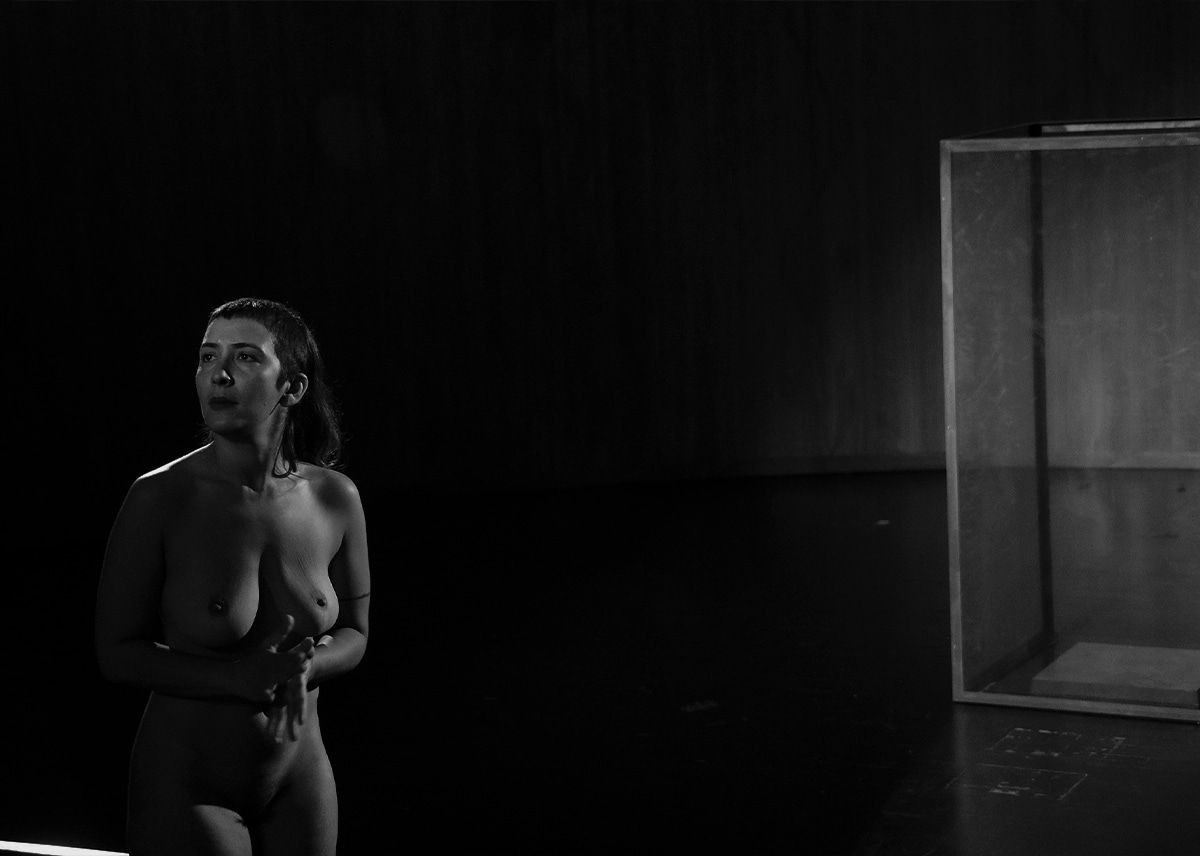
Mahsa Salali’s Naqqāli
'Salali positions the female body... as an active agent'

At Sea
Bearing witness in the face of dismissal