
Pressure
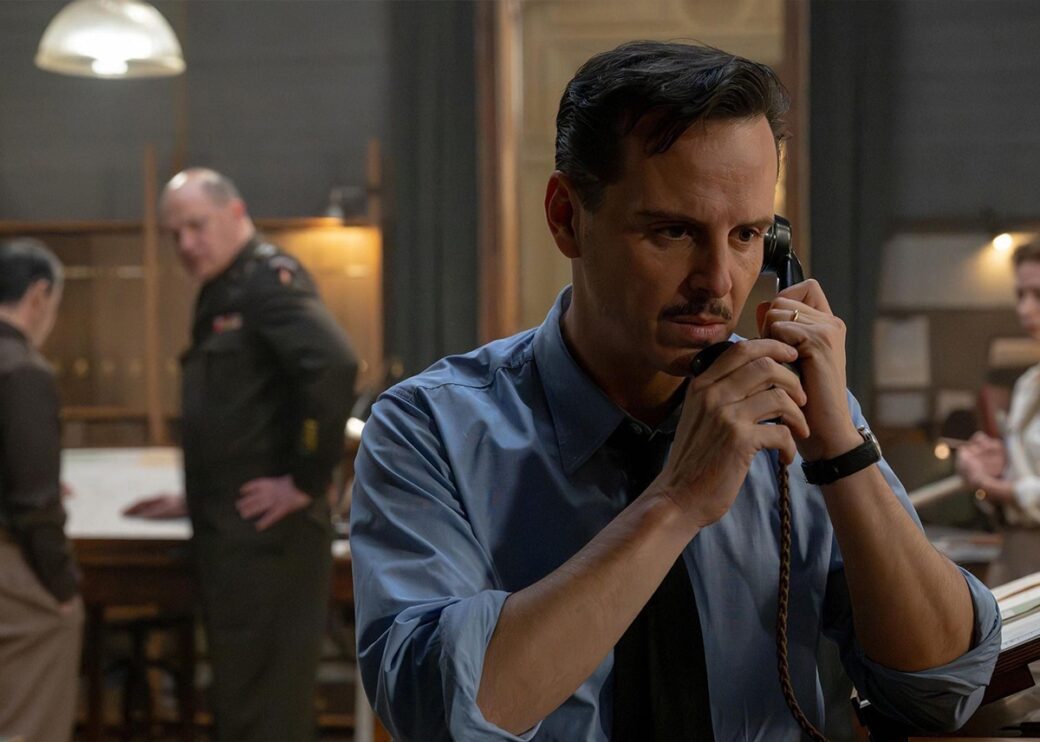
Directed by Anthony Maras, 2026
The Normandy landings were the largest seaborne invasion in history – a multi-faceted operation that required advanced naval technology, deception, and meticulous logistics. Yet, when asked what had given the Allies the advantage on D-Day, Dwight D. Eisenhower, the Supreme Allied Commander in Europe, replied, ‘We had better meteorologists.’
A new film, the latest to reflect the ongoing fascination with World War II, bills itself as ‘the untold story behind D-Day’. Set at the Allies’ headquarters in Hampshire, Pressure focuses on the crucial question afflicting General Eisenhower: when to launch the invasion.
The narrative begins on 2 June 1944 as James Stagg, a Scottish meteorologist whom Churchill describes as ‘a genius’, leaves his heavily pregnant wife to report to the general. Eisenhower (played by Brendan Fraser) is nervous, and not just because, as he tells Stagg (Andrew Scott), ‘The fate of the war hinges on this’. Little more than a month earlier, over 700 US soldiers had died in a D-Day rehearsal in which, to ‘toughen them up’, he had introduced live artillery.
Eisenhower is aware that every passing day increases the chances of the Germans spotting signs of the invasion. He wants to land at dawn on 5 June, which coincides with a full moon and the highest tides. His trusted American weatherman, Irving Crick (Chris Messina), predicts calm, suitable conditions. Stagg predicts a storm.
Eisenhower’s dilemma is intended to provide Pressure’s tension. The stakes may be high but, aside from the music, the drama is subdued. It’s partly because the viewer knows the outcome of D-Day (and probably also the date), but mainly because the weathermen’s debate is so one-sided: Krick’s team use models appropriate for the stable weather regions with which they’re familiar, while Stagg’s take into account the complexities of northern Europe.
The dispute has nothing that elevates it above the weather. Although Krick is bright-eyed and Stagg hard-nosed, there’s no meaningful battle of philosophies, temperaments, or even personalities. Pressure is about two weathermen (one much better than the other) who come to different conclusions.
The film’s most interesting figure is Eisenhower. The general comes across well, much better than the historical record might suggest. (As president, he ordered the assassination of Congolese prime minister Patrice Lumumba; and, when told that the country had 80 political parties, replied, ‘Oh, I didn’t realize that many Congolese could read.’)
Plenty of the character’s warmth comes from the decision to cast Brendan Fraser – an Oscar-winning actor who has suffered personally and professionally (his career stalled after he made a sexual assault allegation against the president of the Hollywood Foreign Press Association). Fraser’s Eisenhower is human, sympathetic, perhaps even ‘soft’. As we see in conversations with his aide – and de facto therapist – Kay Summersby (Kerry Condon), he is beset by guilt.
Pressure’s most engaging scenes take place far from the war rooms and weather charts, and with unnamed characters. Desperate boys clutch their rifles as their Higgins boat approaches the Normandy shore, fully aware that the ramp is about to be dropped, and they’re going to run into machine-gun fire. These moments provide the natural emotion of a war film – especially a patriotic one – but they’re extrinsic to the central drama.
Pressure may bill itself as ‘the untold story behind D-Day’, but it’s based on a stage play that opened 12 years ago. What’s more, Stagg described his role as the Allies’ weatherman-in-chief in the classic documentary series The World at War; and also wrote a memoir.
The only times Pressure can claim to be telling ‘untold’ stories are when it deviates from the historical record. For instance, Stagg joined Eisenhower’s team not in the days before the invasion, but towards the end of 1943. Similarly, his wife was only in her second trimester at the time of the landings whereas, in Pressure, she is about to pop. This wouldn’t matter, except that a caption at the beginning of the film tells us: ‘This is a true story’.
Ironically, given it’s a film about meteorology, the scene with the plot’s turning point has a slapdash approach to the weather. On 4 June, the morning before Eisenhower hopes to invade, Stagg is walking by a church when there is a sudden and powerful downpour. Would an ace meteorologist, on the cusp of having his prediction come true, and with his pregnant wife having been taken to hospital, really hide from a thunderstorm under a tree?
The Second World War, particularly its Anglo-American aspects, continues to lure Western filmmakers. One day, perhaps, producers will be bold enough to explore other narratives, say the Indian contribution – which stretched from Burma to Africa and Italy – or the Poles and West Indians of the RAF.
Pressure at least highlights a little-known and essential story of the war. It has a nice conceit and a good title but, as a drama, it doesn’t live up to its name.

WritersMosaic monthly
Get new reviews in your inbox
One email monthly, unsubscribe anytime

Disappearing Images
A festival of ephemeral art and the impermanence of our current world

A Trial
An examination of theatre’s complicity in post-truth politics

The Complex
The unraveling of a dynasty



Marlon James: a Jamaican reckoning
'A return to a home I barely knew'

The name of this wallpaper is ‘Childhood’
A luminescent bubble of memory

What’s in a feminist? Holding on to Gloria Steinem
Is Gloria Steinem's feminism still relevant today?






Illuminating, in-depth conversations between writers.
Listen to all episodes
SpotifyApple Podcasts
Amazon Music
YouTube
Other apps

The series that tells the true-life stories of migration to the UK.
Listen to all episodes
SpotifyApple Podcasts
Amazon Music
YouTube
Other apps
WritersMosaic interrogates the notion of ‘staying in your lane’ by asking writers how they attempt to think beyond the parameters of their cultural identity.
Listen to all episodes
SpotifyApple Podcasts
YouTube