
Seesaw

Timothy Ogene
(Swift Press, 2021)
Review by Suzanne Harrington
‘I’d heard more about that “post-colonial world” in a few days than all the years I lived in it, breathed its air, smelled its filth…But that “post-colonial world”, which I apparently “embodied”, was nothing like…the costumed performances of the Ugandan writer. Mine was just another tired world of ordinary and complicated people trudging along, like anywhere else.’
Meet ‘recovering writer’ Frank Jasper, whose first novel – a print run of 50, full of typos – seesaws him from a post office job in Port Jumbo, Nigeria (a fictionalised Port Harcourt, birthplace of the author, Ogene) to a literary fellowship for emerging writers at the William Blake College in Boston. Not that William Blake – this one was a seventeenth-century slaver.
There, he is expected to perform his Africanness at every academic opportunity, with pre-packaged politically conscious soundbites on race, empire and identity, and to participate in a tacit game of cultural ping-pong. Frank doesn’t know how, and isn’t interested. He is fascinated by America; he has never seen a Starbucks cup in real life, or a bong.
He arrives in his grandfather’s corduroy jacket, kept for special occasions, and ‘tired, un-African’ chinos, to meet his Fellows, including the ‘beaming Maasai impersonator’ Barongo Akello Kabumba, in flowing robes and carrying a cattle stick on campus. Frank does not fit in. He gets drunk, gets laid, and hangs out with ordinary Americans, but, amid the academics, he feels awkward, inferior, an imposter.
Ogene, with MAs from Oxford and East Anglia and a PhD from Cambridge, who now teaches at Harvard, is blisteringly funny in his send-up of academia and its absurd jargon. Frank, on his return to Nigeria, utilises this jargon fully as he seesaws into a post-Fellowship career as cultural commentator, lecturing at places like the ‘Institute of Comparative Corruption’ and the ‘University of Tropical Affairs’.
Sex with a white American who, during orgasm, raises her fist in a Black Power salute, inspires his lecture ‘Diasporic Erotics: Inter/course as New World Dialogic Dis-course.’ He argues that ‘the flowering of bodily proximities across geo-temporal itineraries could potentially do more for global cultural understanding than…the Peace Corps’. He is glad nobody asks a question ‘because I had no idea what I was saying’. He uses phrases like ‘post-colonial psycho-manic modernity’ with a straight face.
Before his return home as a ‘Nigerian Salinger’ – he is kicked off the literary programme for ‘non-performance’ and ‘non-participation’ – Frank goes on a road trip through the Midwest where he encounters real-life America. Away from the hothouse of academia, both Frank and the writing slow down, and become more reflective. Out in the corn belt, he is no longer a Nigerian writer – in the eyes of white America, he is just black. The manic satire of the first half of Seesaw softens into a more thoughtful poignancy.
As a reader, you find yourself rooting for Frank, worrying about his drinking, marvelling at his resilience and how damn clever he is, and cheering at his eventual manipulation of the preposterous world into which he found himself propelled; how he harnessed all the seesawing to his advantage, without resorting to Maasai robes. His flawed humanity makes him everyman, transcendent of pre-ordained cultural expectation. He is real, and really funny.
WritersMosaic monthly
Get new reviews in your inbox
One email monthly, unsubscribe anytime

The Complex
The unraveling of a dynasty
Disappearing Images
A festival of ephemeral art and the impermanence of our current world

Ever Land
A layered and haunting view of daily life in occupied Palestine
Coats
The unexpected cost of acquiring two Italian leather coats in Rome
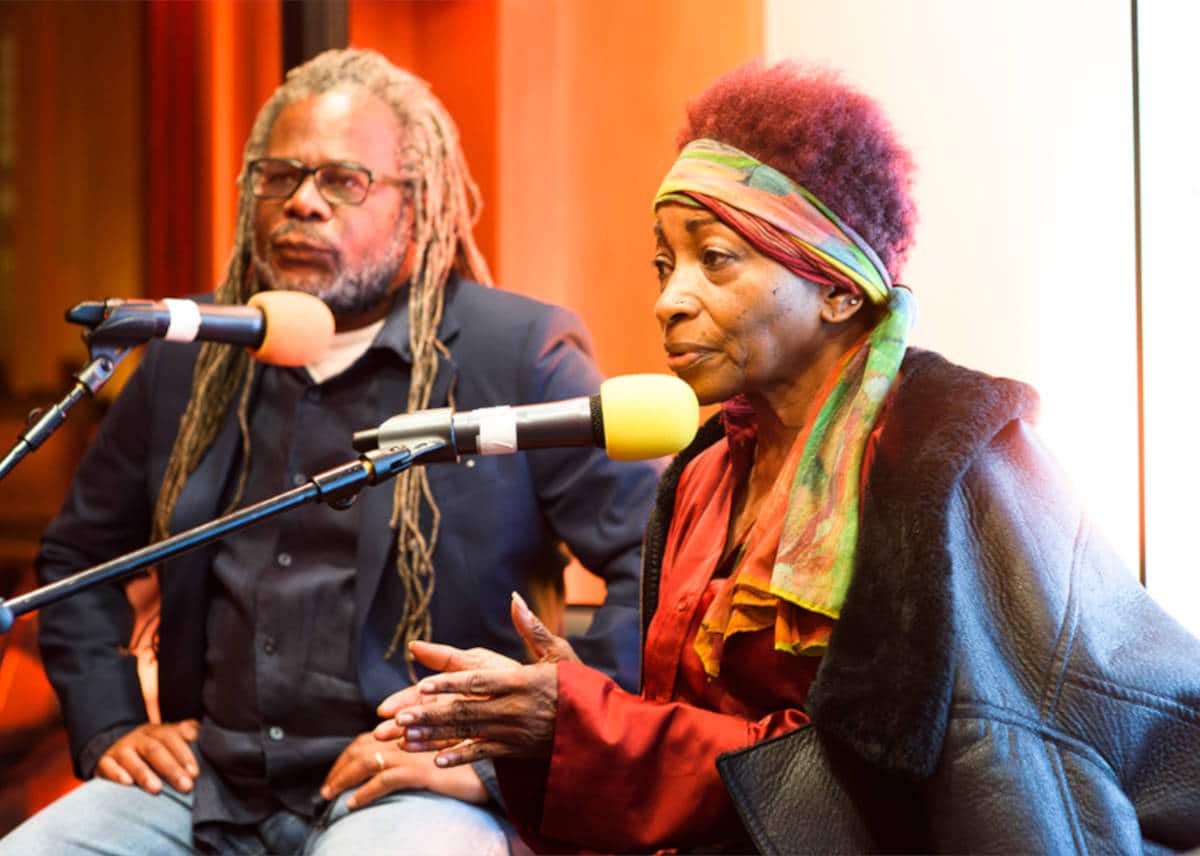
A tribute to Bonnie Greer
Founding editor of WritersMosaic Gabriel Gbadamosi pays tribute to Bonnie Greer, the extraordinary writer, public intellectual and much admired contributor to WritersMosaic who died on 15 September, 2026.
Triage
A response to the endless spiral of worldwide conflict and tragedy

Free Will
Will Harris reads his poem, 'Free Will'. Directed by Matthew Thompson and commissioned by the Adrian Brinkerhoff Poetry Foundation.

Half Written Love Letter
Selina Nwulu reads her poem, 'Half Written Love Letter'. Directed by Matthew Thompson and commissioned by the Adrian Brinkerhoff Poetry Foundation.

Illuminating, in-depth conversations between writers.
Listen to all episodes
SpotifyApple Podcasts
Amazon Music
YouTube
Other apps

The series that tells the true-life stories of migration to the UK.
Listen to all episodes
SpotifyApple Podcasts
Amazon Music
YouTube
Other apps
WritersMosaic interrogates the notion of ‘staying in your lane’ by asking writers how they attempt to think beyond the parameters of their cultural identity.
Listen to all episodes
SpotifyApple Podcasts
YouTube
In the first series of poems commissioned by Hannah Lowe, six poets explore how ritual gives meaning to our lives.
Listen to all episodes
SpotifyApple Podcasts
YouTube