Fiction Prescriptions
Money
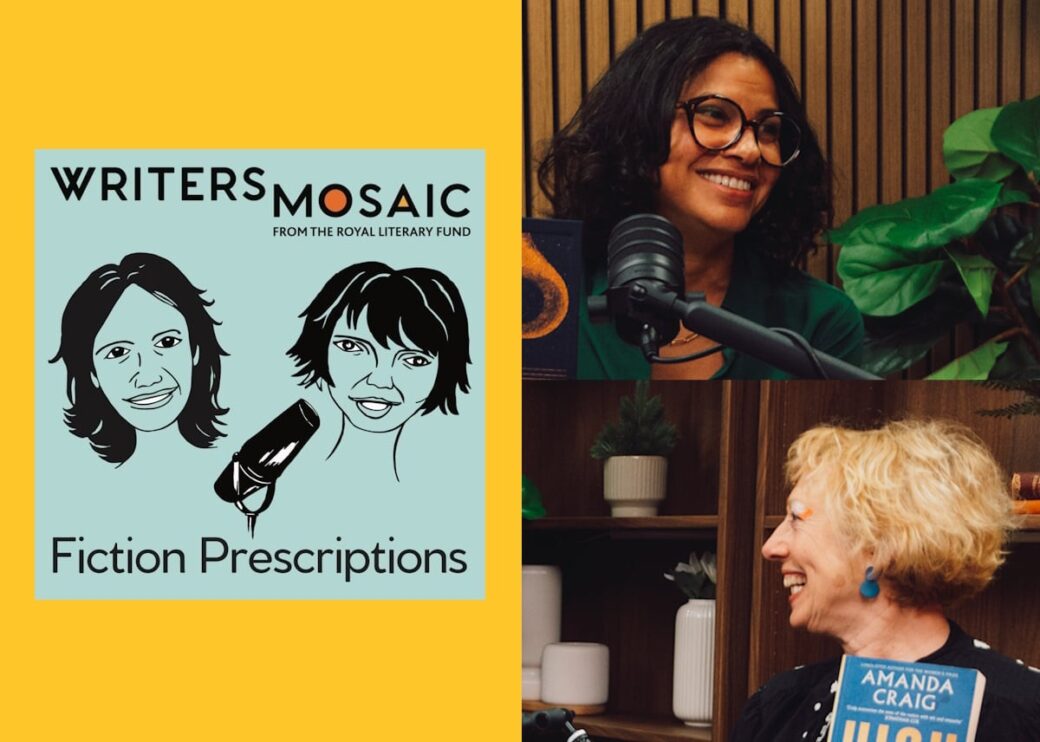

Write in with your dilemmas and our dynamic duo will suggest remedies for the head and heart, drawn from novels, poetry and prose collections.
Contact Isabelle and Ella for a literary check up here:
writersmosaic.org.uk/
Fiction prescribed in this episode:
The White Tiger by Aravind Adiga
Behold the Dreamers by Imbolo Mbue
The Rich Boy by F. Scott Fitzgerald
‘Sharp’ (poem) by Hannah Lowe
Fruit Fly by Josh Silver
Isabelle Dupuy (ID): Hi, welcome to Fiction Prescriptions. I’m Isabelle Dupuy, and I’m a writer.
Ella Berthoud (EB): And I’m Ella Berthoud and a bibliotherapist.
ID: And today we are going to talk about:
EB: Money [laughs].
ID: Because who doesn’t love money, right?
EB: I don’t know if I do love money.
ID: Well, what’s the saying? ‘You can never be too skinny or too rich.’
EB: That’s good [laughs].
ID: But yes, exactly. But on that note, Ella, can you tell us a bit about your relationship with money from your background, your parents, how you grew up?
EB: Well, I think I’m probably more of a grasshopper than an ant. I tend to spend it when I’ve got it and then rue the day [laughs]. And I think maybe that comes from living in a rather lucky background that was quite colonial. So, my parents were—my dad was a diplomat, so we lived all over the world in rather wonderful places and lived a rather bit of a life of Riley, you might say. But actually, there wasn’t a lot of—
ID: Cash.
EB: Cash. It was more about the power, in a way. And also, my mum came from a colonial background too because her dad was in the British Army. So, she was brought up in India under the Raj, lived in Egypt, lived similarly in a rather lavish style but without actually having buckets of cash around. So, I think I’ve just come—was brought up in that lavish way without seeing where the money came from, so maybe that probably meant that I ended up with a really terrible attitude to money. How about you, Isabelle? You actually have worked in finance.
ID: Yes. And that was a big shift for me and the family and the background I come from. I grew up in a very poor country. So, in a way, the opposite, in a way, of the British foreign service space. Although I do come from a middle-class background in Haiti. My parents are educated. We never—we had the trappings of middle class, but in a very poor country. And so, you have to adjust this. But same as you in a way though; it was never about money because there wasn’t much money for anybody. So yes, we had a nice house, and we had a car, and I could go to good schools, but it wasn’t about money because I think that came later, for everybody in a way. It didn’t—I think the world changed to a certain extent. And now we’re seeing it today with oligarchs becoming more powerful almost than governments, even governments in Western countries. So, money has probably become more important.
And I realised, I have to say, that money was important when I went to university. Because I went to university in America, where money matters. And suddenly I was like, oh, shoot, I have no money. And so, I was at Yale, which is a pretty wealthy school. And so, I saw a lot of people with a lot of money around me. And that’s when I started to realise, I’m like, ah, I don’t have any money. And so, I started—I had jobs throughout my student years. And then afterwards, I was always interested in literature and in thinking and writing, but I was scared of poverty. I looked at New York City and I thought, how am I going to survive with no backup? I don’t even have a home here; my parents lived in Haiti. So, that’s what brought me to finance.
EB: Yes, very interesting. And this leads us to some of the books that we’re going to be talking about, which absolutely relate to this topic.
ID: And to our question. And the question of the day comes to us from Ian in Brighton, and it is: ‘Is money more important in societies today than it was 20 years ago?’
EB: Which is a fantastic question. And that leads us directly into The White Tiger by Aravind Adiga. It won the Booker Prize in 2008.
ID: Almost 20 years ago.
EB: And I think it’s very much the beginning of that sense of money becoming more important to the modern world than it was before that era. So, this is a book about a man born into a very low caste in India. He’s in the cake and sweet making caste. And he’s destined to work in a cafe, and that’s what he should spend his life doing, according to the social mores of the time. And he spends his childhood working in that way, but is actually super bright, has to sacrifice his education in order to look after his siblings, and begins to chafe against this destiny and has ambitions to be actually a wealthy man. And he, in order to make that happen, goes to work as a driver for an extremely rich man. But he doesn’t stop there.
And in this book, he is writing to the Chinese premier. He’s addressing the Chinese premier in everything that he says because the Chinese premier is about to come and visit India, and our hero wants to tell him about what it’s like to be an entrepreneur and how you make money in India. And you realise as he goes along telling his story that he has done some pretty terrible and shocking deeds in order to get to where he is. And it gets darker and darker as the book goes on.
ID: And I think what’s cool about this book is the tone, the tone of the writer, of Adiga, because it’s very tongue-in-cheek. It’s quite sarcastic very often. It’ll make you laugh out loud. It’s a great prescription for anyone who wants to explore modern-day capitalism and have a good laugh in an environment that is supposedly—that, in a way, was completely made for it, and at the same time not, which explains the crimes and the inhumanity that has to come into play for you to change castes. And so, it’s the beginning, isn’t it?
This is a preview of the show. The full text will be available as a PDF here: Fiction Prescriptions: Money
Next time on Fiction Prescriptions: AI.
(Playful book chat only – not medical advice. If you need serious support, contact samaritans.org)
Fiction Prescriptions
Superstitions
Ella Berthoud & Isabelle Dupuy
Food
Ella Berthoud & Isabelle Dupuy
The manosphere
Ella Berthoud & Isabelle Dupuy
Parenting
Ella Berthoud & Isabelle Dupuy
The state of the world
Ella Berthoud & Isabelle Dupuy
Love
Ella Berthoud & Isabelle Dupuy

New Year’s resolutions
Ella Berthoud & Isabelle Dupuy
WritersMosaic monthly
Get new episodes by email
One email monthly, unsubscribe anytime

Illuminating, in-depth conversations between writers.
Listen to all episodes
SpotifyApple Podcasts
Amazon Music
YouTube
Other apps

The series that tells the true-life stories of migration to the UK.
Listen to all episodes
SpotifyApple Podcasts
Amazon Music
YouTube
Other apps
In the first series of poems commissioned by Hannah Lowe, six poets explore how ritual gives meaning to our lives.
Listen to all episodes
SpotifyApple Podcasts
YouTube
WritersMosaic interrogates the notion of ‘staying in your lane’ by asking writers how they attempt to think beyond the parameters of their cultural identity.
Listen to all episodes
SpotifyApple Podcasts
YouTube



Marlon James: a Jamaican reckoning
'A return to a home I barely knew'
The name of this wallpaper is ‘Childhood’
A luminescent bubble of memory
What’s in a feminist? Holding on to Gloria Steinem
Is Gloria Steinem's feminism still relevant today?




Pressure
What's missing from the latest 'untold story behind D-Day'?

A Trial
An examination of theatre’s complicity in post-truth politics