Fiction Prescriptions
AI
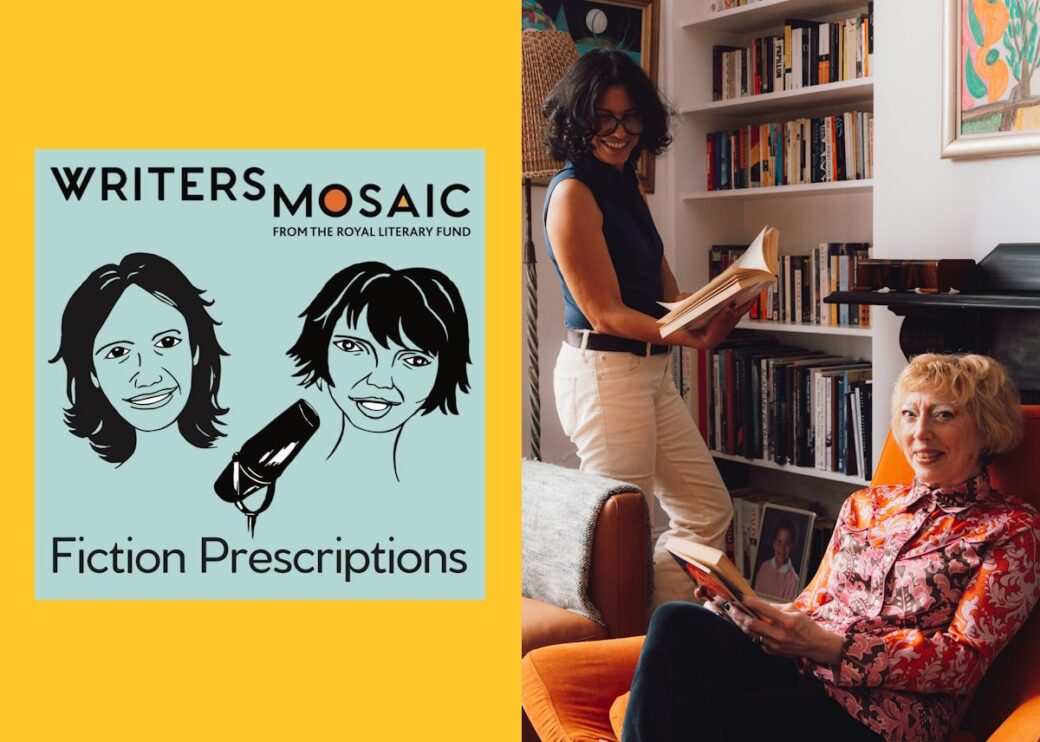

Write in with your dilemmas and our dynamic duo will suggest remedies for the head and heart, drawn from novels, poetry and prose collections.
Contact Isabelle and Ella for a literary check up here:
writersmosaic.org.uk/
Fiction prescribed in this episode:
‘Liar!’ (short story) from I Robot by Isaac Asimov
Machines Like Me by Ian McEwan
Turing Test (poem) by Franny Choi
Monk and Robot by Becky Chambers
Transcription by Ben Lerner
Rose House by Arkady Martine
Isabelle Dupuy (ID): Hi, welcome to Fiction Prescriptions. I’m Isabelle Dupuy, and I’m a writer.
Ella Berthoud (EB): And I’m Ella Berthoud, and I’m a bibliotherapist. Today we’re going to be talking about AI.
ID: Ooh, artificial intelligence.
EB: And we have a question from Adelaide in Leeds, which is: ‘Is AI going to kill us all?’
ID: Ooh, that is a very pertinent question. I think I read about this every day in the papers, no?
EB: Yeah, it’s everywhere. Not just AI, but everyone’s talking about it constantly. So, it’s a great question. And we’re going to try and answer it with some fantastic books on the subject. And we have to start with Isaac Asimov, who was one of the first people to write about it. In 1941, he was already writing about artificial intelligence. And he wrote this brilliant collection of stories called I Robot.
ID: There’s a film with Will Smith that has actually become very popular in the wake of this question, based on one of the stories. So, the book has many more stories than I, Robot.
EB: Yes. And that’s what’s fascinating about going back to it now, seeing all the different stories that he wrote and how incredibly pertinent they are. So, we’ve chosen one which is called ‘Liar!’, and it’s about the Three Laws of Robotics, which Asimov wrote himself back in the 1940s. I’m going to read you the Three Laws because it comes at the beginning of the book, very helpfully.
[EB reads from ‘Liar!’]
‘1. A robot may not injure a human being or, through inaction, allow a human being to come to harm.
2. A robot must obey the orders given to it by human beings except where such orders would conflict with the First Law.
3. A robot must protect its own existence as long as such protection does not conflict with the First or Second Law.’
EB: And that’s from the ‘Handbook of Robotics, 2058 AD’.
ID: Yes, and so that’s the basis of the movie, I, Robot, but also the basis of the story, ‘Liar!’. And ‘Liar!’, it does address the question that we’ve been asked because ‘Liar!’ is an AI that lies. So, people think the AI can read people’s—they think it’s become, through a glitch, a robot coming off an assembly line is able to read people’s minds. And so, they isolate the robot, and the scientists in this company are panicking. And the first person they sent to confront this robot and try to figure out how to deal with it is their in-house psychologist, or how they call it—
EB: A ‘robo-psychologist’.
ID: ‘Robo-psychologist’. And all this robot does really is tell people whatever they want to hear, because this robot interprets the First Law to that extent, that his job is to keep people from having psychological harm. And so, he tells her that a colleague that she’s in love with is, of course, in love with her, and so on. And so, this robot is just holding a mirror up, really, but people think he’s reading their mind because he’s giving them exactly what they want. That’s what this robot is able to do. And I think that’s probably one of the dangers of AI, because AI does do that. It does—it does reinforce our prejudices. It reinforces what we want to hear. It will never really tell us something that is in opposition to what we’re asking for it, especially if it’s an emotional realm, because the robot doesn’t care.
EB: It’s horribly like talking to ChatGPT when you read this story because, as you say, the robot is telling everyone what they want to hear. So, the robot has three different conversations with three different people all working at this lab. Each of them has a burning question, and the robot has read their minds, and he tells them exactly what they want to hear, but it turns out that they’re all in conflict with each other. And it has a very satisfying end, which we won’t reveal.
ID: No, but you could see how through that device, you could have the end of the world. The robot, the AI, could provoke war. It’s interesting, because there’s two points. But the other point about this question that’s interesting is that maybe that question has been thrown out by all the big AI companies, like OpenAI, like Elon Musk. And so, they—and you have to wonder if perhaps they are throwing out this question, asking for regulation, because they’re trying to distract you from lesser evils of AI. Because the absolute evil is always the one that you can splash all over the papers, but it’s also the one that doesn’t have any nuance to it. It destroys us or not, but how about all that space in between?
EB: Yeah.
ID: And I think this is something important to put into this dialogue. So, what, a robot that makes us all even more narcissistic?
EB: Well, I think Asimov does answer the question, ‘Is AI going to kill us all?’, very well because with all these different stories that he has in I Robot and many other collections that he also wrote in, he does come back to the human story. So, although we see robots and AI having terrible consequences and disasters, in all of the stories, it tends to be that humanity comes out triumphantly, don’t you think, in most of them?
ID: I think that—I was listening to one of his radio plays. He has a collection of three radio plays that you can listen to. They’re brilliant because they were all recorded in the late 1930s, with special sound effects and everything. And I think that what comes through is that we will always remain our own worst enemy, and AI will help to reinforce this or not.
EB: [Laughs] Yeah, I think that’s a good point.
ID: And ‘Liar!’ is part of that too. It’s about unrequited love, it’s about ambition, it’s about competition, it’s about jealousy. And those are the things that the robot is able to reinforce in all of these protagonists. The robot—it’s exactly like AI today. Because AI today, if I ask AI, ‘Is a Coke bottle red or is it green?’, it will give me the right answer. And it will say, ‘No, the Coke bottle is red, and the Coke can is red.’ And we know that it is red, and so everybody’s happy. That’s a factual thing. But if I ask the AI about my feelings towards someone, what does it know? It’ll just tell me whatever I want to hear and reinforce it. Yeah, exactly. I’m like, ‘Should I be angry with so-and-so?’ And what will it say?
This is a preview of the show. The full text will be available as a PDF here: Fiction Prescriptions: AI
Next time on Fiction Prescriptions: Morality.
(Playful book chat only – not medical advice. If you need serious support, contact samaritans.org)

Fiction Prescriptions
Money
Ella Berthoud & Isabelle Dupuy
Superstitions
Ella Berthoud & Isabelle Dupuy
Food
Ella Berthoud & Isabelle Dupuy
The manosphere
Ella Berthoud & Isabelle Dupuy
Parenting
Ella Berthoud & Isabelle Dupuy
The state of the world
Ella Berthoud & Isabelle Dupuy
Love
Ella Berthoud & Isabelle Dupuy

New Year’s resolutions
Ella Berthoud & Isabelle Dupuy
WritersMosaic monthly
Get new episodes by email
One email monthly, unsubscribe anytime

Illuminating, in-depth conversations between writers.
Listen to all episodes
SpotifyApple Podcasts
Amazon Music
YouTube
Other apps

The series that tells the true-life stories of migration to the UK.
Listen to all episodes
SpotifyApple Podcasts
Amazon Music
YouTube
Other apps
WritersMosaic interrogates the notion of ‘staying in your lane’ by asking writers how they attempt to think beyond the parameters of their cultural identity.
Listen to all episodes
SpotifyApple Podcasts
YouTube
In this second series of poems commissioned by Hannah Lowe, six poets explore the theme of surveillance.
Listen to all episodes
SpotifyApple Podcasts
YouTube


Ladies of the Rachmaninoff Eyes
The impact of space between what is happening on and off the page

On Snow
'The mind inevitably seeks a reenactment of the teal light I associate with home'
It’s being published I get paid for; the writing I would do for free
‘Any advance [...] for your novel is to compensate you for the horrors of being published'




Some Sacred Harbour
As much a book of joy as of anger
Death of the Soccer God
The 'uneven' novel on the disappeared Haitian footballer, Joseph Edouard Gaetjens