
An alternative history of photography
The Photographers’ Gallery
(7 Oct 2022 – 19 Feb 2023)
Review by Amaal Said
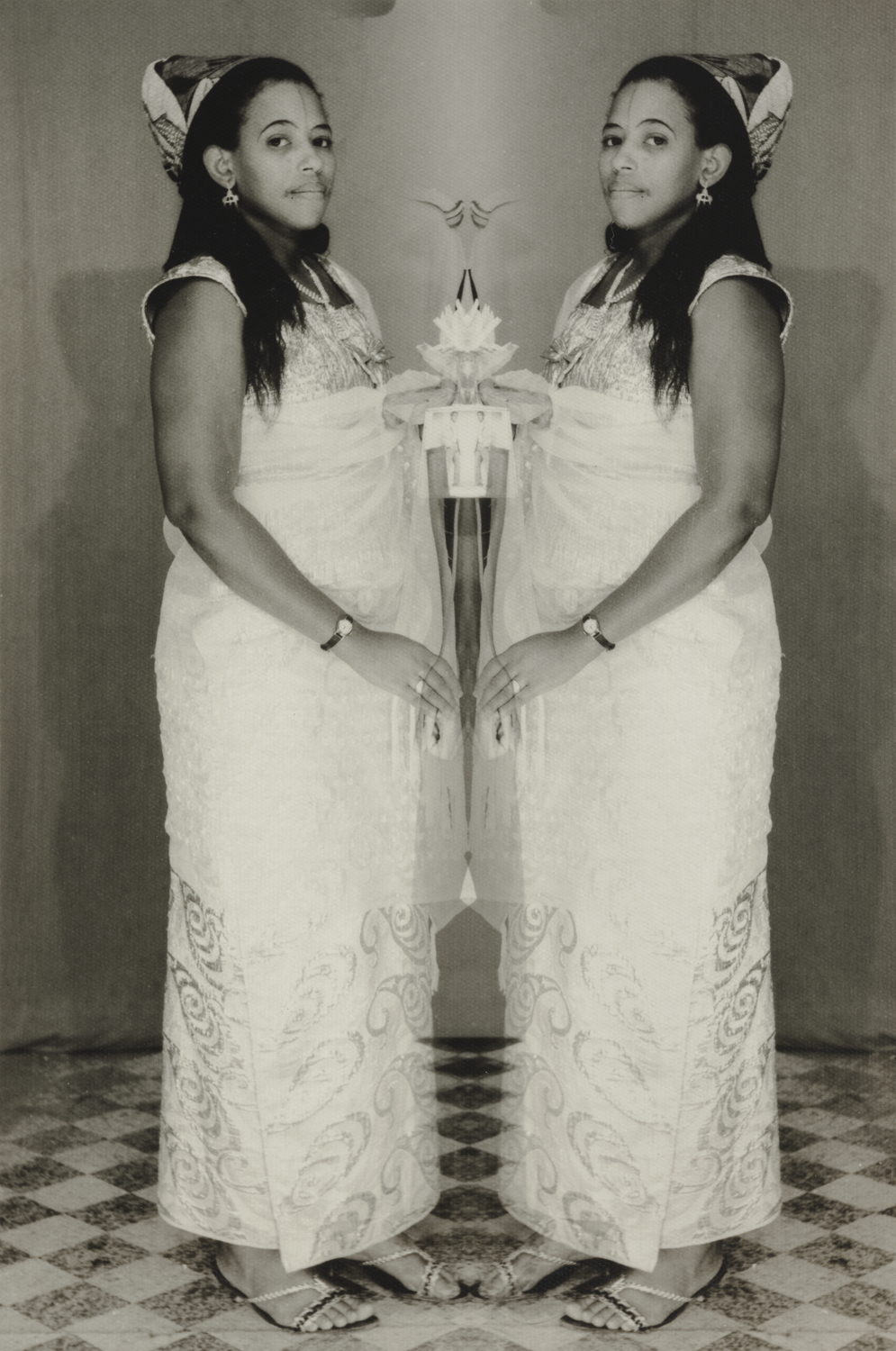
On show at the Photographers’ Gallery, An Alternative History of Photography: Works from the Solander Collection raises questions about who is considered when we think about the history of photography. This more open and inclusive collection of works is timely and needed. That isn’t to say I didn’t have questions about some of the photographs included in the exhibition, but the intention of widening the canon, opening it up, making way for others, feels necessary. I felt overwhelmed at the amount of work covered and excited about the possibilities, exploring what the word ‘alternative’ could mean. This work wasn’t intended to be revolutionary. Instead, the Solander Collection, brought together by Phillip Prodger and Graham Howe, was intended to create conversation, and to direct us to underrepresented photographers and photographs from across the world.
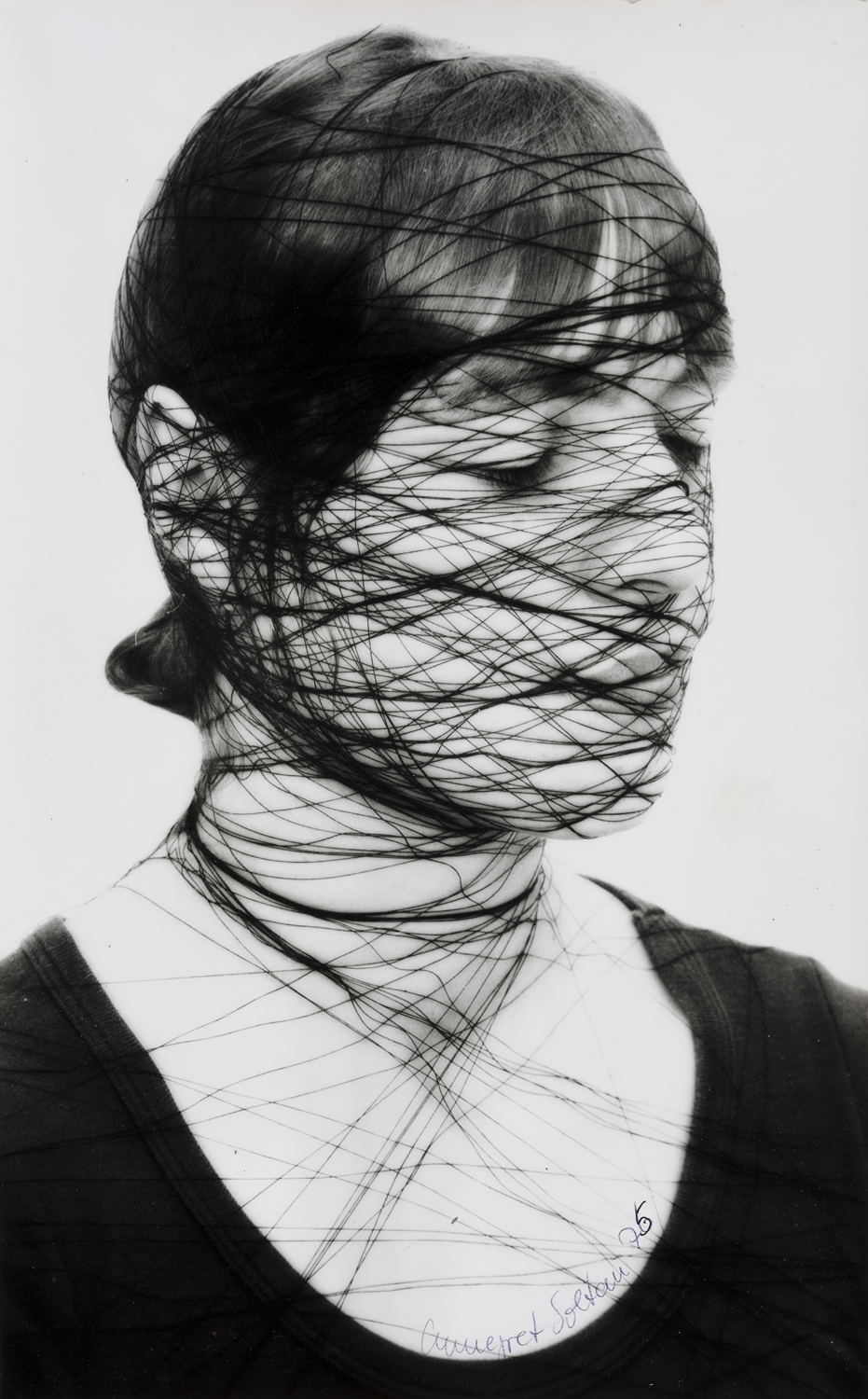
Although understanding the intention, I couldn’t help but feel discomfort at certain points when making my way through the exhibition. As the American critic A.D. Coleman put it when writing about photographer Bruce Davidson’s photographs as a white person of East Harlem, ‘even when there is mutual admiration and respect between photographer and subject, there is automatically a barrier, for they stand on different sides of the socio‐cultural fence.’ Reflecting on an image by French naval lieutenant and photographer Paul-Émile Miot, Mi’Kmaw Woman Posed on the Stern Deck of a Schooner, Newfoundland, 1857-1861, anthropology curator Kenneth R. Lister asks if the woman’s countenance, reclining on coiled rope, conveys her agency. I remember stopping and staring into the image for an extra minute or two, looking for what he meant by the agency of a woman whose name isn’t even noted. And then I thought, isn’t it convenient to assume a mutual respect between a photographer and the subject? Doesn’t it absolve us of guilt as viewers? What if we noted that she might have been uncomfortable? What if she wasn’t asked before it was taken? What if she had said no? These are all scenarios to consider in the exhibition.
A key takeaway for me, however, was the expansion of what cultures are now considered to have photographic histories and legacies, and what can be learned. The works of Malian photographer Malick Sidibé, Ghanaian James Barnor and Cameroonian Michel Kameni all mark distinctive periods of their countries’ histories. These photographers capture the cultural fashions and people of their time. As photographer Martyn Ewoma reflected on Sidibé’s work, ‘this is the Malian man as told by the Malian man.’ We need photographers telling the stories of their own communities, rather than the European travelling photographers coming in to document and leave. For instance, in photographer John William Lindt’s images of Australia’s Aboriginal communities, there is an element of performance, of an outsider interpreting a culture deemed exotic and different. In ‘Young Woman with Sleeping Child’ (c.1870-73), Lindt has orchestrated the background and has positioned her clothing so that her skin markings are showing. You can tell, also by the ‘Madonna and child’ pose, that this image is not for the community themselves but for a European audience. This is why, in contrast, the works of these African photographers are so important. The individuals in the images are respected and celebrated as people, instead of simply catalogued for European consumption. The exhibition encompasses a range of other photographers who also turn a lens on their own communities.
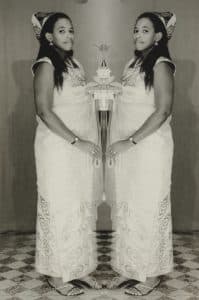
As someone obsessed with documenting her own domestic life, I greatly admire the consideration of the everyday in photography. I was therefore immediately drawn to Roy DeCarava’s photograph ‘Lonely Women’ (1960) of a woman walking down the street. There’s a simplicity to the piece that resonated with me. On the same wall you’ll find Robert Frank’s ‘NYC’ (1948), in which a man with no legs is on a skateboard on a rainy day. Both of these images feel intimate to me. They feel incredibly human. I got the same feeling looking at Jo Ann Callis’s photograph ‘Woman in Pink Slip’ (1977) of a woman with a flashlight wearing a pink slip dress. At once simple and part of the everyday but expressing something deeper. It’s encouraging to know that photography can capture not only the profound moments and aspects of our history, but also, as Callis states in an interview with the Los Angeles Times, ‘my insecurities, my revenge, my disappointment.’
I left the gallery grateful that photographers whose work hadn’t been considered or celebrated before had been brought into a space for fresh eyes to see. And I appreciated being able to see such a wide collection of work in one space. It feels a necessary and much needed direction to go in and to work towards – to consider the wealth of talent coming from all over the world, from people documenting themselves and their communities. We need to question the canon of photography and consider the photographers and works that have been overlooked and left out. There is always a need to be conscious and aware of the power differences inherent in photographic work. Images and photographers will continue to have the power to be exploitative. I would highly recommend walking around and taking the time to explore this alternative history.
WritersMosaic monthly
Get new reviews in your inbox
One email monthly, unsubscribe anytime
A Trial
An examination of theatre’s complicity in post-truth politics
The Complex
The unraveling of a dynasty
Disappearing Images
A festival of ephemeral art and the impermanence of our current world
The name of this wallpaper is ‘Childhood’
A luminescent bubble of memory
What’s in a feminist? Holding on to Gloria Steinem
Is Gloria Steinem's feminism still relevant today?
Coats
The unexpected cost of acquiring two Italian leather coats in Rome


Free Will
Will Harris reads his poem, 'Free Will'. Directed by Matthew Thompson and commissioned by the Adrian Brinkerhoff Poetry Foundation.

Half Written Love Letter
Selina Nwulu reads her poem, 'Half Written Love Letter'. Directed by Matthew Thompson and commissioned by the Adrian Brinkerhoff Poetry Foundation.

Illuminating, in-depth conversations between writers.
Listen to all episodes
SpotifyApple Podcasts
Amazon Music
YouTube
Other apps

The series that tells the true-life stories of migration to the UK.
Listen to all episodes
SpotifyApple Podcasts
Amazon Music
YouTube
Other apps
WritersMosaic interrogates the notion of ‘staying in your lane’ by asking writers how they attempt to think beyond the parameters of their cultural identity.
Listen to all episodes
SpotifyApple Podcasts
YouTube
In the first series of poems commissioned by Hannah Lowe, six poets explore how ritual gives meaning to our lives.
Listen to all episodes
SpotifyApple Podcasts
YouTube