
Old Friends and Rock, Bird, Butterfly
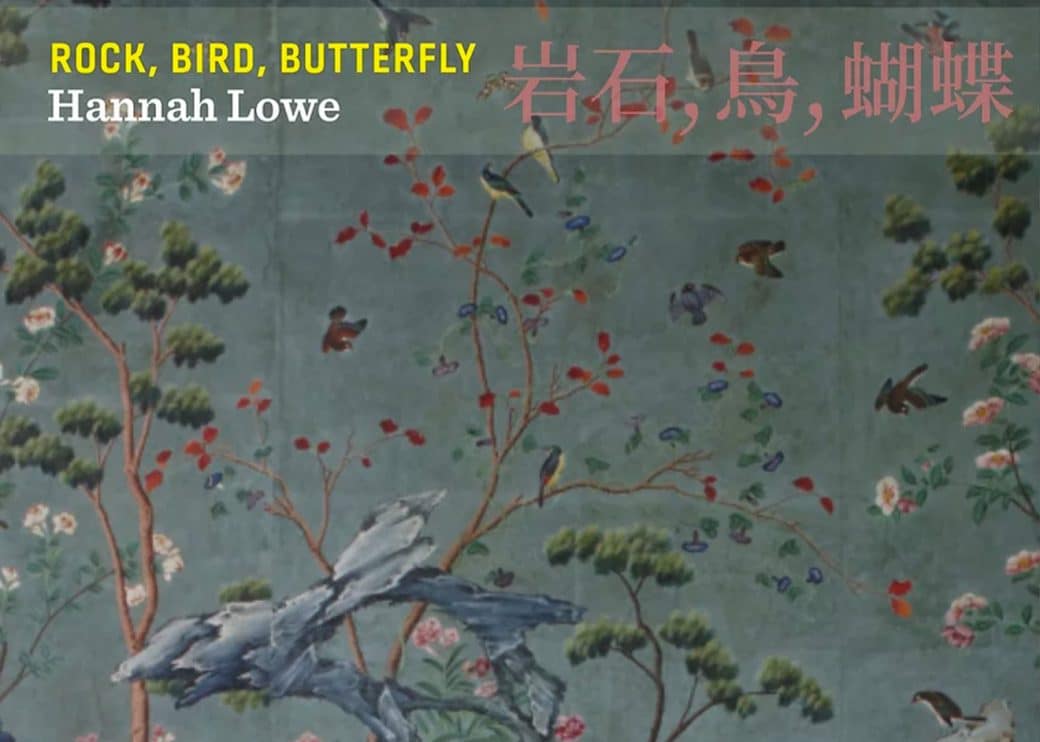
Hannah Lowe
Hercules Editions, 2022
Review by Shara Atashi
My initial admiration for Hannah Lowe’s poetry unfolded as I read the Joe Harriott poems from her collection Chan (2016) and was caught unawares by her distinct, anecdotal tone that gave life to a great musician who had vanished too early and could have been forgotten.
Now I have her two delicately illustrated chapbooks about Britain’s historical connection to China before me and I am once more surprised at how she conjures up the ghosts of forgotten human beings and objects.
While confirming Lowe’s incomparable poetic craftmanship, both books also provide excellent educational material to trace Britain’s brutal colonial history, and they do so rather gently. As a part of a critical intervention, they unveil two pathways shedding light onto that history: the fate of Chinese immigrants in Britain in Old Friends, and the British aristocracy’s whimsical taste for chinoiserie in Rock, Bird, Butterfly.
Old Friends
The thirteen poems in this chapbook are numbered and, apart from a few exceptions, untitled. Instead of titles, illustrations adorn each poem, either an old photograph, a painting or a map. Together they form a story which unlocks random images of London’s notorious docklands all of us may carry in our memory.
In a restaurant called ‘Old Friends’ in Mandarin Street, the narrator dreams of tapping an interlude on wine glasses which hang upside-down above the bar. Steam fills the atmosphere and – upon Hannah’s magic spell – ghost-waiters appear and move about the tables, carrying heaps of hot spareribs and steaming bowls of wonton soup.
The slums of Limehouse. A tour through the black and white docklands, and we arrive to observe sailors from faraway lands. They are unloading boxes from the barques, passing them on, storing or selling them. Who would have thought back in those days that those sinister-looking warehouses by the wharfs would one day be dressed up as expensive, arty looking flats?
… Run-down lodging houses. Seafarers
from Malaysia, Cape Verde, China. The Thames
laps the docks, hauls in the tea clippers –
the smell of oranges and ginger crams
the air …
Two Chinese men inspecting chickens in a crate
but I see colour. Anna May Wong crossing
the empty road …
The poems take you to old films ‘starring’ criminal Chinese and to the inflammatory posters advertising those films. Anna May Wong, considered the first Chinese-American Hollywood star, played a pickpocket in the crime film Limehouse Blues (1934). This was the time when Chinese immigrants entered the cinema screen as villains, demonised. The old Limehouse China Town had previously been sensationalised in British literature as a seedy and dangerous place, something to which poem No. 11 refers:
China swelled and swilled in the heads of Rohmer,
Charles Dickens, Oscar Wilde, Thomas Burke –
they perfumed doorways, misted every corner,
drew alleyways where shadowed figures lurked
to lure you to shadowy dens, a dark
lacklustre eye turned upon the newcomer,
fallen white girls tied to beds in cellars
… Picture now
the writer – fake detective, lewd explorer,
deluded liar – sitting at the windows
of humdrum English suburbs, full of wonder.
The depiction of Chinese migrants as the ‘yellow peril’ was obsessively nurtured by Sax Rohmer in his novels of Dr Fu Manchu, the evil emperor of the underworld, as well as by popular music-hall songs such as Limehouse Liz (1933).
Yet these ‘mysterious’ foreigners had been brought to the Thames’ shore by the British East India Company in collaboration with the British army. The first significant number of seamen came to replace white sailors who were fighting at sea during the Napoleonic wars. The next displacement followed during the First Opium War between 1839 and 1842, once Britain became aware of the value of this reliable source of cheap labour. Opium was produced in Bengal by Britain and was sold to Chinese smugglers for illegal sale in China from territories conquered there.
For me, the most intriguing poem in Old Friends is No. 8, titled ‘Brilliant Chang’. It represents Lowe’s inventiveness at its best as she exorcises the real-life 1920s cocaine supplier to London’s high society. She reinstates Chang’s intoxicating charm a hundred years later by letting her female narrator yearn to be seduced by him –an allusion to the irrational, mortal fear of interracial sexual relations expressed in British newspapers of the era. In this case, an inflammatory headline in the London Evening News warns, ‘White Girls Hypnotised by Yellow Men’:
… these lonely
nights, I think of you, sitting in the red glow
of a corner table, one knee pressed gently
against a woman’s knee, I wish her me,
your hand on mine, your mouth against my ear,
and all the sweet words you might whisper there.
Rock, Bird, Butterfly
How might poetry articulate the adventurous journey of wallpaper from China to Britain? This book is a surprising revelation.
Early tales suggest that Chinese-British relations began as the young Jesuit Catholic convert Michael Alphonsus Shen Fu-Tsung was welcomed by King James II in 1687 – the first recorded instance of a Chinese man in Britain. The king had a portrait made of him and had it hung in his own bedroom. Shen Fu-Tsung was able to catalogue the Chinese books in the Bodleian Library at Oxford and explain to the librarian both what they contained and which way up to hold them. He was probably the first among those who awakened a strong desire in Europeans to learn about China – a magical world of warriors, astrology and oriental treasures such as porcelain, tea and spices, and all that would later be labelled ‘chinoiserie’. Chinese hand-painted wallpapers were specifically manufactured to meet this European desire from the eighteenth century onwards.
Lowe’s story-in-poems about Chinese wallpapers begins with ‘Dazzling Blue’, in which the poet is
… raving about curators
and wallpaper restorers, how China
did everything better than us – pottery,
gunpowder, printing and yes, wallpaper
but when I say ‘us’ I don’t mean you and me.
Now check out these rainbow-tailed warblers,
[…]
I am writing wallpaper poems, or am meant to be
[…]
So I share a long story
about the ornate wallpaper still on show
at Coutts private bank on the Strand – how
it was saved from a sinking clipper
on the Java Sea, as Malayan raiders
with machetes sailed closer and closer –
that’s how much that wallpaper cost
£26 for one sheet of paper!
What is so striking about these poems is that they cover historical events. The adventure on the Java Sea was real, and the expensive product was miraculously rescued by the merchants who hurried into lifeboats with it and managed to keep it dry throughout the hazardous journey. This wallpaper still hangs there, at Coutts private bank in London, and a painting of the journey by William John Huggins hangs in the National Maritime Museum in London.
Lowe blows life into things considered dead: the objects of chinoiserie are turned into potentially speaking subjects in ‘If the Wallpaper Could Speak’, asking whether a phoenix could ‘name who painted her’ or a bed describe the dreams ‘that shook each night from the sleeper’s head’.
The poet visited many British country houses to trace the history of still existing Chinese wallpapers and was intrigued to find that any knowledge about the conditions under which they were made was absent, and that what is known is based on conjecture. This precious little book is illustrated with examples of what she saw to give us an idea of how fine these hand-drawn and painted treasures are. Surely many readers will be mesmerised and want to visit those houses to have a closer look.
‘The Mines’ takes us again to colonial history, the initial curiosity and astonishment over all things Chinese turning into a greed the satisfaction of which needed slaves and cruelty:
Anyone who was anyone had to have
a China room, and Lord Penrhyn had two
and built his driveway three miles long to give
his visitors the impeded view
of every tower and vestibule, and knew
to set the bragging mouth of his grand front door
high up on his cliff so he could peer
across the valleys and fields and mines he owned –
so rich was he (six hundred slaves on three
plantations he’d never seen)
On the one hand are the fine flowers, birds and insects created to meet European taste while enriching it with Oriental symbols of wisdom and harmony. For example, the images of ducks were made for bedrooms to awaken marital harmony and fidelity (‘The Ducks’). On the other hand, it was all a superficial folly of Europeans when the main purpose for such possessions was ‘keeping up with the Joneses’, as Lowe mentions in her ‘Afterword’.
In subsequent poems, Lowe also resurrects ‘The Hanger’ of the papers, seeks out the sparks of passion in ‘The Curator’ and moves on to ‘The Look of Things’, where she returns to present time and all the modern objects of mass production in Chinese design:
… Even now
in Camden Market, I always buy my notebooks
with Chinese-looking covers – peacocks,
climbing vines. And not because I am part Chinese –
I just like the look of things Chinese.
The book closes with the striking poem ‘Mr Foote’s Chinese Wallpaper’ based on an actual criminal trial in which Mr Foote was sentenced for sodomy based on the evidence that his footman and alleged victim Sangsty had seen rolls of Chinese wallpaper in Foote’s private living room, a place a servant would never normally be allowed.
https://www.herculeseditions.com/rock-bird-butterfly
https://www.herculeseditions.com/old-friends

Shara Atashi
Shara Atashi is an Iranian-born writer and translator now living in Aberwystwyth, Wales.
WritersMosaic monthly
Get new reviews in your inbox
One email monthly, unsubscribe anytime
Haunting the Black Air
Poetic freedom across space and time
The Disappearers
A sprawling visceral experience that drops you in head first

The Lady Imam
Is the world ready to catch up with amina wadud?


It’s being published I get paid for; the writing I would do for free
‘Any advance [...] for your novel is to compensate you for the horrors of being published'
Complex antihero: an interview with Arthur Hughes
Unravelling Authur Hughes' Richard III
Marlon James: a Jamaican reckoning
'A return to a home I barely knew'





Illuminating, in-depth conversations between writers.
Listen to all episodes
SpotifyApple Podcasts
Amazon Music
YouTube
Other apps

The series that tells the true-life stories of migration to the UK.
Listen to all episodes
SpotifyApple Podcasts
Amazon Music
YouTube
Other apps
WritersMosaic interrogates the notion of ‘staying in your lane’ by asking writers how they attempt to think beyond the parameters of their cultural identity.
Listen to all episodes
SpotifyApple Podcasts
YouTube