
All the men my mother never married
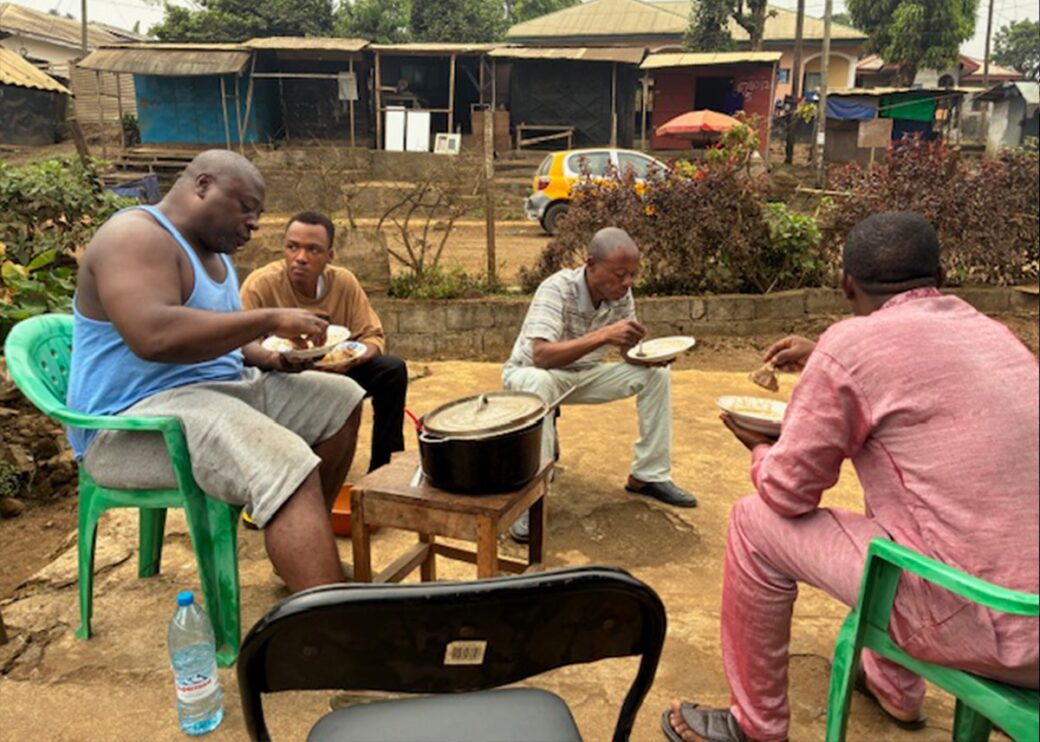
Ngah, short for Ngalle, is the affectionate nickname my mother uses for me. I cherish this term. She only calls me Eric when I have done something wrong. In January 2024, I stood on our family home’s veranda in Buea, Southwest Cameroon. Weaverbirds played on the hedges, darting in and out of the red hibiscus flowers. The savannah grass at the base of Mount Cameroon bent forward like weary soldiers and, despite the bright sunlight, the mountain appeared shy, cloaked in a veil of fog. Some neighbourhood children took turns pushing each other in a wheelbarrow, and others chased car wheels down the hill. I smiled.
‘Ngah,’ my mother’s voice drifted in from the kitchen.
I noticed something unusual about her posture when I got there. She always sits upright with her back against the wall, facing the entrance with one foot on the stone she claimed was ‘flattened over the years by my father’s footprints.’ I don’t remember my father; he died when I was just twelve months old and I have never seen even a photograph of him. I’ve been told he was severely disabled, so I can’t picture his foot making those prints. That afternoon, Mum sat by the door, her chest puffed out like an albatross struggling to land. She held beads with shimmering crystals, counting them as if reciting a Bible verse. She got up, hugged me, and led me to her chair, and I wondered why my mother was making me sit on it. I am the fifth child and not even close to being her next of kin. As she walked back, she nodded at the four corners of the kitchen before sitting down again. What was my mother implying with these cryptic gestures?
She cleared her throat, fixed me with a steady gaze, and began to speak.
‘Ngah, do you know why I’ve never married?’
Over the years, I have had many things I wanted to ask my mother, such as how she managed to have six children with six different men. However, as I grew older, I realised she was not unique. Many women in the village had children with married men.
She repeated the question, her voice sounding like someone practising a song, her tone wavering with each breath.
I have treasured my conversations with my mother, but I was unprepared for one so burdensome.
She reached into the mokoweh, a pot blackened by smoke, and took out a brown piece of paper before handing it to me.
I unfolded it and saw it was the site plan for our compound.
‘Ngah, I am the first child of your grandfather.’
I already knew this piece of information. There was a time when I was called Mosreh Mo Ngbwa, which I believed meant ‘The Dog of Dawn’. Recently, while researching Cameroon’s colonial encounters for a novel, an elder told me that my grandfather’s name, like that of the colonialist, means someone who takes what does not belong to them.
‘I was in the kitchen when my father, your grandfather, called and asked me to pack my bags. I was leaving the family home.’
She paused, and I sensed my mother was omitting parts of the story.
As she was about to carry on, I heard, ‘Mama, you dey for house?’ It was my sister; she had come for their afternoon prayers.
My mother never completed the story but before leaving she said, ‘Ngah, Joowah Nwelle’ – ‘We’ll talk tomorrow.’
I remember the day my mother first took us to a nearby village to meet one of our many fathers, a well-known wrestler. I was about six or seven years old. We found him inside his humble one-room hut, which had a palm-leaf roof and wooden walls. Initially, I thought it was a mistake and that there must be an outer house. I looked around the compound and saw nothing. I sat on the ground by the door, while my mother sat on a log opposite the wrestler. To the left was the Ewongo, a place where goats slept, and near where he sat there was a small fire with a kettle on top. There was nothing else in the room.
Where did this man sleep, given that he already had two older children? And what kind of charm did he use to attract my mother? He had a tank-like belly with drooping nipples and did not resemble a champion wrestler at all. He looked like sun-dried pawpaw leaves with early signs of maggot infestation. I cannot forget the image of him sitting by the fireside, looking dazed as my mother badgered him for money to pay my sister’s school fees. I never re-encountered the man.
I met the father of our youngest, who was a hospital chef. He was married and lived in a government housing estate. My brother’s father often napped on the veranda, resembling a pregnant hippo breathing heavily in a dried-up pond. I only recognised him because someone pointed him out. I’ve never known the father of my mother’s first and third children, but I’ve heard rumours about them.
I grew up unaware of my father’s true identity, but I knew his family. That changed after a disastrous court incident in May 1996, when some relatives disowned me. I can somewhat understand their reasons. My mother’s reputation preceded her.
My paternal grandmother was shocked when my disabled father introduced my mother to the family as his future wife. They probably thought she was just a casual fling. By then, my mother already had four children with different men and was being presented to my father’s parents. They likely doubted that my disabled father had gotten her pregnant. According to my mother, she was already six months pregnant with me at the time of the introduction. They couldn’t believe the bad luck my mother had brought to my father. His family never accepted my mother, and this hostility persisted.
There is a common saying among the Bakweri: Wasra Lingani Emolana, wasra Viti li linga eh Mwana – ‘If they did not love the woman, they could never love the child.’ Since I started returning to Cameroon in 2017, I have been trying to build bridges with my father’s side of the family – a difficult task, as I can still see resentment in some of their expressions. My father’s name is often ignored, as if my paternal grandmother had only two children instead of three.
The site plan my mother showed me that sunny afternoon symbolised an agreement between her and my grandfather. If she had ever married, she would have lost the house and the small plot of land her father had given her. The men who approached our mother as potential fathers had nothing to offer her. They were married men seeking a quick affair, and we were the outcomes.
As George Lamming says, ‘It was my mother who fathered me.’ Yes, my mother raised us. I often wonder if some of our fathers exploited her. That is a story for another day.
WritersMosaic monthly
Get new writing in your inbox
One email monthly, unsubscribe anytime
It’s being published I get paid for; the writing I would do for free
‘Any advance [...] for your novel is to compensate you for the horrors of being published'
Complex antihero: an interview with Arthur Hughes
Unravelling Authur Hughes' Richard III
Marlon James: a Jamaican reckoning
'A return to a home I barely knew'
Haunting the Black Air
Poetic freedom across space and time
The Disappearers
A sprawling visceral experience that drops you in head first
The Lady Imam
Is the world ready to catch up with amina wadud?


Illuminating, in-depth conversations between writers.
Listen to all episodes
SpotifyApple Podcasts
Amazon Music
YouTube
Other apps

The series that tells the true-life stories of migration to the UK.
Listen to all episodes
SpotifyApple Podcasts
Amazon Music
YouTube
Other apps
WritersMosaic interrogates the notion of ‘staying in your lane’ by asking writers how they attempt to think beyond the parameters of their cultural identity.
Listen to all episodes
SpotifyApple Podcasts
YouTube