
RENDANG

Will Harris
Granta Poetry, 2020
Rending the surreal from the urbane, RENDANG (Granta, 2020) is an extraordinary achievement. Will Harris’s debut poetry collection combines everyday moments of city life with a soaring escapism. The book’s exclamation marks are its two lengthier poems, ‘The White Jumper’ and ‘RENDANG’, which veer between urban settings, dreamscapes and childhood memories with uncertain roots. Harris’s poems become a magical reclamation of individuality from the mass of some of the world’s largest cities, finding identity in the clutter of modernity.
Harris’s London is frantic and often unpleasant. Racism threatens from the margins and from the centre. His speakers visit the British Museum to see obfuscations over the reality of slavery, then combine their moral disgust with the physical disgust of seeing ‘bees groan inside / the carcass of a split bin bag’. Strangers interrupt his poems with ‘Look where you’re going, cunt’ and ‘The country’s full. Why are they all men?’
The London of this book is exclusive, too, and out of reach. The ‘white jumper’ is a transient image – Harris wrote for The Poetry Society that ‘the simplest way to explain [it] is to say I had a dream’ – but its spectre hovers around the edges of the poem titled ‘The White Jumper’, teasing the reader, offering little clues to its symbolism. The image of a white jumper recurs, distorted, either as a threat or a reminder of the speaker’s not-quite-belonging, as he grows from child to poet in London. Hugo’s grandma wears a ‘plain white nightie’ while screaming in Urdu; Bob has a dream about a ‘white coffin’; the speaker’s grandma has a ‘white-frilled coffin’ at her funeral, hair ‘white at / the roots’, and mourners ‘wearing only / white’. The speaker only finds his sense of belonging, away from the pervading ‘white’ of the city, in surrealist escape:
‘it felt not just like we were above
ground but that despite being in Covent
Garden we were on a ridge above a
forest looking down our feet in
thicket dark our heads
in thickest
stars’
In dreaming, in surrealism, RENDANG offers escape. Its final poem is the titular ‘RENDANG’, in which the implicitly autobiographical speaker finds solace by literally laying ‘the pages / of this book around me. // I talk to them. RENDANG, / I whisper. RENDANG’. He spends the poem, again, alienated from city life by its mundanity and its blasé treatment of violence. His friend Hayley offers him a place to stay, where the sum contents of her belongings are ‘a pile of clothes, a postcard of H.D., a framed / copy of The Velvet Underground & Nico’, and where he is woken in the night by a car crash. They respond by listening ‘to music, sirens / screeching behind us. Her new favourite / thing was dubstep’. Later, a tourist asks him for directions to Grenfell Tower:
‘I described the route and as I did
he smiled. Not in an evil way.
The opposite. Like someone on
a pilgrimage’.
He feels utterly bemused by other people’s ability to assimilate such tragedy into their sphere of the everyday. In response, he reaches again for the surreal, to ‘imagine myself unborn’, then ‘lay / the pages of this book / around me. I talk to them. // No, they respond. No, no.’
Harris’s speakers assemble fragments of the mundane from their lives and concoct new selves out of the collage. His father’s Ming vase; Hayley’s rudimentary belongings; the pages of the book itself. In the very first poem, ‘Holy Man’, Harris’s speaker is accosted by someone who tells him, with a tinge of racism, that he ‘has a kind face’. In response, he pictures himself refracted through stained glass as ‘a freshly mown lawn, a stack of banknotes, a cartoon / frog, a row of pines, an unripe mango, a septic wound’. In so doing, Harris transforms these mundane objects into a new, more individual, sense of self through the stained-glass window of surrealism.
The poems might seem abstract, maybe even obtuse, at first reading. But, like Harris’s speaker in ‘Holy Man’, do we begrudge stained-glass windows for putting a filter on our view of the outside world? After RENDANG, it would feel miserably ascetic to view life without the stained-glass windows of Harris’s poetry.
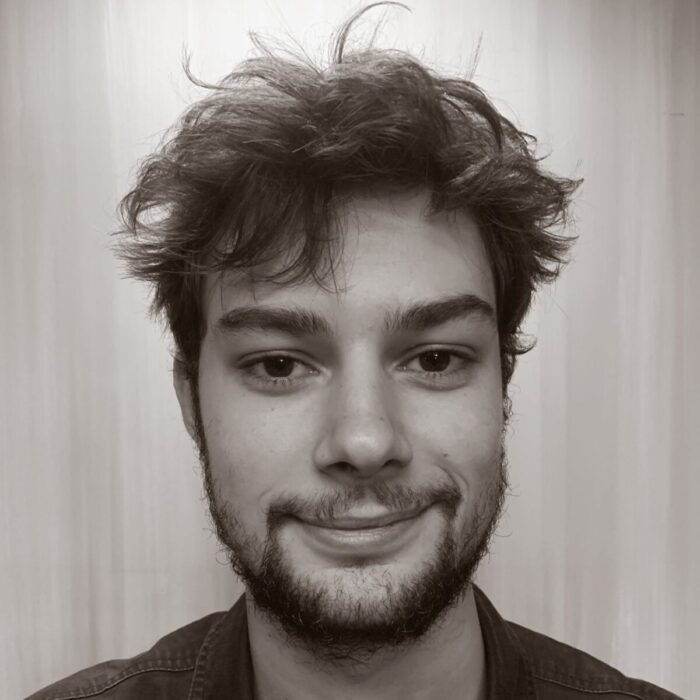
Magnus McDowall
Magnus McDowall is a poet from London and a postgraduate student on the Creative Writing MSt at the University of Oxford.
WritersMosaic monthly
Get new reviews in your inbox
One email monthly, unsubscribe anytime
The Disappearers
A sprawling visceral experience that drops you in head first

The Lady Imam
Is the world ready to catch up with amina wadud?
Pressure
What's missing from the latest 'untold story behind D-Day'?


Complex antihero: an interview with Arthur Hughes
Unravelling Authur Hughes' Richard III
Marlon James: a Jamaican reckoning
'A return to a home I barely knew'
The name of this wallpaper is ‘Childhood’
A luminescent bubble of memory





Illuminating, in-depth conversations between writers.
Listen to all episodes
SpotifyApple Podcasts
Amazon Music
YouTube
Other apps

The series that tells the true-life stories of migration to the UK.
Listen to all episodes
SpotifyApple Podcasts
Amazon Music
YouTube
Other apps
WritersMosaic interrogates the notion of ‘staying in your lane’ by asking writers how they attempt to think beyond the parameters of their cultural identity.
Listen to all episodes
SpotifyApple Podcasts
YouTube