
Bad Signal
I write a line of poetry, then another and another; then I read them back. The first line feels clunky, but moves into the second line smoothly enough; the third line suddenly darts off in some random direction, one that feels like it wants to undermine the logic of its two predecessors. The lines now feel like they’ve lost signal, that they’re breaking apart from each other. Reading back over the tercet, I have to accept I’m following my impulses, that I’m unsure how I’ll make connection with both the reader and the poem’s architecture. Do I need to write more? I don’t know. I just need to listen to the channel, or channels, the lines emanate from.
I’m trying to see if I can forge an association between things, activating materials that aren’t necessarily supposed to coexist. I’m thinking about the ways this relates to my own experiences, and how I’ve grown up trying to make some kind of sense out of the irregular, illogical and abnormal. As far back as age ten, I remember looking around my classroom and noticing differences in my classmates. Each of us from various parts of the world dressed in a uniform that resembled Western business attire. For lunch we’d eat bangers and mash and speak to each other in a language that was different to those of our parents and grandparents. I would go home and modulate my language to align with my family. If my cousins were over, I’d change once more, code switching and inflecting slang in a way I was unable to around my white English friends. These were all early forms of linguistic leaps and shifts, made in order to connect with different groups more effectively.
Eventually, I came to appreciate that all language use can be seen as extending a hand; words and their corresponding meanings are always about relationships, always looking for some kind of connection or response from whoever they’re intended to reach, even when that conversation is thought of as silent, as happens in poetry.
A boy in my class once remarked how I wasn’t really English because my ancestry wasn’t. I went home that night and pulled out the clothes from my wardrobe. I put on a pair of jeans and thought, am I not supposed to be wearing these? Because people from my country wore a different kind of trouser? Should I instead look to walk around North London in traditional Cypriot garb, or at least dress how my grandfather might have done in 1930s Cyprus? I glanced over at the small globe in the corner of my room for my country of origin. There it was, nestled in and among the great and ancient states of the Middle East and Asia Minor, like a paperclip. My geography teacher once joked that some islands are so minuscule they appear as no more than specks staining the world map.
I read back over the three lines again and consider the rule of three (a writing principle that suggests things arranged in a pattern of threes are more memorable, impactful and satisfying). What do I want from these lines? Do I want to impress upon the reader my ability to associate feelings with things? Better still, what is my intention? I want to bring the reader into my three lines, for them to smell and touch and feel the edges and bumps and blemishes. I’ve come to consider the lines as loosely linked ideas riffing and skidding around each other. I want the reader to participate in the experience I’m trying to build.
When I was at nursery school, my teacher pulled my grandmother aside one afternoon and told her how I’m somewhat recalcitrant and aloof in class. How I fail to participate in group activities, and how for much of the day I would stare blankly into the face of whichever teacher was giving me an instruction. She suggested a hearing test. My grandmother, whose English consisted of ok, hello and thank you, warned me that if I didn’t listen to the teachers, I’d be forced to spend the entire day with her at home which she knew I loathed. Jumping to my own defence, I replied in my young Cypriot Greek that I just didn’t understand what anyone was saying to me, because I couldn’t speak English.
A wave, an ocean and a shore all belong to the same group of images. If I were to write a sequence of lines that described a wave and placed it in relation to a shoreline, brought forward an image of a beating sun, then ended on the speaker having some generic epiphany about, say, mortality, I’m sure the reader would be able to piece together what I’m trying to get at. It’s familiar, logical, and most of all seems real. Yet if I were to make the ocean out of rubble, depict the sun as being moody and standoffish, then cast an idea of heat as being like a pig roasting on a spit, readers might stumble or at least be challenged imaginatively to work with the eclectic strangeness a little more. My job therefore would be about how I build enough information or context into those images to ensure the reader has enough of a toehold to make some kind of connection – even if it differs vastly from my own.
An editor once remarked to me that there needs to be a clear route or throughline for the reader to successfully connect the dots in a poem, or for it to make sense. That A has to speak to B to unlock C so as to qualify D. But then, isn’t instrumental music comprised of irregular arrangements, or a series of non sequiturs? Isn’t jazz music known for improvisation, with a degree of randomness? In fact, a sequence of sounds need not ‘follow’ logically: as I write this, I can hear a plane fly overhead, alongside the tapping of keys on my keyboard which is followed by the drilling noise coming from next door. If we perceive sound to be a series of non sequiturs, alongside the ways we think and feel (we don’t think or feel in a straight line), why then do we need to arrange poems in such linear and logical sequences that one thing must always lead to another? Why do we make such demands of language and yet grant other mediums the freedom to move in more lateral, orbital, unpredictable ways?
I send the three lines to a friend, a professor of international law who I consider to be poetry adjacent. I ask him what he thinks. He says he needs to read more of the poem to really get a grasp on it. He says he’s struggling to connect with the ideas. He’s reading them literally. Is he a bad reader or am I a bad writer? I write back and say no, that’s it; that’s the whole poem. It’s a tercet. He responds with an ok.
I’m with my father. It’s July and we’re driving from North London to East London to visit his mother. I’m twelve years old. I ask how long we have left of the journey. He doesn’t reply. He looks ahead and keeps driving. I can feel his energy – slightly irritated, hot, preoccupied. I don’t repeat my question. I feel stupid. Excluded. I don’t understand why he won’t just reply. He’s making me work for something that could be so simple. I need to wee but I’m fearful of asking again. When he gets angry, I get scared. There are small beads of perspiration forming around his lip. His moustache glistens. He unwraps a stick of chewing gum and throws it into his mouth. He chews hard. The gum is integral to the scene, but I’m going to distort it as an image so I can regain some kind of control. Or to include myself and my sensibilities in a moment I felt I was locked out of. I write three lines.
A stick of gum moustache mint
stuck to the car’s stereo heat outside
I look for where I can lay my bladder down
I’m sitting on a beach in Cyprus with my father 25 years later. I’ve been writing and teaching poetry long enough that he now considers it my job. He comes back to the sun loungers with two bottles of Keo beer, placing one down beside me. He asks what I’m reading, I say a collection of poems. He says he doesn’t get poetry. He doesn’t know what it means. I close the book and take a swig of the beer. What’s out there, I ask him, pointing to the sea just a few feet away. What do you mean, he asks.
It’s never the question that throws us; it’s the way we wobble on the answer. Most people when pressed can reply to almost anything, and not just with a fixed singular response. What confused my father, I think, was a feeling of the many different possibilities a question can hold, and in return, the ways a hand can reach out and ask for something back – connection, participation, collaboration.
What’s out there, what is that thing in front of us, I ask him again. The sea, he snaps, lighting a cigarette, exhaling the smoke above our heads. I can sense he’s getting irritated. Yes, I know, I say, but what does it mean? Nothing, he says… it’s just the sea. But when you’re in it, or lying in front of it, how does it make you feel, I ask, knowing this will be my last attempt before he checks out of the conversation completely. And then my father, the logical accountant, the working-class immigrant, in his mid-fifties, wearing Speedos and drinking beer on a beach, goes on to talk about the sea in such magical and intuitive ways it occurs to me that poetry can also be a form of mathematics. A formula that calls into being its own logic, drawing from two spaces, two minds, the poet and the reader, the speaker and the listener, to arrive at a temporary answer that feels like the only one necessary. He immersed himself in the idea of the sea the way I like to immerse myself in a poem. He stubbed out his cigarette and said, I’m going in for a swim, you coming?
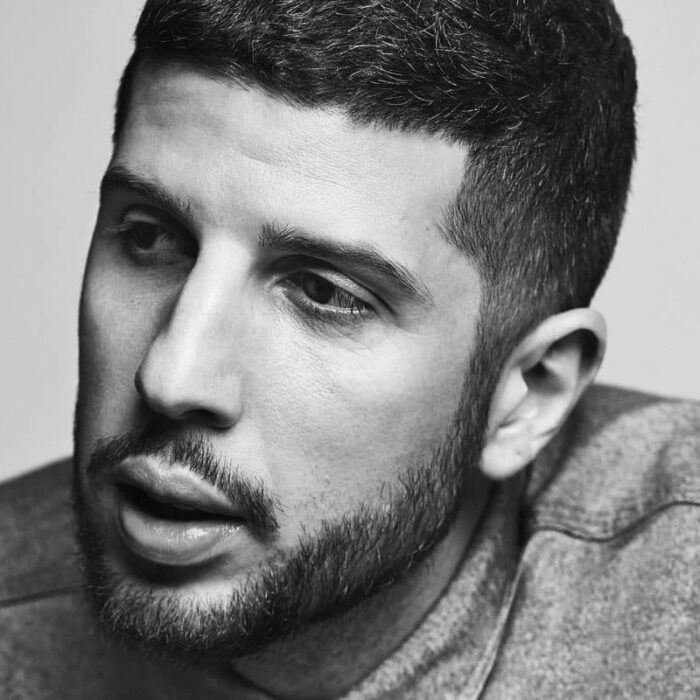
Anthony Anaxagorou
Anthony Anaxagorou is a British-born Cypriot poet, fiction writer, essayist, publisher and poetry educator.
WritersMosaic monthly
Get new writing in your inbox
One email monthly, unsubscribe anytime
Triage
A response to the endless spiral of worldwide conflict and tragedy
My tomorrow is today
'I clasped my hands together, not in prayer but to stop them from shaking'
Ballet Black at 25
Cassa Pancho: 'It’s a miracle that we are still here in some way'
Mahsa Salali’s Naqqāli
'Salali positions the female body... as an active agent'
At Sea
Bearing witness in the face of dismissal
Ai Weiwei: Button Up!
A journey through the dangerous world of human tragedy

Free Will
Will Harris reads his poem, 'Free Will'. Directed by Matthew Thompson and commissioned by the Adrian Brinkerhoff Poetry Foundation.

Half Written Love Letter
Selina Nwulu reads her poem, 'Half Written Love Letter'. Directed by Matthew Thompson and commissioned by the Adrian Brinkerhoff Poetry Foundation.

Illuminating, in-depth conversations between writers.
Listen to all episodes
SpotifyApple Podcasts
Amazon Music
YouTube
Other apps

The series that tells the true-life stories of migration to the UK.
Listen to all episodes
SpotifyApple Podcasts
Amazon Music
YouTube
Other apps
In the first series of poems commissioned by Hannah Lowe, six poets explore how ritual gives meaning to our lives.
Listen to all episodes
SpotifyApple Podcasts
YouTube