
Yvonne Brewster remembered

Yvonne Brewster remembered
By Pat Cumper
7.10.1938 – 12.10.2025
Yvonne Brewster was born in Jamaica at a time when the island was beginning to negotiate its independence from Britain. Her generation helped create the cultural identity of a new nation – whether in literature, theatre, dance, music or the visual arts.
Yet her middle-class upbringing – like mine in Jamaica a few decades later – was rooted in British traditions: the schools she attended were modelled on English grammar schools. Class divisions reflected, and were reinforced by, colonial racial stratification. Shakespeare, Milton and Austen were on the curriculum. Christmas cards depicted snowy scenes and pine trees. We knew the words to ‘Rule Britannia’ and ‘God Save The Queen’.
I say all that to say that Yvonne was a proud Jamaican – with all the complexity that identity created in 1950s Britain – when she came to study at the Rose Bruford Training College of Speech and Drama in Sidcup, in south London. She knew more about the culture she was coming into than anyone she would encounter would know about her background. When you straddle two cultures, it can give you an objectivity about both. Yvonne was nothing if not clear-eyed.
Despite the decades lived in London as a formidable presence in British theatre, she was always a part of the Jamaican theatre scene. Shortly after graduation, she returned to Jamaica and persuaded her family to let her and fellow Rose Bruford graduate Trevor Rhone convert the garage of a Kingston house into a small theatre – The Barn Theatre. A new production at The Barn was an event. Over the years, it showcased new work by Trevor Rhone, by then Jamaica’s leading playwright, and by the groundbreaking feminist theatre collective Sistren, among many, many others.
None of this was easy. When she decided to return to England to settle, she faced enormous challenges. She had been told at Rose Bruford that the only parts for which she would be cast were maids and servants, and not to expect any meaningful success in British theatre. Those who warned her in those early days failed to understand something important: fundamental to her character was an absolute determination to defy limitations. Among many other accomplishments, she – along with Mona Hammond, Carmen Munroe and Inigo Espejel – established Talawa Theatre Company and became its first artistic director. The Jamaican saying ‘Wi likkle but wi tallawah’ means ‘we are small but mighty’. The description might have been used for Yvonne herself.
When I was chosen to be the fourth artistic director of Talawa theatre company, Yvonne invited me to have tea with her. It was an invitation I did not dare refuse. We sat in her garden, drinking tea from her fine bone china, and a gentle but thorough interrogation began. Once she had satisfied herself that I might do the job reasonably well, she regaled me with Talawa’s origin story. Pardon me if I do not get all the details right as it was a while ago, but this is how I remember it.
Work as an actress was sparse, as a director, even more so, despite the success of a couple of plays she had directed at the then Tricycle Theatre. So Yvonne approached the Arts Council for funds to produce a play herself. It would be a grand one of Haitian resistance to slavery – an adaptation of CLR James’s book The Black Jacobins. Her application was successful, but her husband made it very clear that he was not happy having that much money go through their bank account, with all the commensurate responsibilities. ‘Start a theatre company,’ was his advice. So she did.
Then there were the stories she told me of her friendship with playwright Alfred Fagon: of the early-morning restlessness that drove him to run for miles across London to get to Yvonne’s, where he would expect – and receive – a cooked breakfast; of taming what she considered Alfred’s rough edges; her pride at his success; and her anger when his body was not found for days after his death, with no attempt made to find out who he was before he was buried anonymously and his flat cleared.
Yvonne knew how to be grand. There was a sweep of her scarf that she perfected – up and over the shoulder – which you knew would precede a particularly spicy observation. Always coiffed and manicured, she could go from cut glass to back-a-yard in a sentence. She didn’t suffer fools gladly and was unafraid of the institutions of British theatre. She was also shrewd, observant, mischievous, and probably a particularly challenging opponent to have. She was made of stern stuff: fearless and fierce, both opinionated and open-minded, a joyous and determined pioneer.
Perhaps the only battle she lost was the one to establish a physical theatre building, despite coming within a hair’s breadth of doing so. How wonderful it would be to see an Yvonne Brewster Theatre in central London – she always insisted that is where it had to be – led and programmed for the audiences we know are hungry for bold, groundbreaking work. Now that would be a fitting memorial.
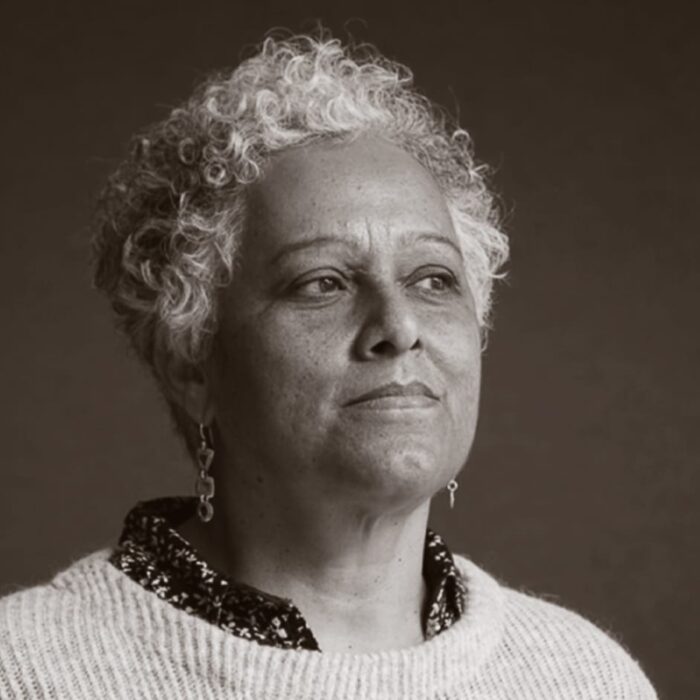
Patricia Cumper
A playwright and theatre director, Patricia Cumper has also adapted novels for radio and television.
WritersMosaic monthly
Get new writing in your inbox
One email monthly, unsubscribe anytime
The name of this wallpaper is ‘Childhood’
A luminescent bubble of memory
What’s in a feminist? Holding on to Gloria Steinem
Is Gloria Steinem's feminism still relevant today?
Coats
The unexpected cost of acquiring two Italian leather coats in Rome
A Trial
An examination of theatre’s complicity in post-truth politics

The Complex
The unraveling of a dynasty
Disappearing Images
A festival of ephemeral art and the impermanence of our current world

Free Will
Will Harris reads his poem, 'Free Will'. Directed by Matthew Thompson and commissioned by the Adrian Brinkerhoff Poetry Foundation.

Half Written Love Letter
Selina Nwulu reads her poem, 'Half Written Love Letter'. Directed by Matthew Thompson and commissioned by the Adrian Brinkerhoff Poetry Foundation.

Illuminating, in-depth conversations between writers.
Listen to all episodes
SpotifyApple Podcasts
Amazon Music
YouTube
Other apps

The series that tells the true-life stories of migration to the UK.
Listen to all episodes
SpotifyApple Podcasts
Amazon Music
YouTube
Other apps
WritersMosaic interrogates the notion of ‘staying in your lane’ by asking writers how they attempt to think beyond the parameters of their cultural identity.
Listen to all episodes
SpotifyApple Podcasts
YouTube
In the first series of poems commissioned by Hannah Lowe, six poets explore how ritual gives meaning to our lives.
Listen to all episodes
SpotifyApple Podcasts
YouTube