Between Worlds
A journey through houses of worship in Scotland


The Hindu Temple/Mandir
The Hindu Mandir (temple) in Leith in Edinburgh started in an old church with the community bringing photos, saris, artefacts and decorations to build the altar and give the interior a festive look.
The Hindu Temple in Leith
They each had their own special shrine
In a temple dedicated to a single deity,
Unless they were inseparable consorts
Like Radha and Krishna or Shiva and Parvati.
But that was in a vast land with ample space and time
For 330 million gods and goddesses
To have their place and shrine.
But here they have graciously entered
In a group to stand in a motley crowd
For new arrivals to worship,
In this unifying church which devotees have transformed
With gifts of saris draped around in a canopy
That protects the heavenly host
Who in turn look upon with benevolent tolerance
Men and women entering through separate
Doors and congregating to celebrate every Jayanti1
And Puja2, not as they did, ringing one bell
At a single open doorway, in the land
Where it all began, but recreated in new finery
With Brahma’s blessings and Vishnu’s protection,
While Shiva meditates in a dreaming trance –
For this is a world he wills and lets flow.
from Bashabi Fraser, Ragas & Reels (Edinburgh: Luath Press, 2012).
- A day dedicated to the worship of a particular deity.
- Ceremonial worship.
The Hindu Mandir in Leith
From Shiva’s3
knotted hair
Migrant streams emerged
Urging multiple journeys
From Bombay,4
Mombasa, Surat,
Cape Town, Calcutta,5 Karachi,
Dilli,6 Lahore and Kampala –
In divergent torrents.
They look back to
Lost homes and dreams with
Longing, regret and despair –
But now they converge
In a fresh surge
Of hope, bolstered by
The watchful eyes of deities
Looking down with promise
At the multitudes who will come
To pray, preserve and persevere
With benediction received
At a journey’s end.
- Shiva, the Destroyer of a sinful world, belongs to the Hindu Trinity alongside Brahma (the Creator) and Vishnu (the Preserver).
- Now known as Mumbai.
- Now known as Kolkata.
- Delhi, affectionately known as Dilli by many of its past and present inhabitants in Indian languages.

In the Hindu Temple, Edinburgh
With years of fundraising, the Hindu Mandir has transformed its interior with commissioned sculptured images of deities which now stand in splendour within its portals. The Mandir has a salaried priest, rather than a volunteer, who performs all the pujas (ceremonial worship), conducts Hindu festivals, and presides over weddings, rice-giving ceremonies for infants, upanayana (the sacred thread ceremony – a rite of passage for Brahmin boys) and funerals.
In the Hindu Temple in Edinburgh
The journey has been long
From cold stone starkness,
Draped with gold-edged saris,
Bedspreads with sun-splashed prints,
From framed pictures
And tinsel-wrapped pillars
To this magnificent
Platform of deities
Sculptured with pride,
Wrapped with splendour,
Standing in statuesque
Grandeur for a congregation
That gathers with alacrity
On each puja day.

Ratha Yatra (The Chariot’s Journey). The chariot of Jagannath, Lord of the Universe, stands ready to set off on its journey through Edinburgh from the Hindu Mandir. (Below) The deities of Jagannath and Subhadra are carried by devotees to the waiting chariot, where they will be placed for the journey through the city of Edinburgh.
Jagannath, with Subhadra and Balaram (also known as Balabhadra), his eldest sister and brother, leaves the sanctified inner recesses of the temple to meet and greet the public on his way to his Mashi’s (maternal auntie’s) house. The divine trio will be away for nine days. The return journey (Ulta Rath) will be made after this earthly respite. This non-Vedic god symbolises egalitarian values as he stands above divisions of caste, class and creed. The word ‘juggernaut’ is a reference to Jagannath, the Lord of the Universe, though in English the name of the deity has been transferred to the chariot and its journey.

The Lord of the Universe
I belong to you
And I will come unto you
And all who are
Denied entry to the
Inner sanctum, can
Join me on the highway
And walk with my
Chariot when I rumble
To my aunt’s abode
In Gundicha with
My siblings, Balaram
And Subhadra.
You can leave me
There for me to enjoy
My vacation with
Home comforts
Over nine delightful days
And come back to
Pick me up as
We proceed on the
Reverse track back
To my gated shrine.

Ganesh Visarjan (immersion)
Ganesh, the elephant-headed god, is the son of Shiva and Parvati. He is the god of prosperity and will bless every new venture/enterprise. After Ganesh Puja (ceremonial worship), Edinburgh devotees prepare to immerse Ganesh in the sea at Portobello on his birthday, Ganesh Chaturthi, so that he can make his way back through the waters to Mount Kailash and join his parents and siblings.
On Ganesh Chaturthi
The birth of the
Remover of obstacles,
The creative spirit,
The guardian of wisdom,
The sanctifier of good fortune
Is auspicious.
But after the ceremony
And feast he loves
He has to be
On his way, speeding
Against the current
Towards the reunion
With Shiva and Parvati
Who await his sparkling
Eyes, his mischievous smile,
His good-humoured
Presence and magnanimity

The Malankara Church
A Malayali mass is held one Sunday a month at the Malankara Church on Ferry Road in Edinburgh, when both Syrian Orthodox Christians and Catholics from Kerala gather to accept the Eucharist. This arrangement has been granted with a special dispensation from the Pope. The priest comes up from England to conduct mass.
The Malankara Church
St Thomas the Syrian has been claimed
As the disciple who in the first century came
To lead the Malabar Nasrani in Jesus’ name
Till the Portuguese arrived at the southern coast
Bringing with them the Catholic host
In a tug-of-faiths which was settled at a cost.
Today the Syrian Orthodox choose to congregate
With the Catholics from their native state
As Malayalam is the bonding thread that unites
A group gathered to sing, pray and feast
On the last Sunday every month, with their priest
From London, offering the Eucharist.
The seventeenth century tensions have long been dissolved
And the Pope’s new dispensation has resolved
All tensions in this resplendent deputy of God.
from Bashabi Fraser, Ragas & Reels (Edinburgh: Luath Press, 2012).

This is their Calvary. Keralan Christians pray on Good Friday as they enact the Stations of the Cross on Calton Hill in Edinburgh.
On Calton Hill
They have left their coconut palms,
Their whispering backwaters behind
And walked up Calton Hill
To remember the tortuous journey
Their Saviour made
Falling three times under the
Weight of a brutal burden.
Today they trudge up
A windswept hill
That ruminates on
A splendid city sprawl.
They kneel to thank
Their Saviour as they
Recall His heartbroken Mother,
Simon of Cyrene’s courage,
Veronica’s compassion
And the weeping women
Of a powerless Jerusalem.
Their priest prays
In Malayali, a tongue
Doubting Thomas knew,
Which they repeat
On their newfound Calvary.
The Gurdwara in Leith (overleaf)
An old church in Leith has been converted into a Gurdwara. Its steeple bears the khanda, the Sikh symbol of a double-edged sword, surrounded by a chakra (circle) and flanked by two kirpans (single-edged swords), signifying the amalgamation of temporal and spiritual power.

The Gurdwara in Leith
Where the city stops at an ocean’s brink
Once ships set sail or docked to rest
They paused to ponder on the kingdom
Looming through the morning mists.
Bhai, Landa, Kasbia, Potwal
Ronde, Rathour, Sheber, Digpal,
Names repeated like a mantra
From the cradle of their yatra,7
Unified in prayer, they had sought
Tenement flats to pray and meet
Till St Thomas opened doors to greet
A community from a divided state.
The khalsa symbol of balance, power and continuity
Now meditates on the pinnacle of a dockside city.
from Bashabi Fraser, Ragas & Reels (Edinburgh: Luath Press, 2012).
7. Journey

Sweeping the Streets on Vaisakhi.
Spring cleaning before ushering in another year in Glasgow – sweeping the streets before the Sikh spring festival of Baisakhi according to the Sikh calendar.
They come from the land of the five rivers
The road must be spotless
For the Panj Pyare
The beloved five
Who represent the five
Sacred symbols
Of dignity and valour.8
The new beginning is hailed
After a bountiful harvest
As spring is ushered in.
The streets of Glasgow
Will soon resound
With Nagar Kirtans9
Sung as the Holy Book
Is carried with the reverence
The Word deserves.
- The five ks – the symbols of Sikhism – are the kara (bangle), kangha (comb), kirpan (sword), kesh (hair) and kuccha (short trousers).
- Hymns

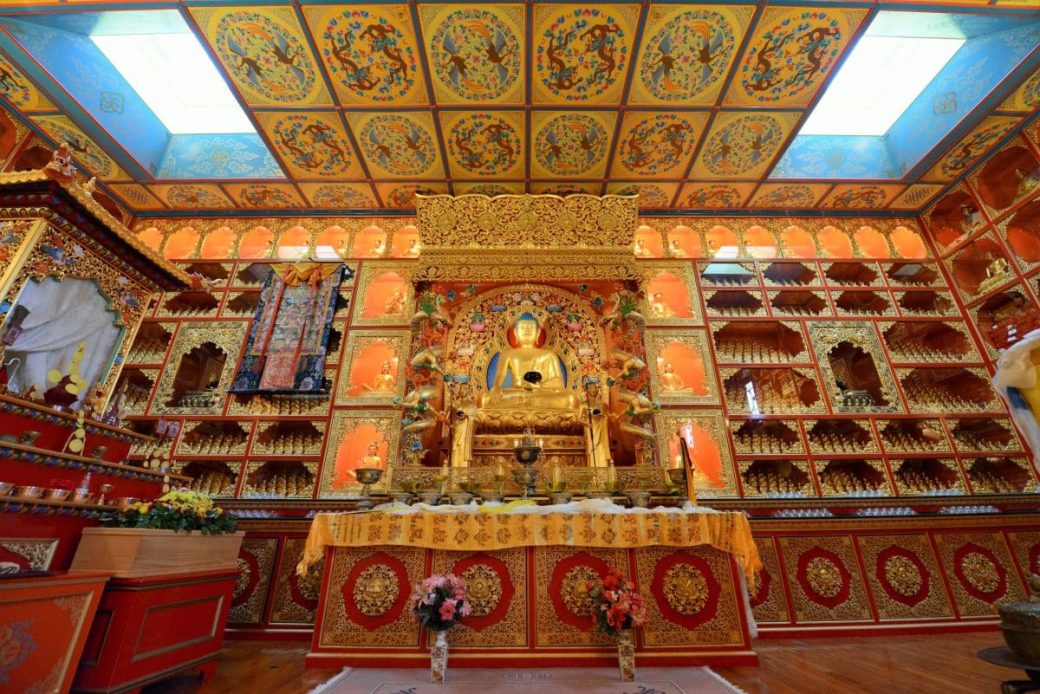
Kagyu Samye Ling, the Buddhist monastery in Eskdalemuir in the Borders in Dumfries and Galloway.
Samye Ling (Samye: named after the first Buddhist Monastery University in Tibet + Ling: place) started as a Monastery and Buddhist Centre in Johnstone House, a hunting lodge. The renowned Tibetan artist, Sherapalden Beru was responsible for the beautiful architecture of the monastery. He has worked with a group of local craftsmen to design and maintain the thangkas (appliques depicting Buddhist scenes and symbols) in the Karma Gadri style and the prayer-wheels in the temple.
Samye Ling
The forbidden land
Is not forgotten
In the dale where
The Esk flows, where
A sculpted monastery
Offers the peace
Of the plateau land
Magically willed by
The divine craft
Of Sherapalden.
Meditative thangkas,
Whispering prayer-wheels.
A thousand lamps
Beckon the devotee
And embrace the visitor
In the golden glow
Of the Enlightened and
Compassionate One.

With the Buddha in Samye Ling.
Inside the temple – the Buddha sits in meditation with lamps surrounding the shrine, the embodiment of light flowing from the Enlightened One.
Inside Samye Ling
Deep inside the burnished hall
Amidst the ornate wooden honeycomb
Of quiet treasures, sits the Compassionate One
Contemplating in the silence as the gongs
Wait like watchful sentinels, walling in
The monks at prayer, their scriptures
Idle, letting the muted meditating air
Stand still in this sanctuary that rests
Comfortably on the undulations of the Borders,
Having arrived without flourish
On an invisible magic carpet
Straight from the land of Zhongs
In the eastern Himalayas, to its
Chosen place of tranquil refuge.

At the Central Mosque in Edinburgh On Eid ul Zoha (also known as Eid ul Adha), a student from Kerala, India comes to celebrate in national attire.

At home – Edinburgh University students from Kerala line up next to the Central Mosque in Edinburgh on Eid ul Zoha (also known as Eid ul Adha).
Eid ul Zoha
Ibrahim’s faith and trust
In Allah granted him
The renewal of life
In his beloved son Ismail.
The sacrificial offering
Switched by the Almighty
Calls for a celebration
As believers come together
From across diverse oceans
Joined by university students
Proud in national attire
Reliving Eid in Kerala
On a rare sunny afternoon
In bonny Dunedin.

Friday Prayer in Glasgow’s Central Mosque
Friday Prayers at Glasgow’s Central Mosque
The
Muezzin’s
Call has been a bugle
Alert for the two thousand
Who now gather on the south bank
Of the Clyde and bend in disciplined unison
For the Zuhr Salah,10 facing the magnetic power of
Mecca, confident of the sun’s certainty while
The interior lights shine, the fans frozen
For now, ready to whir into action
As the congregation prays, led by
The Imam in devout solidarity.
from Bashabi Fraser, Ragas & Reels (Edinburgh: Luath Press, 2012).
- Early afternoon prayer.
Friday Prayer
The restaurants are deserted
The shops are sparsely staffed
As the men have left
Their counters and desktops
To gather in communal prayer
In a close-knit bond
For the Salah-al-Zuhr
On the day of the All Merciful
When a brotherhood bows
In unison for blessing and peace.

Durga Puja in Glasgow. Dilip Chatterjee, a maths teacher in a secondary school, presides as the community priest.
Durga Puja
She comes armed
With auspicious
Conch shell tidings,
The wheel of preservation,
The water of sustenance,
Mounted on the forest king,
Nominated by the gods.
She comes to vanquish
The devourers
Of light and life.
This is her moment
As Bijoya11 – flanked
By her children
Visiting her planetary
Home for five precious
Days – away from
The duties of wife
And divine consort.
- The victorious one.

The priest performs aarti (offering of light) during a puja in Glasgow Hindu Mandir

Aarti in Glasgow Hindu Temple.
Offerings and Thanksgiving
Multitudes came, riding
The waves and steeds
To the land of milk and honey
Blessed by tropical plenitude,
To sample the fruits
Of the earth and replenish
Hearth and home.
The priest has made the
The reverse journey,
Lighting a lamp to
Offer a thanksgiving
To the hands
Who have blessed
The continuity between continents.

Diwali procession on the Mound in Edinburgh on its way to Calton Hill.
From Saughton Prison to Calton Hill on Diwali
Nimble fingers
of expressive hands
like Santa’s elves
In an invisible land
Have shaped Shiva,
Hanuman, and Ganesh
For the floats
As their visible
Plenipotentiaries
For the Diwali
Procession, flagged off
By Highland pipes
Playing sprightly reels
To rhythmic heels
Clicking down the Mound
Through Princes Street
To Calton Hill, where
Fireworks will explode
And a flame will erode
The effigies of demon forces
To let light return
With a hope-filled dawn.
© Bashabi Fraser and Hermann Rodrigues
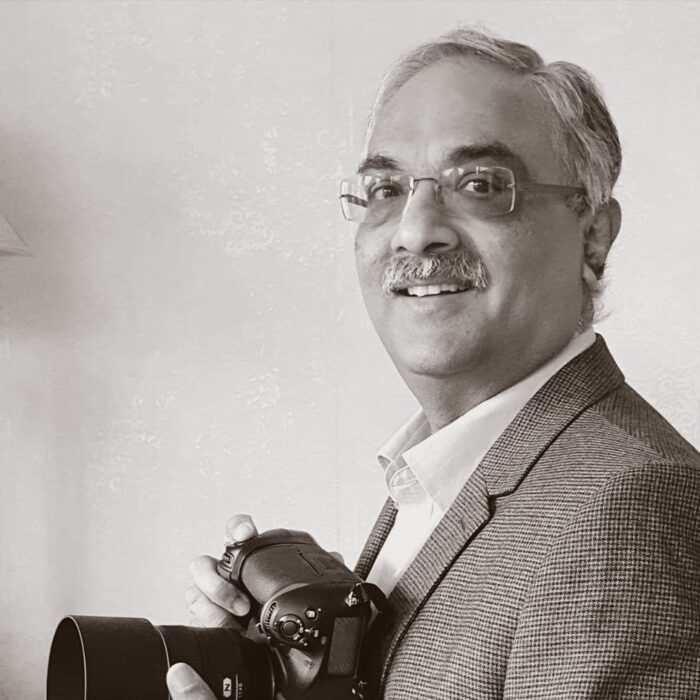
Hermann Rodrigues
Hermann Rodrigues is a photographer with a deep passion for the camera and the Asian community in Scotland.
Between Worlds

Between worlds
Bashabi Fraser

Opposites Attract
Debjani Chatterjee

Betweenness: belonging and becoming
Nalini Paul

The Outlier: Michael Madhusudan Dutt
Namita Gokhale

To pin the wings of the butterfly
Suhayl Saadi

The torn worlds basted through my poems
Yogesh Patel

Price of emigration
Tariq Latif
WritersMosaic monthly
Get new episodes by email
One email monthly, unsubscribe anytime

Illuminating, in-depth conversations between writers.
Listen to all episodes
SpotifyApple Podcasts
Amazon Music
YouTube
Other apps

The series that tells the true-life stories of migration to the UK.
Listen to all episodes
SpotifyApple Podcasts
Amazon Music
YouTube
Other apps
WritersMosaic interrogates the notion of ‘staying in your lane’ by asking writers how they attempt to think beyond the parameters of their cultural identity.
Listen to all episodes
SpotifyApple Podcasts
YouTube


It’s being published I get paid for; the writing I would do for free
‘Any advance [...] for your novel is to compensate you for the horrors of being published'
Complex antihero: an interview with Arthur Hughes
Unravelling Authur Hughes' Richard III
Marlon James: a Jamaican reckoning
'A return to a home I barely knew'


Haunting the Black Air
Poetic freedom across space and time
The Disappearers
A sprawling visceral experience that drops you in head first