Between Worlds
Between worlds
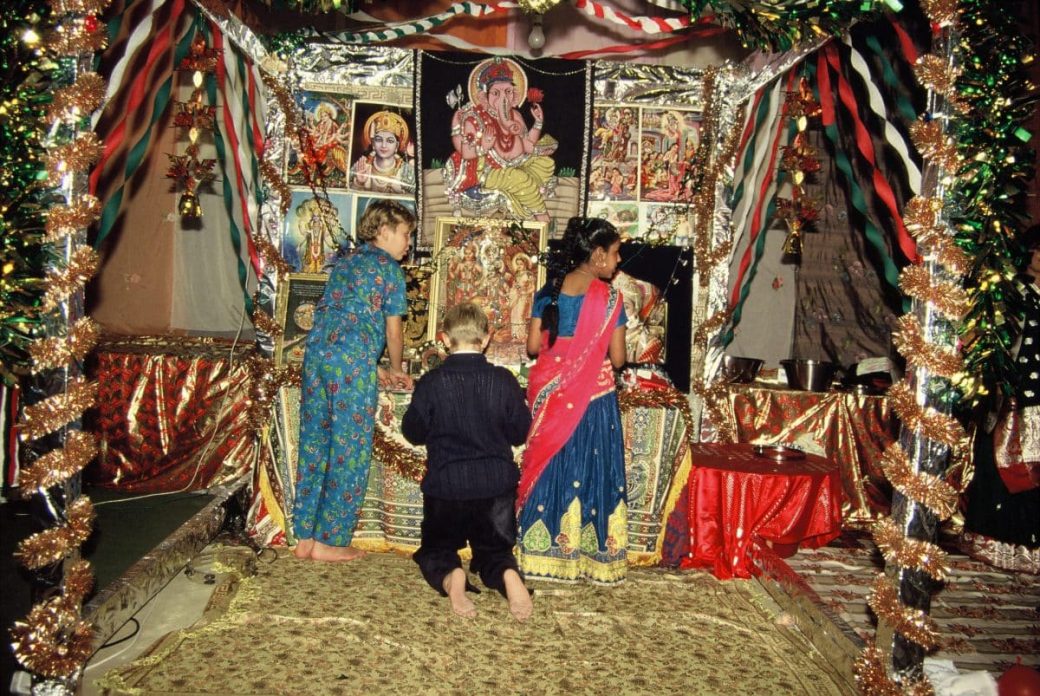

In my poem, ‘The Affirmation’, I recount an experience at a church service attended with friends in an adjoining neighbourhood, where I was confronted by a question I have been asked several times in Scotland:
… one kindly lady at the end of our pew
In warm Scottish fashion, turned round to show
Her welcome. As she shook hands, she ventured
‘And where are you from?’ I answered
‘We live here’
But my answer did not satisfy my questioner, who posed the second inevitable question, ‘Where are you actually from?’ she repeated urgently. I had no problem replying,
I heard the pride
In my voice as I said ‘from India’
Which reassured her…
My daughter’s reaction was quite different:
but sparks appeared
In my daughter’s eyes – dark and protesting
Drowning my explanation, as they explicitly affirmed
That she was from here and not just there.
(Tartan & Turban, 2004)
I am quite comfortable with my migrant status, as I combine the threads of my land of origin with that of my adopted nation, journeying back and forth for my creative and academic work and to see family and friends, knowing that my departures and arrivals are not imbued with a sense of an irretrievable homeland. But must my daughter and her generation who are the children/grandchildren of migrant parents/grandparents be forever positioned in Britain as the ‘Other’ (Said, 1978) because they look different from the mainstream population?
So when Gabriel Gbadamosi met me over a most enjoyable, unhurried lunch in Edinburgh with the proposal to guest edit a special issue for the Royal Literary Fund’s WritersMosaic, we discussed what would be an ideal theme to bring writers of colour together on a common platform. I realised that I have always felt that I am living between two worlds, carrying the ‘elsewhere’ with me to the ‘somewhere’ I have arrived at, looking back sometimes with longing, but never with regret, as I have the advantage of having my homeland open to my many returns and my hostland as a place not wholly unfamiliar: London was once my childhood home and Edinburgh my student city, where I am now a marital migrant. But migrant groups who have been forced by conflict, political upheavals or natural calamities, acute economic hardship and violence to flee their countries are confronted by the reality of no return. So, when do they and the writers amongst them and their succeeding generations cease being labelled as immigrants in their adopted country?
Today, the term immigrant has been loaded with a criminality which has robbed it of the sense of adventure and obscured the quest for a better life that has marked mankind’s migrant compulsion through the centuries. New arrivals now encounter hostility in airports, fear detention centres in lonely spots away from the public eye, face vigilant coastguards scouring the Mediterranean for flimsy boats, with desperate souls fleeing unspeakable terrors, and dreamers take unimaginable risks travelling in unbreathable container lorries as they seek a safe haven, a new beginning at their journey’s end. Such experiences have obliterated the human story behind these flights and given them a criminal badge. Globalisation has taken on a new intensity. As Amitav Ghosh says,
I think the world has been globalising for a long time. It is not a new phenomenon, but one that has achieved a new kind of intensity in recent years. The only real barrier to a complete uniformity around the world is not the image but language… For any kind of deeper, resonant communication, language is essential. (quoted by Debashree Dattaray, in Choudhury, 2009, p. 143).
And it is through language that the displaced, the dislocated, the current flotsam and jetsam of moving, struggling individuals can convey and communicate their in-betweenness in a society where they will be identified as the eternal migrant, never quite belonging, but simultaneously becoming one with a nation where they must compulsively carve out a rightful space for themselves. These ‘in-between’ spaces ‘provide the terrain for elaborating strategies of selfhood – singular or communal – that initiate new signs of identity, and innovative sites of collaboration, and contestation, in the act of defining the idea of society itself’. (Homi K. Bhabha, 1994, p. 2).
These two issues, of becoming and belonging in this in-between space, are explored by Nalini Paul in her memoir, where she prefers ‘subjectivity’ to ‘identity’ as a term through which to transcend the boundaries imposed by a binarism (Said, 1978) that perpetuates the difference between the Self and Other, the us and them.
The discomfort of the individual who claims the cosmos as her/his world to embrace, understand and communicate with, and who resists being slotted into spaces of unfreedom, goes back to the colonial encounter as for example between the Bengali poet, Michael Madhusudan Dutt and the cultural influence of the West. Dutt’s in-betweenness is probed and unpacked by Namita Gokhale in her study of this ‘native intellectual’ in Frantz Fanon’s term (used in The Wretched of the Earth, 1961), as he goes through the three stages of appropriation of the colonisers’ culture: abrogation, or tearing up the rules when his own ability to write in western genres in the language of the dominant power was questioned and dismissed; immersion in his own literatures, languages and culture; and Dutt’s fighting back stage when he incorporated the West and East in his writing, remaining true to his cosmopolitan prerogative.
The American marine biologist, Rachel Carson says in her book The Sea Around Us that
wherever two currents meet, especially if they differ sharply in temperature or salinity, there are zones of great turbulence and unrest, with water sulking or rising up from the depths and with shifting eddies and foam lines at the surface. At such places the richness and abundance of marine life reveals itself most strikingly.’ (Carson, 1951)
Carson’s natural marine phenomenon remains a relevant transferable metaphor for the migrant-meeting-mainstream reality as it embodies divergent currents meeting, clashing and interacting in that contact zone of connectivity where people can have the choice of being drowned by seething, surging waves, by cataclysmic shifts causing insurmountable chasms stemming from misunderstanding, or where they can accept the ‘richness and abundance’ that can be the result of positive interaction and constructive interchange. What is engendered is a transformation that the cultural critic Homi K. Bhabha (1994) considers the inevitable outcome of the hybridity enacted in the ‘Third Space’, the contact zone of intersectional cultural crossroads. It is a transformation that the writers experience and express in this issue as they document their creative processes as writers living and writing between worlds. Their experience is of multiple worlds.
Nalini Paul’s parents migrated from India to Canada, from where Nalini made her way to Scotland, her ‘Third and Final Continent’ (the title of a story by Jhumpa Lahiri in Interpreter of Maladies, 1999). The two different worlds of Nalini’s parents, the multicultural richness of migrant families from across the globe, native Canadian myths, Indian folklore and Scottish city, island and Highland narratives are strung together in a tapestry that echoes M. M. Dutt’s earlier cosmopolitanism.
In Debjani Chatterjee’s discussion of how opposites attract, we find her diplomat father’s many sojourns giving her the privilege of being able to ‘lightly tread’ in many worlds and many tongues, while negotiating her Indian heritage and her encounter with her Irish husband’s taste in music and cuisine. She thus adopts E. M. Forster’s cross-cultural dictum, ‘Only connect’, as her guiding principle in her acceptance of diversity, while maintaining her identity as a British-Indian writer.
‘British life’ has not been easy for second-generation British South Asians, as the poet Tariq Latif affirms: ‘in our jobs discrimination is a given’ and ‘institutions practise preferential promotion’. It is in the pain that his protagonist Ramjit experiences in a dissatisfying life in a hostland where ‘the ugly meaning’ of ‘prejudice/ and racial discrimination’ come across as the ‘price of emigration’, while love and dignity seem realisable only in the land of origin, where he leaves behind his dying father and beckoning relatives.
The call of the adopted country is inescapable for the migrant writer, Yogesh Patel, in what is a ‘dual belonging’ – a questioned ‘belonging’ raised by every writer in this issue – the urge to integrate marred by the relentless hurdles to success. The evocation of ‘home’ is interrupted by his interim years in Africa from which Yogesh has travelled to London. Yet the ancestral land, India, where he did not grow up, remains his stamp of identity in the eyes of society in both Africa and Britain, this last being his ‘Third and Final Continent’. The knowledge of not being wanted, of being faced with the feeling of ‘banishment’ from the continent of origin (not Africa, but the sub-continent) confronts him with the ‘punishment’ of exile. Yogesh uses two powerful metaphors of the unwelcome – the whale and driftwood, both of which are propelled by the ocean currents that Carson evokes.
Yet it is on the banks of the Thames that Yogesh has ‘found’ his home, and voice, in a homecoming of sorts. We have witnessed the passion and power of the Black Lives Matter movement in America and in Britain, as black, white and Asian have mingled and marched together to demand the righting of centuries of wrongs, of silences and denials. Black and white players now ‘take the knee’ and salute the memory of George Floyd, asphyxiated by the brutal knee of a policeman in Minnesota – a statement that confirms there will be zero tolerance for racist taunts and attacks in a game that has been marred by such incidents. Will this be a turning point in our history, when young white campaigners join their compatriots of colour to demand change for a more just society in a show of the collective conscience of a nation?
Suhayl Saadi notes the idea of a continuum effecting shifting change in multiple worlds as he challenges ‘nativist clerical fascism’ in a clever analogy drawn from quantum mechanics, an effect of quantum entanglement that sees the links between unlikely ambassadors – the Greek monks taking Buddhism to the Far East and Sri Lanka, and the Arab naming of our brightest stars and Western classical musical instruments. What Suhayl confirms is not the disjointed, fragmented world of dissimilarity dependent on misunderstanding and perpetuated by misinformation, but the solace that is derived from the knowledge of ‘overlapping fields of possibility’ akin to Homi Bhabha’s transformatory experience of hybridity in the Third Space, the contact zone, and to the richness and abundance that the meeting of different currents can generate in Rachel Carson’s account of ocean currents.
The Indian writer, Amitav Ghosh recalls ‘the elemental force that untethered’ his ‘ancestors from their homeland and launched them on the series of journeys that preceded, and made possible, my own travels.’ He says, ‘When I look into my past the river seems to meet my eyes, staring back, as if to ask, Do you recognize me, wherever you are.’ He goes on to affirm, ‘Recognition is famously a passage from ignorance to knowledge.’ (2016, p. 4.) The migrant writers writing in this issue have had a series of journeys (geographical, emotional and intellectual) before their arrival here in the UK, moving from the banks of the Padma, the Hooghly or the Ravi, to the banks of rivers they now accept as their final shore – the Thames, Clyde, Don or the Forth (in my case) – but the rivers left behind will always retain a tenacious hold on the writer’s memory and let the knowledge of that left-behind world cast the current reality of life, on another shore, in another light.
Gabriel suggested I include a photographic essay on the various religious buildings which help narrate the journeys people from the sub-continent have made to gather, worship and recreate a space for diasporic congregations. I have worked with the acclaimed photographer, Hermann Rodrigues and used his captivating photos of places of worship and of religious festivals in Scotland to tell the story alongside my captions and verse. What all these writers share is a sense of homecoming, and as searching writers, like me, they can ask the same questions of their hostland as I do:
But will you let me blend in Edinburgh
With the flowing pen power that you hold in your folds?
Can the Stanzas of your many steps
Divide to let my lines interstice your spaces –
Edinburgh?
(The Homing Bird, 2017, p. 13)
Ken Saro-Wiwa, the Nigerian writer, human rights activist and defender of his Ogoni people, who was executed in 1995 by the ruling ruthless regime, wrote of the power of the pen and the fear it could evoke in his ‘tormentors’, those who ruled without conscience: ‘The men who ordained and supervised this show of shame, this tragic charade, are frightened by the word, the power of ideas, the power of the pen….They are so scared of the word that they do not read. And that will be their funeral.’ (Ken Saro-Wiwa, Prison Letter, quoted by Rob Nixon, 2013, p. 104). The writers who occupy an interstitial space, amongst the British literati today, may continue to be omitted from mainstream anthologies and the canon of British Literature, nevertheless they do have the power of the pen to tell their own stories in their own distinctive voices. And, rather than evoking the fear Saro-Wiwa talks of amongst their ‘tormentors’, I believe their work will have the compelling power to persuade and convince their readers of the universality of experience of departures and arrivals, of uprooting and rebuilding, of standing out and fitting in that marks the global narrative of plural communities that challenge and subvert any notion of monolithic culture.
References
Homi K. Bhabha, The Location of Culture (London and New York: Routledge, 1994).
Rachel Carson, The Sea Around Us ([1951] Oxford University Press, 2018).
Debashree Dattaray, ‘Rethinking “Diaspora”: A Postcolonial Reading of The Hungry Tide and A Fine Balance’ in Bibash Choudhury, Ed., Amitav Ghosh, Critical Essays (New Delhi: PHI Learning Private Limited, 2009).
Frantz Fanon, The Wretched of the Earth (London: Penguin Books, 1965).
Bashabi Fraser, Tartan & Turban (Edinburgh: Luath Press, 2004).
— The Homing Bird (Edinburgh: Luath Press, 2017).
Amitav Ghosh, The Great Derangement: Climate Change and the Unthinkable, Chicago: University of Chicago Press, 2016).
Jhumpa Lahiri, Interpreter of Maladies (Boston: Houghton Mifflin, 1999).
Rob Nixon, Slow Violence and the Environmentalism of the Poor (Cambridge, Massachusetts: Harvard University Press, 2013).
Edward Said, Orientalism (Harmondsworth: Penguin Books, 1978).
© Bashabi Fraser
Between Worlds

Opposites Attract
Debjani Chatterjee

Betweenness: belonging and becoming
Nalini Paul

The Outlier: Michael Madhusudan Dutt
Namita Gokhale

To pin the wings of the butterfly
Suhayl Saadi

The torn worlds basted through my poems
Yogesh Patel

Price of emigration
Tariq Latif

A journey through houses of worship in Scotland
Bashabi Fraser & Hermann Rodrigues
WritersMosaic monthly
Get new episodes by email
One email monthly, unsubscribe anytime

Illuminating, in-depth conversations between writers.
Listen to all episodes
SpotifyApple Podcasts
Amazon Music
YouTube
Other apps

The series that tells the true-life stories of migration to the UK.
Listen to all episodes
SpotifyApple Podcasts
Amazon Music
YouTube
Other apps
WritersMosaic interrogates the notion of ‘staying in your lane’ by asking writers how they attempt to think beyond the parameters of their cultural identity.
Listen to all episodes
SpotifyApple Podcasts
YouTube




It’s being published I get paid for; the writing I would do for free
‘Any advance [...] for your novel is to compensate you for the horrors of being published'
Complex antihero: an interview with Arthur Hughes
Unravelling Authur Hughes' Richard III
Marlon James: a Jamaican reckoning
'A return to a home I barely knew'



Haunting the Black Air
Poetic freedom across space and time
The Disappearers
A sprawling visceral experience that drops you in head first