Between Worlds
Betweenness: belonging and becoming

Whether we choose to identify with one or another culture, we often inhabit an in-between state. Having grown up in Canada as the middle child and only daughter of Indian parents who decided to leave their beloved country for Vancouver, I have, since the age of two and a half, lived between worlds. My parents felt this more profoundly, as they grew up somewhere else. Being exposed to different languages, customs and cuisines seemed normal rather than strange to me, as children living on my street were mostly in the same situation. The various ‘mother countries’ included China, Italy, Yugoslavia (as it was then), Portugal and Germany. There were no others from India living in our neighbourhood, but I knew a small handful at primary school. My mother, who worked full-time as a nurse, would feed us on a varied diet of Indian and ‘Canadian’ cuisine, from chicken curry with rice and cauliflower sabzi, to hamburgers, spaghetti with meatballs and ‘Shake ‘n Bake’ chicken, to Chinese noodles with stir-fried vegetables. I sampled various delicacies, the names of which I never learned, at friends’ houses: Portuguese sugar-coated biscuits, German almond cookies, and various flavours of ‘pop’ – my mother barred us from the elixirs of Coca-Cola, Sprite and 7-Up, unless for special occasions. I also remember being offered chocolate coins for the first time by my Austrian friend’s mother. Her father, whose finger was cut short to the first knuckle, told me when I asked what had happened, that he went wandering into the snowy mountains for days and became very hungry… I knew he was making this up, but so entertaining was the telling of his story, I almost believed him.
Between memory and imagination
Between childhood and adulthood
Between truth and falsehood
Between race and belonging
Each of us chooses a story, a version of reality which becomes the truth. We are all in a process of becoming, through our process of being. We are not fixed in space and time as one identifiable ‘thing’. Our ‘thingness’ is malleable and open to change, as are the objects with which we interact. They, like us, are in a process of change constantly. It is this change in constancy that characterises everything we know. As an Indian child and a Canadian child, I was looking at everything from at least two perspectives. I belonged and yet I did not. But, in childhood innocence, this knowledge is never clear. It simply becomes part of oneself, as an inherent split that shifts with every new situation. One day I might go to Sunday school with white friends and the next I would visit Indian relatives, listening to my paternal grandmother speak with her British-Indian accent about the chowkidar(night watchman) at my grandfather’s house, and how he would fall asleep during his watch, ‘standing up, lazy fellow!’
India – that vast subcontinent in which I feel privileged to have been born – is full of contradictions around empire and its place within it. As the country with the second-highest number of languages (22 officially recognised languages and up to 1599, depending on how one defines ‘language’, as dialect or otherwise), it is perhaps impossible to say what it is to be ‘Indian’.1 With English as one of its two official languages, the other being Hindi, the legacy of empire is ever-present in government and educational institutions, and English is the language of choice for the middle and especially the upper classes. Having grown up in Canada, class was both absent and present, because we were led (falsely) to believe that we were all the same and had the same life chances, regardless of our origins (a difficult term, which often singles out people of colour, those who neither appear to be, nor are able to pass as, white). My paternal relatives speak with a sophisticated-sounding accent, a British-Indian voice that to this day I find comforting because it reminds me of aunts and uncles, some of whom have passed away, and the world in which they grew up, which has changed forever (a difficult word, but an accurate one, denoting irretrievable loss). Boarding schools (the best in the country in the 1940s and 50s) were part of that world, the aforementioned chowkidar, the cook who did his training in the US, and my grandfather, a member of the Masons, a doctor and surgeon in whose maternity unit I was born in Ambala on a cold November morning (‘at seven minutes past seven’, my mother tells me). Relatives from my father’s side dined with the Kennedys, met the Beatles, went to parties with diplomats (My grandmother worked as a secretary for the American Embassy in Delhi; her sister’s husband worked as the military attaché for India in Washington, DC).
Between mother and father
Between village and city
Between Hindi and English
Between spoken and written
I was largely deprived of my mother’s story when growing up. My parents met at university, but my mother was raised in a village in Uttar Pradesh. Despite her university education (many use the word ‘educated’ to denote class, rather than a university degree), her village upbringing gave her a lower social status, certainly in the eyes of my paternal grandmother. Since my move to Scotland more than 20 years ago, phone conversations with my mother in Canada have opened new worlds to me through her stories, like long-forgotten books gathering dust on the shelf being spoken out loud and saved from obscurity. Their pages glow. I always knew that she had gone to university to study nursing, but I did not know that her intention was to study medicine, to become a doctor. I knew that she went to boarding school and lived on campus for both college and university, but I did not know about her adventures, including a close brush with a poisonous snake in the shower cubicles; a hostile reception in a village where she (still a teenager) began a presentation on birth control (people starting throwing things at her and she had to take shelter); and when my maternal grandfather used to make his own ‘blood pudding’. As prosperous farmers, they hired staff to help with the harvest. As Christians, they lived in harmony with Muslims and Hindus. Cows and pigs were kept well away from the village, so as not to offend those from either religion. My mother spoke Hindi fluently, whereas some of my paternal relatives struggle with this difficult language. My mother summons up memories of India at the slightest reminder, more so these days; and I try to write it all down.
My aunts from the paternal Paul side travelled the world, were artists, teachers, socialites. Their confidence always shakes me a bit, but with each visit or phone conversation, I try to absorb a fraction of it, to allow it to permeate into my being, so that when I give lectures on postcolonial theory and racial otherness, I draw upon their strength, somehow. I try to let the memories, conscious and subconscious, sustain me (I was too young to remember India when we emigrated).
Between religion and philosophy
Between past and present
Between real and unreal
Between tangible and imagined
When I wrote my PhD on the Caribbean writer Jean Rhys’s novels in 2008, I deliberately chose a white writer who had issues with her racial identity (she wished to be black). I refused to be pigeonholed as an ‘ethnic minority’ who writes about her ‘identity’. Identity is a misleading term because it suggests a fixed position, as if X could point at Y and say, ‘You are Y’ without regard for the complexities which have informed who and what Y is or is not. Identity starts as a fix in the mind with the potential for determining peace or destruction, for promoting harmony or prejudice leading to racism and viewing others as alien, which in turn can lead to violence. I prefer the word ‘subjectivity’, suggesting an alterable subject position. We are only ever a Y in relation to an X; and X is only X in so far as they see themselves as superior (for instance) to Y. X will always be someone else’s Y. The writer and critic Homi Bhabha’s theory of hybridity makes clear that we do indeed incorporate elements of each other, that there is never an absolute, fixed subject position, but that otherness and the positing of a coloniser and colonised are both caught up in a perpetual interplay of mirroring and mimicry. Colonial power is undermined when the colonised mimics the coloniser.
Between light and darkness
Between language and thought
Between bird and human
Between grounding and flight
Growing up in Vancouver, I had very little knowledge of the indigenous cultures of the First Nations of Canada. What we learned in primary school comprised only tokenistic representations and always in the context of interactions with colonial settlers, whose versions of ‘history’ dominated our learning. Cultures were simply deemed ‘native’, paying little heed to their myriad of complex customs and languages. Masks and other ceremonial artefacts stared gloomily from behind glass inside museums. We might receive a visit from a ‘native’, who would demonstrate a dance for us in school. Derogatory representations seeped their way into our children’s books, television programmes, cartoons and toys. But, as time moves forward, truths glare like beacons, blow like gales, much louder and stronger than the meagre titbits of false knowledge we were given as children.
The raven is the ‘trickster’ in indigenous Canadian folklores. I use the word folklore not lightly, for these cultures in British Columbia (BC), my home province, include the Haida, Salish, Masqueam and Kwakwaka’wakw, among many others, and are millennia old. BC has more than 30 indigenous languages, and nearly 60 different dialects. The trickster is responsible for the creation of humans, and often outwits them by changing physical form, sometimes only so that he can have a good meal or sleep with a fisherman’s wife. The other animal characters, too, say much that is vital about human nature, family rivalries, class and power. I love the idea of transformation, and how, in writing, landscape and memory can be used as tools to forge a new path. Like my mother’s voice, these stories have been floating around my mind and onto the page for the last several years, making their way into writing so that I might transport myself in return – in mind, if not in body.
When we focus on the ‘real’, we think of the physical, and often the 7 organic. We think about the feeling of being in a place, the qualia or ‘what it is like to be’. When I walk in open spaces, my feet connect repeatedly with the ground, with each step forward. And yet I feel a sense of flight as my feet spring off the path and propel me forward into space. The elements surround me – wind, sea, sky – and I become part of the landscape, a transformation unfolding. I spent a year in Orkney working as the George Mackay Brown Writing Fellow and had that dramatic coastal landscape at my doorstep. The year was life-changing. It allowed me to see and work in ways I had never imagined, bringing poetry and dance to the stage with the Johnsmas Foy; allowing artwork and archaeology to help me weave words into being; and following the migrations of birds to inspire poems.2 This is in a sense where my journey began, and from where it continues. We can exist between memory and belonging, between past and present, between countries and cultures. The poetic imagination allows us to transcend these boundaries. Often, the past can be liberating. We can draw strength from a sense of belonging. But it can also hinder, weighing us down with its baggage of fixed positions, categories of class, race and gender, notions of status and superiority. Writing, by contrast, sets us free if we let it. We write ourselves into being and our becoming unfolds as words – on the page, in the voice and in the air – as we take flight.
1. This discrepancy reflects the vast number of non-Aryan (e.g., Dravidian) languages in the south of India, which have not been recognised officially. See: Abbi, Anvita, ‘Languages of India and India as a Linguistic Area’, Jawaharlal Nehru University, New Delhi, 2012; and Census Data 2011: General Note, Census of India.
2. As part of the annual St Magnus International Festival in Orkney, the Johnsmas Foy showcases local talent in the form of a performance (such as theatre, poetry, music). ‘Johnsmas’ – ‘midsummer’ in Old Orcadian; Foy – a farewell feast, drink or gift.
© Nalini Paul
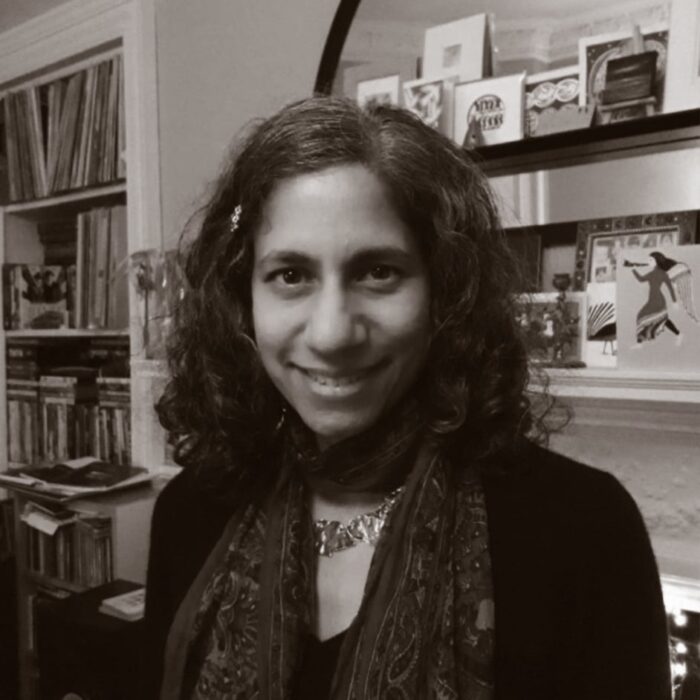
Nalini Paul
Nalini Paul is a widely published poet based in Glasgow. Born in India, she grew up in Vancouver, and has lived in Scotland for most of her adult life.
Between Worlds

Between worlds
Bashabi Fraser

Opposites Attract
Debjani Chatterjee

The Outlier: Michael Madhusudan Dutt
Namita Gokhale

To pin the wings of the butterfly
Suhayl Saadi

The torn worlds basted through my poems
Yogesh Patel

Price of emigration
Tariq Latif

A journey through houses of worship in Scotland
Bashabi Fraser & Hermann Rodrigues
WritersMosaic monthly
Get new episodes by email
One email monthly, unsubscribe anytime

Illuminating, in-depth conversations between writers.
Listen to all episodes
SpotifyApple Podcasts
Amazon Music
YouTube
Other apps

The series that tells the true-life stories of migration to the UK.
Listen to all episodes
SpotifyApple Podcasts
Amazon Music
YouTube
Other apps
WritersMosaic interrogates the notion of ‘staying in your lane’ by asking writers how they attempt to think beyond the parameters of their cultural identity.
Listen to all episodes
SpotifyApple Podcasts
YouTube

It’s being published I get paid for; the writing I would do for free
‘Any advance [...] for your novel is to compensate you for the horrors of being published'
Complex antihero: an interview with Arthur Hughes
Unravelling Authur Hughes' Richard III
Marlon James: a Jamaican reckoning
'A return to a home I barely knew'
Haunting the Black Air
Poetic freedom across space and time
The Disappearers
A sprawling visceral experience that drops you in head first