
Othello
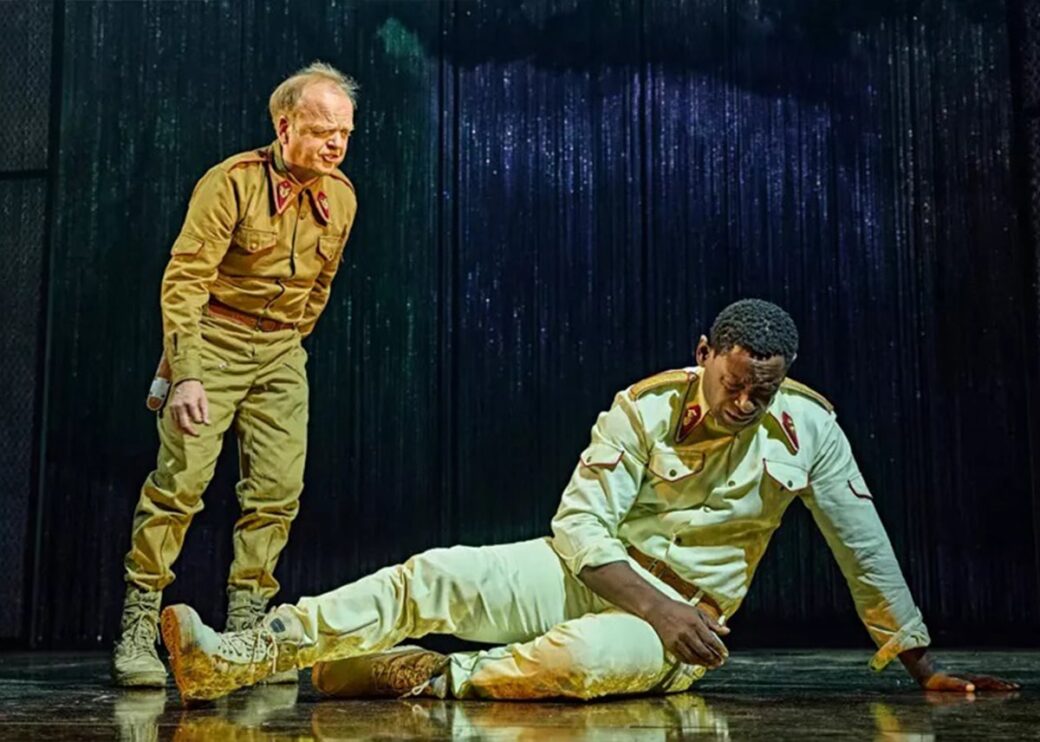
Theatre Royal, Haymarket, London
Directed by Tom Morris, 5 November 2025 – 17 January 2026
Considering how it is being staged these days, Othello is not a play for black people to watch. Black people are not its intended audience. The play might be about race, but it is from the perspective of a white man who controls the narrative, speaks conspiratorially with the audience and achieves his fascistic goals. At the performance I saw, there were many black people in attendance, well dressed, sat down good in their seats with their drinks and snacks. Othello can seem, from afar, to be Shakespeare’s gift to black people, evidence of his recognition of our presence in late-Elizabethan England, and the play does depict a familiar situation. We can be the best, better than the rest in our roles, but we are always in danger of being manipulated and othered, vulnerable to the white supremacist patriarchy and its jealousies.
Of course, Tom Morris’s Theatre Royal Haymarket production, with David Harewood as Othello and Toby Jones as Iago, is beautifully designed, performed, costumed, choreographed and soundtracked (by ‘Let England Shake’ musician PJ Harvey). We expect nothing less from a West End production; I particularly enjoyed the illusion of torrential rain projected onto a black backdrop to suggest the storms Othello’s convoy navigated approaching Cyprus.
The problem I had, as with other stagings I’ve seen of Othello, is in being part of an audience primed for entertainment rather than to consider the social issues the play delineates and how they relate to modern times. This production is, rather than a tragedy, a farce in which tragic events happen to unfold. It felt, too often, that it was being played for laughs, and the audience responded as if racism, misogyny, uxoricide and mental health crises are quaint relics from the past that we can laugh back at. When Emilia delivers her moving speech ending with ‘and when they are full they belch us’, about what men do to women, the three women to my left laughed with the rest of the audience because the actor, Vinette Robinson, chose to deliver that last line tongue-in-cheek.
Othello himself never has the audience’s devotion; that is reserved for Iago. I know this because I’ve played Othello myself. At the time, I happened to meet Simon Russell Beale and asked him for acting advice. His response to me was to ‘take care of your Desdemona’s mental health because she will be abused and killed every night and not know why.’ The same could apply to Othello, whose own clear self-hatred and misogyny are such that he burns down his own judgement at the word of an underling. He believes Iago over his wife, enough to subject her to an honour killing, before being shown that he has been the target of an insidious campaign.
It’s a difficult role particularly because the actor has to play against a narrative he doesn’t know that the audience has been fed. Iago, the servant, controls everything, and Othello, the commander, becomes the powerless subaltern. Harewood writhes on the floor as Iago spits down his lies about Desdemona’s invented trysts with Cassio (Luke Treadaway). Shakespeare relied upon his contemporary audience’s casual bias, and Othello’s own internalised racism, to drive the narrative. When Iago has planted and watered the seed and willed it to sprout, and Othello addresses the audience and says ‘Why did I marry?’, the audience laughs along with a joke Othello does not realise he is making. They laugh at him. You can’t tell the audience not to laugh, but the convention of Iago breaking the fourth wall and speaking conspiratorially and relatably to the audience has already been established, so when Othello addresses the audience, they expect to be entertained. The line ‘Why did I marry?’ is the turning point at which he begins his descent towards murdering Desdemona in their marital bed, and yet it is heard by the audience as a harmless, everyday domestic home truth many have said or thought themselves. It’s really hard to play that line and not be thrown off; Harewood, a veteran in the role, instantly steers the ship back to centre with poise and clarity. Perhaps it would’ve been better for the play as a whole if Iago was the only one who spoke to the audience; Toby Jones plays what he is given with sickening virtuosity.
Unfortunately, Morris’s production doesn’t seem to know what it is supposed to be; it does not seem as if it is fully in control of the ship. When you’re relying on audience participation – not just laughter; gasps rounded the theatre when Othello slapped Caitlin Fitzgerald’s Desdemona across the face – you have failed to find the deeper resonances of the story, or do not trust the public to keep coming back and filling the seats if the reports come back that it is too heavy. Especially in this day and age, what is the point of staging a play like Othello if it doesn’t speak to our racist, populist, anti-Islamic, anti-immigration, anti-intellectual current politics skewed to appeal to a disenfranchised working class?
I felt that the production could have done more to establish why Othello and Emilia were so unconditionally faithful to and trusting of Iago. Desdemona was not; in the text, she tells her maid, ‘Do not learn of him, Emilia, even though he be thy husband.’ Why then did Emilia, knowing Iago to be a rat, deliver him the handkerchief and then lie to Desdemona’s face, even after witnessing Othello go out of his mind interrogating his wife about its loss? Brabantio’s warning to Othello that Desdemona ‘has deceived her father, and may thee’ isn’t enough to carry the next three hours. Without this depth it feels a bit like panto. Nobody dies at the end of a panto; villains are reformed and called back into society or they are banished. But here, two women are murdered by their husbands and a mental health crisis ends in suicide. A black person in office is shown to be just another savage intent on subduing white femininity after all, and you imagine it would take centuries for another black person, however gifted, to be similarly appointed.
I didn’t laugh once; it was too depressing. A modern audience should not find Iago funny and relatable. Morris’ Othello is in modern dress, and Desdemona and Emilia are perhaps more defiant here than in previous productions I’ve seen, but that only makes the lack of interrogation of the text more glaring. As for the audience, I can only think that scrolling has done something to our brains, in that we can take in the most dreadful scenes and, as long as there’s a jaunty juxtaposition somewhere, we are okay to laugh and not be forced to address a more volatile and honest emotional response. We really must be living in strange times if we go to watch Othello for jokes. But perhaps laughter is the only way to deal with grief.


RENDANG
A magical reclamation of individuality from the mass of some of the world’s largest cities

Granta 173: India
A look at four short pieces of fiction from Granta's latest edition showcasing Indian writing

The Thing with Feathers
Dylan Southern’s film adaptation puts masculinity front and centre



Watching a theatre go dark
What we lost with the Blue Elephant Theatre

Waste not, want not
The cultural politics of waste
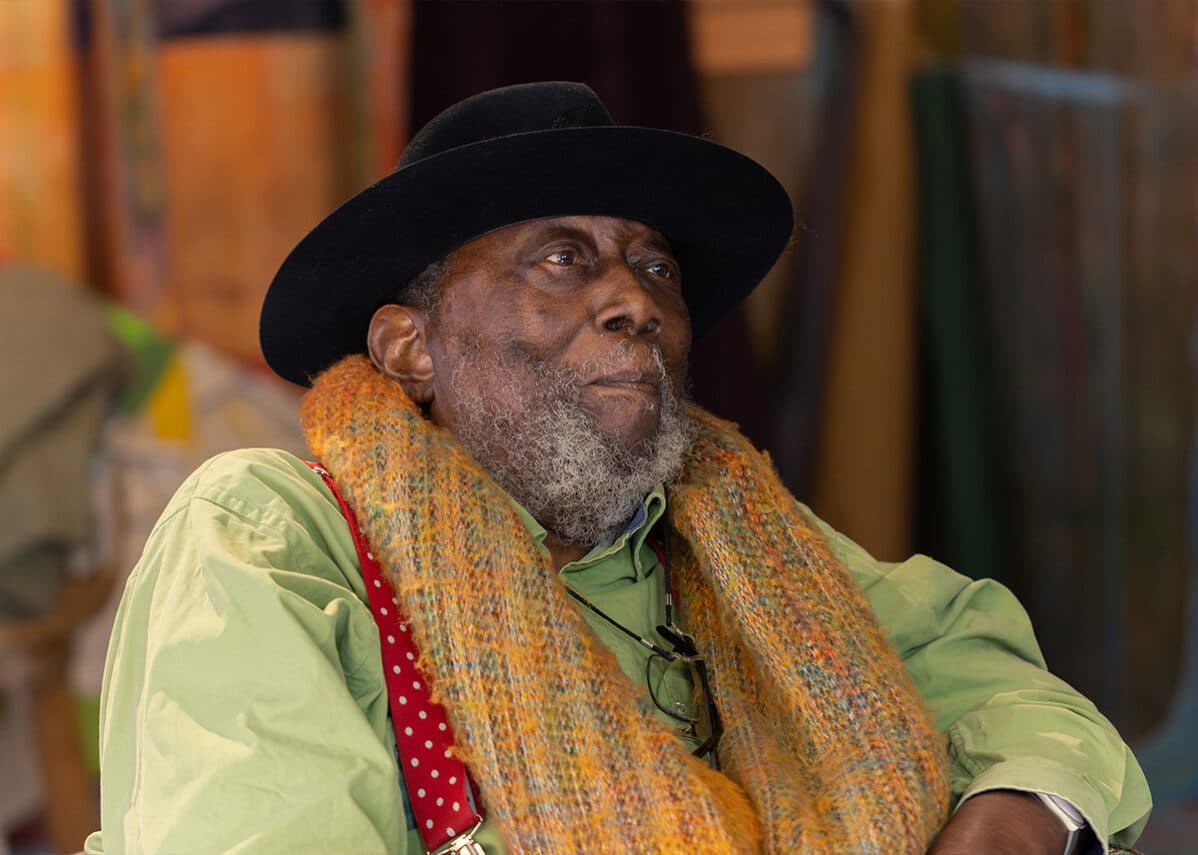
Frank Bowling
An interview with one of the foremost artists of his generation, Sir Frank Bowling


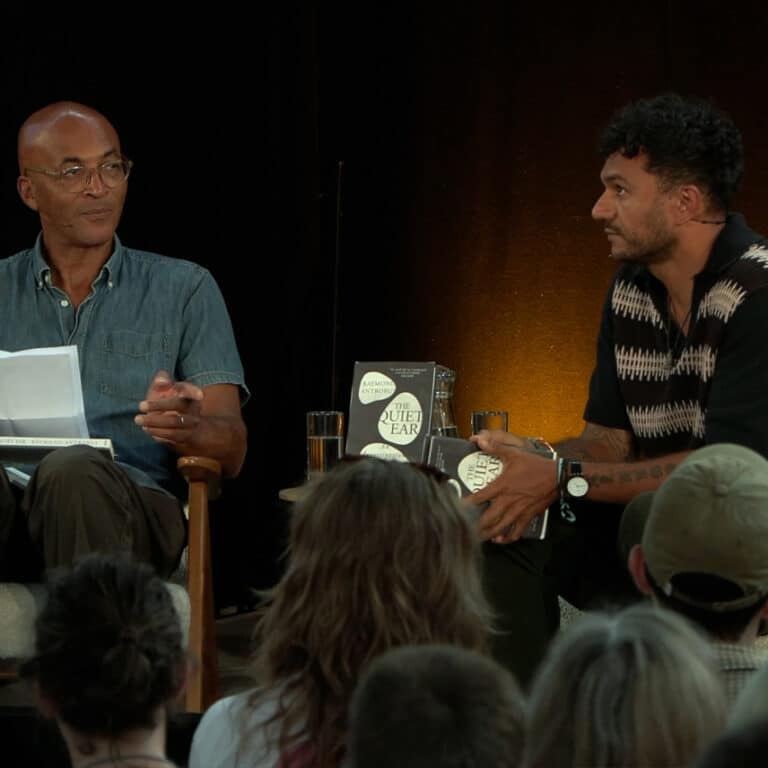
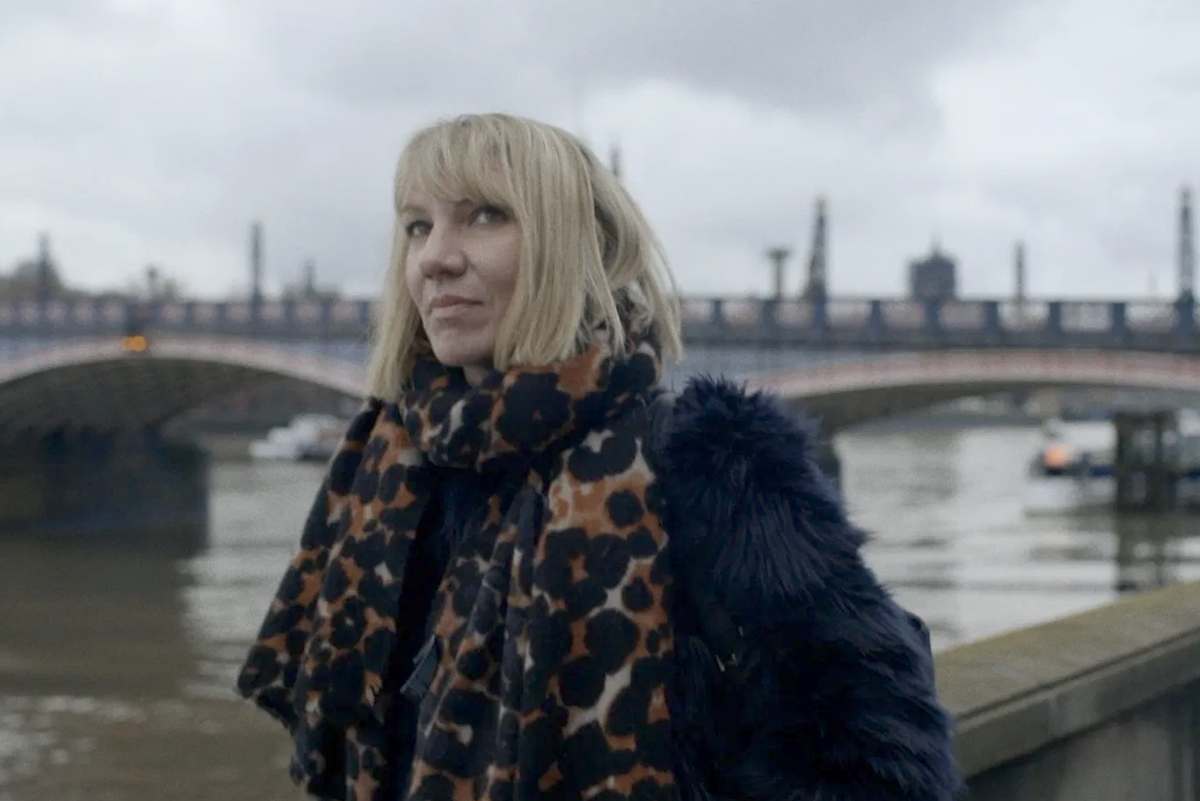
Reggae Story
Hannah Lowe reads her poem, 'Reggae Story' inspired by her Jamaican father, Chick. Directed by Matthew Thompson and commissioned by the Adrian Brinkerhoff Poetry Foundation.
The City Kids See the Sea
Roger Robinson reads his poem, 'The City Kids See the Sea'. Directed by Matthew Thompson and commissioned by the Adrian Brinkerhoff Poetry Foundation.

Illuminating, in-depth conversations between writers.
Listen to all episodes
SpotifyApple Podcasts
Amazon Music
YouTube
Other apps

The series that tells the true-life stories of migration to the UK.
Listen to all episodes
SpotifyApple Podcasts
Amazon Music
YouTube
Other apps
Afro-Caribbean writer Frantz Fanon, his work as a psychiatrist and commitment to independence movements.
Listen to all episodes
SpotifyApple Podcasts
YouTube