
Paris Noir
Centre Pompidou, Paris
19 March – 30 June 2025
Review by Franklin Nelson
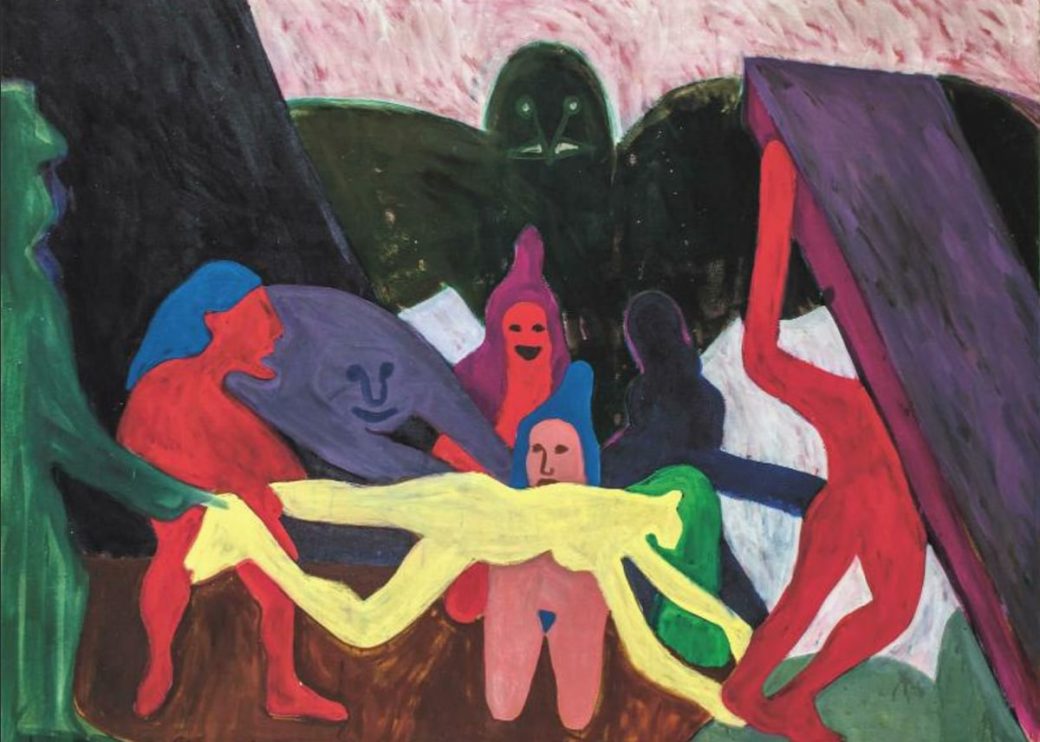
Gerard Sekoto’s Self-Portrait from 1947 is the first work seen by the visitor to Paris Noir at the Centre Pompidou in Paris – the Pompidou’s last show before it shuts for five years in September 2025 for renovations. A South African painter who died in France in 1993, Sekoto stands at an angle but gazes out towards us, both the left side of his rather angular face and his shirt collar bathed in a warm golden light that seems at once to emanate from behind him and project from in front of him. His eyes wide and left eyebrow raised, Sekoto casts a knowing glance, as if to say: ‘It’s nice to see you here, but you took your time’.
In that sense, the painting chosen as the main illustration for the publicity around Paris Noir makes for a fitting opening to this bold and long-overdue display of the creative endeavour of African, African-American and Caribbean artists in France in the second half of the twentieth century. Paris might well have been, as Walter Benjamin put it, ‘capital of the nineteenth century’, with modernity making its presence felt in the blend of money, culture and Haussmannisation. But over the next hundred years, the city would also prove a kind of beacon for black creatives in search of inspiration or caught in the storm of racism (not that France was free of racism). Josephine Baker, Ronald Moody, James Baldwin, Richard Wright, Aubrey Williams, Alejo Carpentier, Loïs Mailou Jones, Ernest Mancoba – the list is long and diverse, but many of its names didn’t make it into the canons of art.
Subtitled ‘artistic circulations and anti-colonial resistance’, the show takes us on a thoughtful journey through roughly 50 years of artistic production from 1947 in all forms: painting, drawing, sculpture, music, photography, film and tapestry, as well as archival material – notably letters. The exhibition’s attempt to propose ‘a fresh perspective on the recent history of the French capital’, according to Pompidou president Laurent Le Bon and Xavier Rey, director of the National Museum of Modern Art, has been enhanced by the decision to stage it in the centre’s main gallery on the sixth floor. In between the art, as one walks through the show, it’s impossible not to glimpse, through the floor-to-ceiling windows, the streets immediately below and far away – streets these artists knew well.
Although this exhibition showcases the work of around 150 artists, some pieces are especially impressive. Beauford Delaney’s James Baldwin (c.1945-50) captures the young writer – who encouraged the older Delaney, his ‘spiritual godfather’, to relocate to Paris from the United States – in a wash of pastels that cast Baldwin, who is seated, as almost floating. Delaney is one of a handful of artists, along with Sekoto, to have work from different moments featured from their French sojourn, giving us a useful sense of how they responded to their new surroundings over time, rather than just in a given moment.
Senegalese Ousmane Sembene’s 1996 classic short film of colonial alienation La Noire de…’ (‘Black Girl’), whose titular protagonist travels to France to work as a maid and eventually dies by suicide, plays on a wall opposite Iba Ndiaye’s Tabaski, la ronde, à qui le tour (1970). The big canvas, in black and shades of brown, depicts the gory sacrifice of a sheep to mark Tabaski, the Senegalese equivalent of Eid. The curators’ message is clear: Sembene’s nameless protagonist, whose commentary on her condition is trapped inside her head, is just another lamb to the slaughter.
Less overtly artistic and more political are films attesting to black activism and life in France. We watch Angela Davis set out, in lovely spoken French, how infighting among people of colour is holding them back; and in Harlem à Paris (1964), whose title collapses the transatlantic divide, the African-American writer William Gardner Smith observes that “for us blacks there’s a lot less racism here”. “I thought I’d end up killing someone,” he adds plainly, reflecting on the idea of staying in America. Later, we are treated to footage of Jessye Norman singing La Marseillaise on Bastille Day in 1989, two hundred years after the prison was stormed. Draped in a billowing tricolour gown, Norman is simply mesmeric: a black Marianne, at the close of a decade of tense race relations and rising support for what was then the National Front, in full command of Place de la Concorde.
This exhibition has its flaws. Some wall texts repeat information. Things tail off a bit after the 1990s, although the last piece – Hassan Musa’s Autoportrait avec des idées noires (2003; Self-portrait with black ideas) – is a helpful reminder of the limits of thinking in racial terms. At almost 50 euros, the excellent and richly illustrated catalogue, with essays by writers and academics such as Hilton Als and Anne Lafont, is too expensive to be appreciated by many exhibition-goers. In addition, the Pompidou would do well to check how many visitors it is admitting at any one time because, when I was there, it was sometimes hard to see the work up close. But overall, there is much to be gained from – and enjoyed in – Paris Noir. Let’s hope that when the Pompidou reopens in 2030, more shows like this are on the agenda.
Franklin Nelson
Franklin Nelson works for the Financial Times, commissioning and writing on UK politics, the economy and society as well as books and the arts.
WritersMosaic monthly
Get new reviews in your inbox
One email monthly, unsubscribe anytime
The Disappearers
A sprawling visceral experience that drops you in head first
The Lady Imam
Is the world ready to catch up with amina wadud?
Pressure
What's missing from the latest 'untold story behind D-Day'?

Complex antihero: an interview with Arthur Hughes
Unravelling Authur Hughes' Richard III
Marlon James: a Jamaican reckoning
'A return to a home I barely knew'
The name of this wallpaper is ‘Childhood’
A luminescent bubble of memory


Illuminating, in-depth conversations between writers.
Listen to all episodes
SpotifyApple Podcasts
Amazon Music
YouTube
Other apps

The series that tells the true-life stories of migration to the UK.
Listen to all episodes
SpotifyApple Podcasts
Amazon Music
YouTube
Other apps
WritersMosaic interrogates the notion of ‘staying in your lane’ by asking writers how they attempt to think beyond the parameters of their cultural identity.
Listen to all episodes
SpotifyApple Podcasts
YouTube