
Turner Prize winner Nnena Kalu ‘gives hope and light’
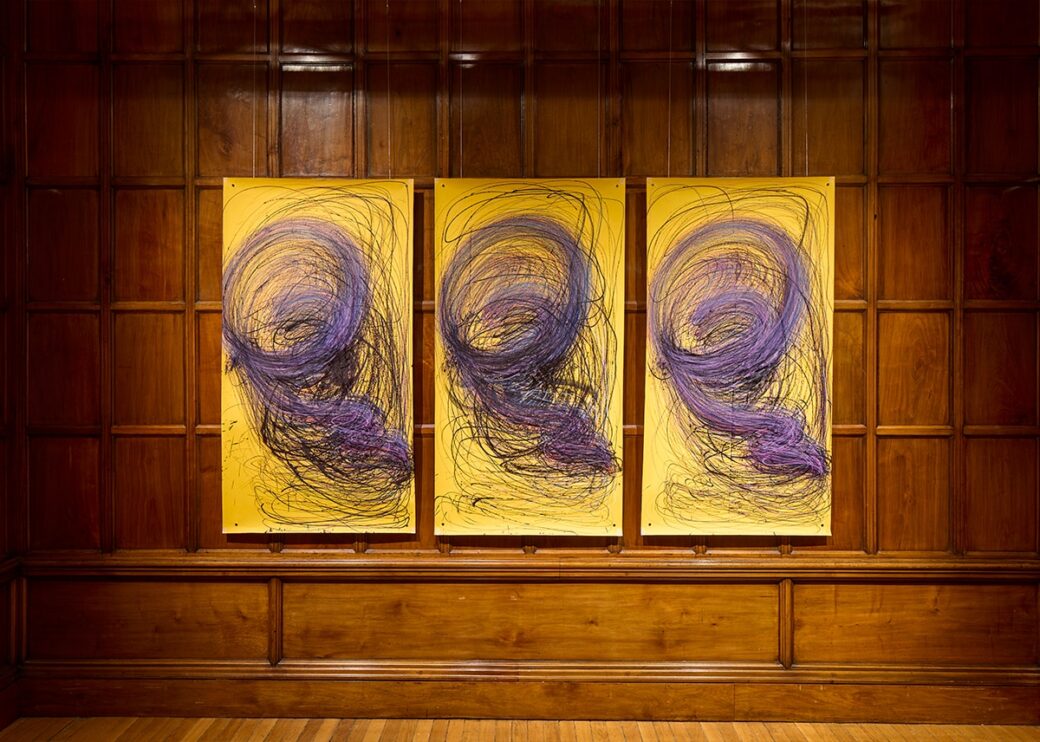
The Turner Prize exhibition 2025
Cartright Hall Art Gallery, Bradford, 27 Sept 2025 – 22 Feb 2026
Bradford is enjoying a highlight year in 2025, being host to the Year of Culture, with all the good things that brings for those of us who love the arts in the usually art-starved North. Perhaps the crown jewel of the year is the Turner Prize exhibition, which is currently on show at the magnificent Cartwright Hall Art Gallery. This year’s winner Nnena Kalu and her fellow nominees are all British-based artists from global majority backgrounds; and to witness this decentring of the norm and be in a space of proper valuing and balancing is worth the trip to Bradford alone. Within this exhibition, there is a feeling that the dark days of the hungry ghost of conceptual art are gone, and art is back from its avoidance of humanity and feeling.
Nnena Kalu’s large-scale works feature hanging sculptures surrounded by drawings on the walls. She made history in becoming the first artist with a learning disability to win the prize. Her Turner show was originally made for Manifesta 15 in Barcelona but has been developed and newly re-made in situ at Bradford. Paper, VHS tape and cloth combine in bright colours, while around the walls are highly expressive free drawings in diptychs and triptychs. It feels like one piece that you are immersed in and, at the same time, it questions the wild, unexpressed unconscious in you – as if knowing that we all have something untamed in us that is necessary but uncommunicated. The nests, loops, tapes, and the insistence of the line on paper strike deep, outside of words and fixed forms, to give shape to what lies beneath the surface.
Rene Matić’s work leans heavily into photography as well as sculptural and other media. Their exhibition, ‘As Opposed to the Truth’, brings a sense of how people care for each other against the backdrop of late-stage capitalism, racism and fascism in the UK and around the world. It shows the light and strength of vulnerability that is present when we hold on to each other. The central piece in the room is a giant white flag with the words ‘no place’ on one side and ‘for violence’ on the other, quoting US political rhetoric after the 2024 attempt on Donald Trump’s life and pointing to the gap between words and actions. Perhaps the most affecting piece is ‘Restoration’, a collection of broken and abandoned Black dolls, now rescued, gathered, cared for and displayed with love.
Mohammed Sami’s exhibition collects work that he made for Blenheim Palace – a beautiful monstrosity built to celebrate military triumph – in which he invites the viewer to consider the causes and effects of oppression and conflict using beauty and colour as his palette. One can only half-smile at Sami’s large canvases that lean into fragmentary memory, distortion of idea and image amidst the fixed natures of ‘presented’ histories. ‘Hiroshima Mon Amour’, the title evoking the 1959 film written by Marguerite Duras, plays with the questions of ‘Who is the hunter?’ and ‘Who is the hunted?’ A smaller but highly affecting painting, ‘On Air’, pulls at your gut in its allusion to the current and seemingly unending power of our own stupidity to be drawn in by the words and images of propaganda.
Zadie Xa’s exhibition, ‘Moonlit Confessions Across Deep Sea Echoes: Your Ancestors Are Whales, and Earth Remembers Everything’, winds together painting, sound, textile and sculpture. It is a room of sheer, unashamed beauty. A shining, brassy floor reflects you and the art, while an undersea soundscape creates a sense of being under a dream-sea and opens into the natural and intimate. Shamanic bells hang in the centre of the work to attract the spirits of light or repel those invested in the dark. Deeply coloured canvases – ancestral memory of our aquatic, magical, mythic origins – life and death, ritual and dance – are held in a perpetual sunrise/sunset painted on the walls. Sea and sky. There are strong themes of truer human spirituality as part of the ecology, a spirituality that is interdependent and communicative with the brothers and sisters of our fellow species, calling us to share our planet more equally.
The Turner Prize 2025 invites the viewer to take part in a very soul-led, humanistic experience. The work of these four artists gives hope and light that go against the narrative of what Britain and the world are within the downward spiral that much of our media presents. We need hope and beauty; we need to witness and be seen; and we need to be invited into the depth of life and the world. The arts, as ever, are the best vessel we have for this.
WritersMosaic monthly
Get new reviews in your inbox
One email monthly, unsubscribe anytime
Pressure
What's missing from the latest 'untold story behind D-Day'?
A Trial
An examination of theatre’s complicity in post-truth politics
The Complex
The unraveling of a dynasty
Marlon James: a Jamaican reckoning
'A return to a home I barely knew'
The name of this wallpaper is ‘Childhood’
A luminescent bubble of memory
What’s in a feminist? Holding on to Gloria Steinem
Is Gloria Steinem's feminism still relevant today?



Illuminating, in-depth conversations between writers.
Listen to all episodes
SpotifyApple Podcasts
Amazon Music
YouTube
Other apps

The series that tells the true-life stories of migration to the UK.
Listen to all episodes
SpotifyApple Podcasts
Amazon Music
YouTube
Other apps
WritersMosaic interrogates the notion of ‘staying in your lane’ by asking writers how they attempt to think beyond the parameters of their cultural identity.
Listen to all episodes
SpotifyApple Podcasts
YouTube