
You Don’t Know Us Negroes and Other Essays

Zora Neale Hurston
(Harper Collins 2022)
Review by Julian Vigo
Zora Neale Hurston came to fame with the publication of her second novel, Their Eyes Were Watching God (1937), which quickly became a classic of the Harlem Renaissance even if it had been thoroughly reviled by her contemporaries, Richard Wright and Ralph Ellison. I must bracket this term ‘fame’, given that Hurston’s celebrity as a black woman novelist was short-lived. Most Americans had simply never heard Hurston’s name until her writing was revived and brought into the public forum by Alice Walker who penned ‘In Search of Zora Neale Hurston’ for Ms. (March 1975), cementing Hurston’s legacy within American literature.
Hurston was a polymath. She was the first black woman to attend Barnard College where she completed her BA in 1925 while conducting research for Franz Boas. She eventually earned her Master’s degree in anthropology as a student of Boas at Columbia University. Hurston conducted anthropological research in the Deep South of the USA, Haiti, Jamaica, the Bahamas and Honduras, documenting cultural traditions and recording black American folklore, songs, and children’s games. Hurston also shot documentary footage, and wrote plays, essays, short stories, ethnographies and an autobiography, in addition to being an actor and singer.
The recently published collection of Hurston’s non-fiction, You Don’t Know Us Negroes and Other Essays incorporates Hurston’s ethnographic and observational skills within a wider critical philosophical outlook on white supremacy, colonialism, sexism, and racism.
The editors, Genevieve West and Henry Louise Gates Jr, have divided the collection into five parts: folklore, art, race and gender, politics and a historically vital last section on the trial of Ruby McCollum, a wealthy married African-American woman charged and sentenced to death for the murder of a prominent white doctor who had repeatedly raped her and forced her to bear his child.
Hurston’s prose addresses the colour line where black lives are denied agency while also showing the reader how, counterintuitively, enslavement and Jim Crow enhanced black Americans’ inner lives and culture instead of destroying them.
The edges of Hurston’s philosophical beliefs regarding strict divisions (segregation) and forced consolidation (integration) are matched by her anthropological and critical prowess where cultural truths are not, as many believe today, a question of ‘woke’ politics that must up-end old-world evils. Rather, Hurston’s writing lifts the shroud of inhumanity that racism cast across generations of black people’s lives and histories to reveal the delicate humanity that was lost.
Likewise, she grasps how culture is the total of its contradictions, and that problems around race and sex have no tidy resolutions. Her essay, ‘The “Pet Negro” System,’ focusing on tokenism, examines how racism functions. In a brilliant summary of the class divisions within the political representations of black Americans, Hurston explores how political tropes become dangerous political fodder for performing a theatre of racism; and how blacks in the north are expected to recount tales of violence and brutality:
It has been so generally accepted that all Negroes in the South are living under horrible conditions that many friends of the Negro up North actually take offence if you don’t tell them a tale of horror and suffering. They stroll up to you, cocktail glass in hand, and say, ‘I am a friend of the Negro, you know, and feel awful about the terrible conditions down there.’ That’s your cue to launch into atrocities amidst murmurs of sympathy. If, on the other hand…you ask, ‘What condition do you refer to?’ You get an injured, and sometimes malicious, look. Why ask foolish questions? Why drag in the many Negroes of opulence and education? Yet these comfortable, contented Negroes are as real as the sharecroppers.
This essay is timely, given the current climate of wokery, as Hurston declares her friendship with Hugo Black, an Associate Justice of the Supreme Court who was also a former Klansman. She notes how many black Americans feared being called a ‘white folks’ nigger’, while white Americans feared being called a ‘nigger-lover.’ Hurston sticks her finger in the socio-political boil of the day where she views division between so-called races as the result of not creating loving relationships with the other for fear of being judged. Couching problems of racism within cultural misunderstandings and racial separation, she offers friendship as the solution while curiously voicing support for laws barring marriage between blacks and whites.
With razor-sharp wit in ‘The Emperor Effaces Himself,’ Hurston mocks the pomp of the 1920s pan-Africanist leader, Marcus Garvey, manifest in his annual parade with ‘Royal African Guards’. She ridicules Garvey’s military frippery while still supporting his political commitment to black self-pride.
‘The Lost Keys of Glory’ implies that Hurston might have made a mistake in placing her professional craft at the centre of her life, querying if she could have been happier capitulating to sexism for the rewards of love. She asks: ‘And the inevitable question arises inside her, how much is a career worth to a woman anyway? Are not the unknown women, bossing the man of her choice really happier than the career-woman?’
In the book’s title essay, ‘You Don’t Know Us Negroes,’ Hurston lays out her disdain for ‘Negro literature,’ which caters to the cliched narrative of ‘Negro life,’ calling it the ‘oleomargarine era of Negro writing.’ She views blacks and whites as stuck in a misinterpretation of each other: white American writers because they are wholly ignorant about black Americans’ lives and cultural contributions; and some black writers because they set out to portray the black experience as monolithically tragic.
Hurston’s words have resonance in today’s world where identifying into oppression —where the subject exists only as an oppressed figure—defies the reality of a far more complex sociological topos. What makes this collection stand out is not only its coincidental message to the ‘woke wars’ and cultural elite of today who prop up vestiges of racism for social media approval. Hurston is also irreverent towards her detractors, arguing that over-identification with a toxic historical past leads to caricature and repetition of outdated tropes about, for instance, black empowerment and love.
Photo courtesy of Library of Congress
WritersMosaic monthly
Get new reviews in your inbox
One email monthly, unsubscribe anytime
The Complex
The unraveling of a dynasty
Disappearing Images
A festival of ephemeral art and the impermanence of our current world

Ever Land
A layered and haunting view of daily life in occupied Palestine


Coats
The unexpected cost of acquiring two Italian leather coats in Rome
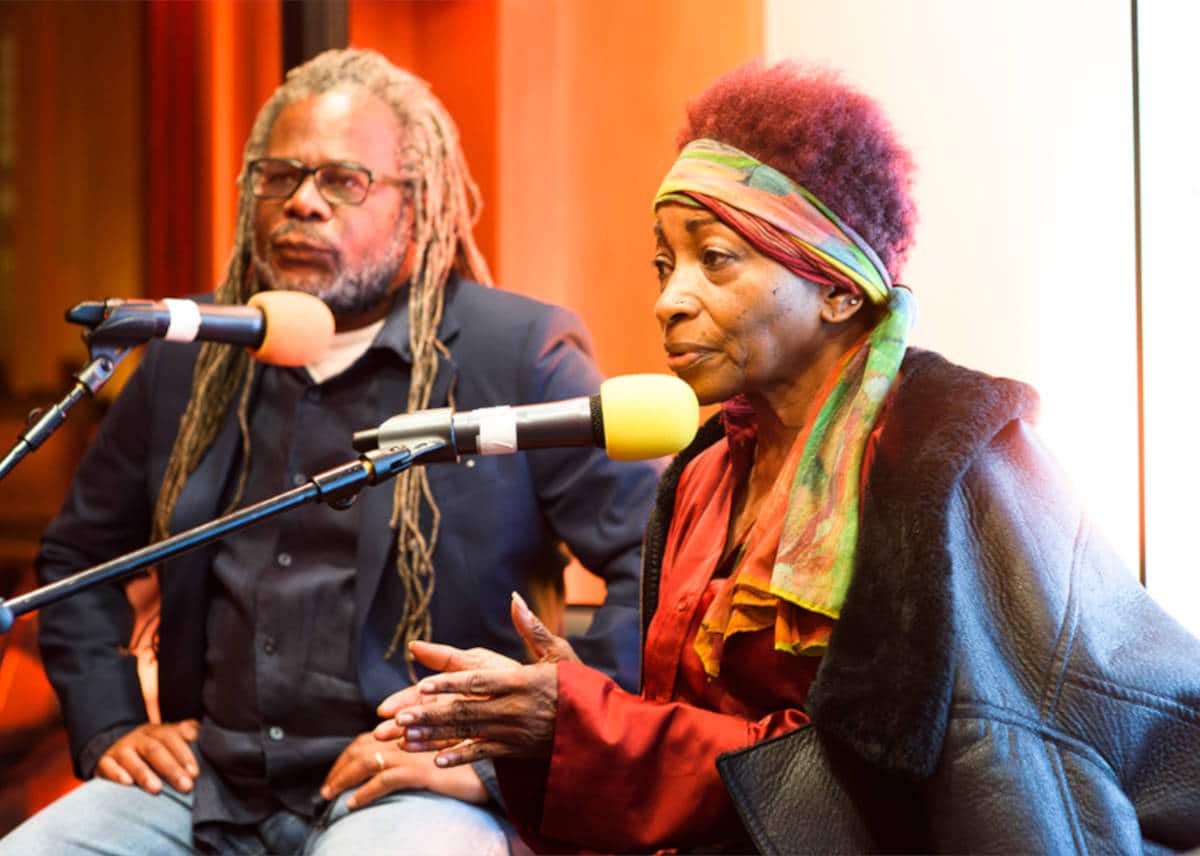
A tribute to Bonnie Greer
Founding editor of WritersMosaic Gabriel Gbadamosi pays tribute to Bonnie Greer, the extraordinary writer, public intellectual and much admired contributor to WritersMosaic who died on 15 September, 2026.
Triage
A response to the endless spiral of worldwide conflict and tragedy

Free Will
Will Harris reads his poem, 'Free Will'. Directed by Matthew Thompson and commissioned by the Adrian Brinkerhoff Poetry Foundation.

Half Written Love Letter
Selina Nwulu reads her poem, 'Half Written Love Letter'. Directed by Matthew Thompson and commissioned by the Adrian Brinkerhoff Poetry Foundation.

Illuminating, in-depth conversations between writers.
Listen to all episodes
SpotifyApple Podcasts
Amazon Music
YouTube
Other apps

The series that tells the true-life stories of migration to the UK.
Listen to all episodes
SpotifyApple Podcasts
Amazon Music
YouTube
Other apps
WritersMosaic interrogates the notion of ‘staying in your lane’ by asking writers how they attempt to think beyond the parameters of their cultural identity.
Listen to all episodes
SpotifyApple Podcasts
YouTube
In the first series of poems commissioned by Hannah Lowe, six poets explore how ritual gives meaning to our lives.
Listen to all episodes
SpotifyApple Podcasts
YouTube