Common world
Kopuwai
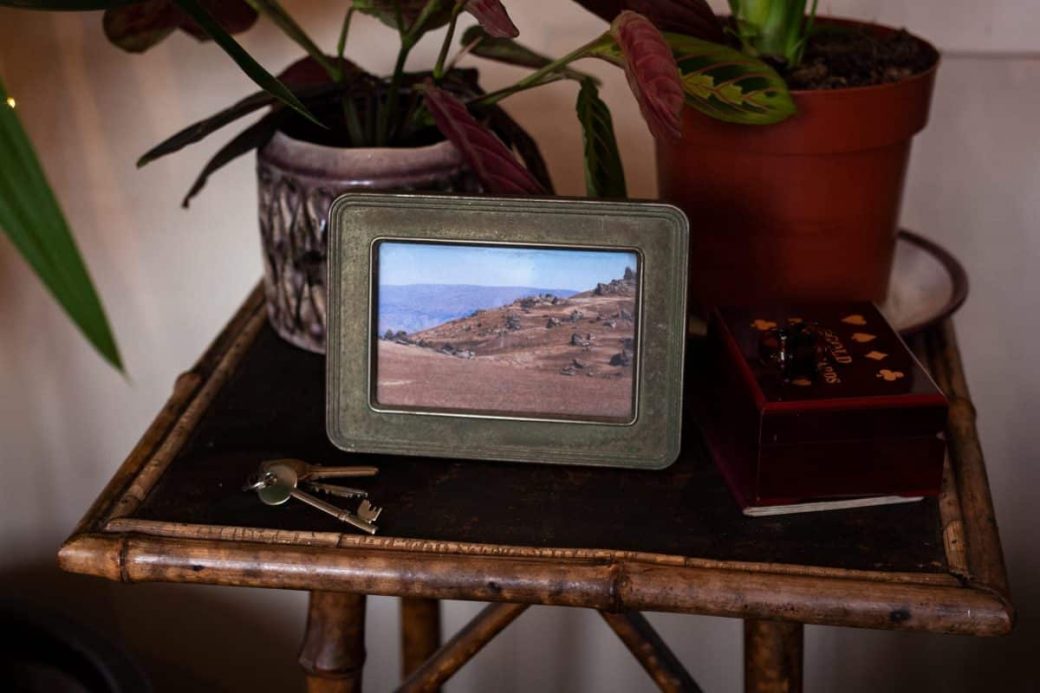

You never lose the view you grow up with. Whether it’s a windswept mountain or the sea or a tower block, the images that frame your childhood stay with you. They hang in your peripheral vision; an ever-present reminder of where you come from, a common connection to the people who still share that view.
In my case, the connection is Kopuwai, a ninety-foot rock standing tall in a southerly wind. In a parched corner of New Zealand’s southern alps, the river-swallowing giant of Māori legend looks down from the summit of the mountain range that bears its name. I grew up in its foothills, part of a long-distance rural community, shaped by the mountain’s over-arching physical presence. This was the backdrop to the first half of my life.
I still carry some of Kopuwai with me; a rough-hewn gold nugget, prised from one of its snow-melt creeks by my father, thirty years ago, and cast into a ring by a London jeweller; it draws me back to the place I remember, squeezing my skin so tight it leaves a mark that doesn’t fade.
I’ve spent exactly half my life now on the opposite side of the world to that mountain, putting down roots in the country my forebears abandoned generations ago. In that time, I’ve felt its absence sharply. I’ve put up pictures of it in my house. I’ve made it the subject of my writing, where it assumes different proportions – where everything seems twice what it was. The colours appear more vivid, the summers hotter, the winter storms more dangerous. But, with time and distance, my connections feel more fragile. It’s a fragility rooted in displacement, in the feeling of ‘otherness’ that so many writers have tried to unpick in their work. A fear that I’m no longer identified as a local in the place that I still call home; that I might become an outsider – a wandering summer tourist, looking on. A fear that my relationship with the landscape and people will change, that the mountain’s steel-blue outline might become a faraway smudge in the haze.
In my memories, people are mixed with the mountain. My father, like thousands before him, panning for gold on its southern slopes, the high country spreading wide like a rumpled quilt. My mother hanging out the washing with snow at her feet, sheets billowing sideways in the wind. Tom, the farmer, long-nosed sheepdogs racing at his heels. When I do go back, every couple of years, I always call in on Tom. He’s ninety now, his memory patchy, and he spends his days indoors. He recognizes my Dad, and me also, but it’s like he can’t quite place us in time. Not that it matters; we talk about fossicking, sheep, the wool price. Then we talk about the mountain. No one has spent more time on this mountain than Tom, but now his connection with it is changing, heading into unknown territory. No longer his place of work, it now seems an adversary. Dangerous scenes play out in his head – storms, accidents. When his son goes up to move some sheep, Tom paces the house, agitated. He peers out the window looking for cirrus clouds at the summit, innocent wisps that warn of danger to come. Like tiny specks of gold, worn smooth by the creeks that wash them to the valley, his memories are travelling further from their source. Unlike me, he has never left this place, but I feel we have this in common – both now inhabiting a world where our memories of the mountain that shaped our lives have been skewed by distance and time. Like Tom, I’m changed, but still connected. Both of us catching ourselves looking back, trying to make sense of the view.
© Stefanie Seddon
Stefanie Seddon
Stefanie Seddon grew up on a farm in New Zealand. Her short stories have won the Bristol Short Story Prize and the Commonwealth Short Story Prize for Europe & Canada.
Common world

Common world
Lucy Hannah

The green room
Jacob Ross

Raising the dead
Nadifa Mohamed

The family
Romesh Gunesekera

Fish out of two waters
Monique Roffey

A common world
Gillian Slovo & Kamila Shamsie

Our world
Robert Huggins
WritersMosaic monthly
Get new episodes by email
One email monthly, unsubscribe anytime

Illuminating, in-depth conversations between writers.
Listen to all episodes
SpotifyApple Podcasts
Amazon Music
YouTube
Other apps

The series that tells the true-life stories of migration to the UK.
Listen to all episodes
SpotifyApple Podcasts
Amazon Music
YouTube
Other apps
WritersMosaic interrogates the notion of ‘staying in your lane’ by asking writers how they attempt to think beyond the parameters of their cultural identity.
Listen to all episodes
SpotifyApple Podcasts
YouTube
In the first series of poems commissioned by Hannah Lowe, six poets explore how ritual gives meaning to our lives.
Listen to all episodes
SpotifyApple Podcasts
YouTube

Free Will
Will Harris reads his poem, 'Free Will'. Directed by Matthew Thompson and commissioned by the Adrian Brinkerhoff Poetry Foundation.

Half Written Love Letter
Selina Nwulu reads her poem, 'Half Written Love Letter'. Directed by Matthew Thompson and commissioned by the Adrian Brinkerhoff Poetry Foundation.
Triage
A response to the endless spiral of worldwide conflict and tragedy
My tomorrow is today
'I clasped my hands together, not in prayer but to stop them from shaking'
Ballet Black at 25
Cassa Pancho: 'It’s a miracle that we are still here in some way'
Ever Land
A layered and haunting view of daily life in occupied Palestine
Mahsa Salali’s Naqqāli
'Salali positions the female body... as an active agent'