
Afghanistanism
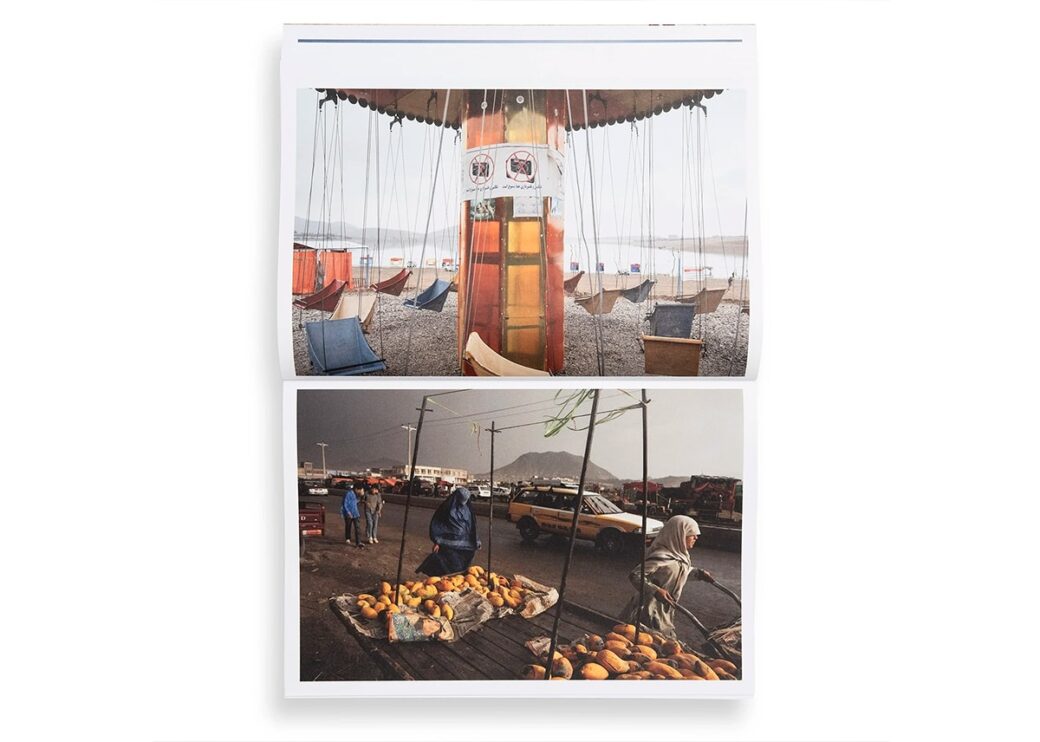
AFGHANISTANISM: Afghanistan 2010-2022
Joël van Houdt
This vast, mountainous stretch of land – its edges touching Iran, China, Pakistan, Turkmenistan, Tajikistan and Uzbekistan – has obsessed would-be invaders for over two millennia. The ‘Great Game’ between colonial powers Russia and Britain began a mere two hundred years ago, but all ’winners’ lose in the end. Joël van Houdt is a Dutch photographer who arrived in Afghanistan in his early thirties and lived there for a dozen years, taking the final images for this book of photographs in 2022 after the Taliban came. The photographs, set between monochrome historical quotes, shine like blood or jewels from the endless terrain of dust, deserts and crumpled ranges.
Individual lives and moments flower unstoppably in the intimate foreground. A typical van Houdt photograph makes the viewer live several of them at once. Men pray or rule in groups, but two uniformed men with guns have fun in an innocent pink swan-headed pedalo. Six gawky teenagers play football in celestial blue shorts. A trio of relaxed band members waiting to play at a wedding stroll past a giant model elephant, their showy scarlet uniforms mimicking British soldiers’ before camouflage clamped down.
Girls and women appear in different spaces to the men, some encased in flax-blue burqas, others bare-headed in gorgeously patterned long red, blue or gold tunics over loose trousers, talking, playing or caring for younger children. A girl of around ten gazes with almost mystical eagerness at the invisible teacher she is copying from. Another, in a scarlet sports kit, leaps up in swallow flight, arms spread wide, face to the sky, body arcing backwards.
Sometimes the viewer’s eye is frighteningly close to death: a briefly exhausted, young-faced US soldier lies stationary, staring, in the dust, unreadable, inches away from us as others go on firing. Consciousnesses split. ‘I saw how his hands were trembling […] “He is only a boy,” I thought and pressed the trigger,’ records Vladislav Tamarov, a Russian soldier from an earlier phase of colonial war. A man carries a severed leg.
Modern technology in these photographs is new, sometimes spectacular and pleasurable: forests of white electric lights glitter at fairgrounds or plazas where men walk in couples. A red light glows from the head of a plastic bird flying on a string. Functional tech is often temporary looking: telephone lines are attached to the denuded, curving trunk of a tree, pink plastic cups lie in the dust. Families have made simple mimics of prams, scooters or children’s cars. It’s about irrepressible inventiveness, but also silently comments on our own excess of shiny, effective possessions.
Colour tells its own story. Blues are often luminous as lapis lazuli, the colour of the spirit. Through a door in a bleak grey shack among black foothills, a single worshipper is illuminated in a small frame of blue light as he kneels to pray on a turquoise carpet. Blue and red play against each other, women in blue burqas crowding around the red velvet display cases of a jewellers. A young teenage girl with short hair, a wide, free smile and a whirling scarlet knee-length dress dances solo against the silver-grey-blue of her family sitting room, while more conventionally-dressed women applaud her. On one of their mobiles, a tiny red figure is proudly recorded in her moment, but the Taliban will arrive in two years’ time.
Red is the colour of joy and beauty and also of the killing that comes in waves. Thousands of Afghan deaths in the 1979 uprising are commemorated by richly patterned red carpets spread like a sea of poppies in Herat in 2016. In the same year, van Houdt catches the rouged, vermilion-lipped image of an Afghan model outside a beauty parlour, her mouth slashed through with a knife. Through the slit made by the blade, you glimpse the blue-grey metal grille with a sign that says ‘Shut’. Blood is hosed from streets.
At the end of the book, we are given three distant shots from a departing plane of the country spread underneath us, a wide, gold-brown, depopulated expanse that will endure as long as the planet. It gives the lie to Trump’s 2019 boast, clearly a rehearsal for his current rhetoric on Iran: ‘If I wanted to win […] Afghanistan would be wiped off the face of the Earth.’ The last quote in the book is from Trump again. It’s barely believable that in 2025, just four years after the shamefully precipitous American and British abandonment to the Taliban of the Afghans to whom they had taught human rights, the President had the gall to say: ‘We’re trying to get it back […] We want that base back.’ This book, which I deduce to have been four years in the making, is still current. The Great Game is not over yet.
Van Houdt’s title, Afghanistanism, acknowledges the ironies in reporting on a country when you weren’t born there. He sources the ‘-ism’, a self-critical journalistic concept, to 1948, when an editor of the Tulsa Tribune, Jenkin Lloyd Jones, warned his fellow newspaper editors ‘You can pontificate […] in […] safety. You have no fanatic Afghans among your readers. Nobody knows any more […] than you do, and nobody gives a damn.’ This sentiment anticipates our twenty-first century anxiety about saying anything at all about a country or identity you can’t embody. Yet this book by an ‘outsider’ never pontificates. Even its form, expensively produced but collaging notes and photographs on paper of different sizes and textures to mimic a folder of work and folded prints, suggests research that strives to contain different viewpoints. Against this plays the absolute aesthetic authority of each individual image. ‘This I saw. See this,’ van Houdt seems to say.
I’ve never had the word ‘genius’ come to my mind with respect to a book’s appropriateness as an artefact – maybe with artists’ books like Chris Ofili’s shiny, gold-covered, glossy-papered volume mirroring his 2002 exhibition The Upper Room – but it happened as I turned the last page of Afghanistanism. Van Houdt has done for Afghanistan what the Oscar-shortlisted film The President’s Cake (2025) did for Iraq, after its own colonial invasion. His mosaic of photographs and words will haunt me forever with its beauty, humour and terror.
WritersMosaic monthly
Get new reviews in your inbox
One email monthly, unsubscribe anytime
Pressure
What's missing from the latest 'untold story behind D-Day'?
A Trial
An examination of theatre’s complicity in post-truth politics
The Complex
The unraveling of a dynasty
Marlon James: a Jamaican reckoning
'A return to a home I barely knew'
The name of this wallpaper is ‘Childhood’
A luminescent bubble of memory
What’s in a feminist? Holding on to Gloria Steinem
Is Gloria Steinem's feminism still relevant today?


Illuminating, in-depth conversations between writers.
Listen to all episodes
SpotifyApple Podcasts
Amazon Music
YouTube
Other apps

The series that tells the true-life stories of migration to the UK.
Listen to all episodes
SpotifyApple Podcasts
Amazon Music
YouTube
Other apps
WritersMosaic interrogates the notion of ‘staying in your lane’ by asking writers how they attempt to think beyond the parameters of their cultural identity.
Listen to all episodes
SpotifyApple Podcasts
YouTube