Common world
The family


My father started out doing the accounts in a tea factory in Sri Lanka. After the tea estates were nationalised in 1976, he was put into marketing. ‘The whole Commonwealth became my patch,’ he joked. But soon that market was saturated. ‘We need more tea drinkers than those in the old empire,’ he said. ‘We need Turkey and Russia. The Middle East. Unfortunately, China, you see, has its own tea and in America they prefer coffee. They have no time for a Commonwealth habit, never mind savouring the nectar of heaven.’
He was, in his own way, a romantic.
When I was fifteen, my father handed me a grey hat he had picked up in a market in Kabul. By then, in the eighties, he was always coming back to our house in London from Kabul or Istanbul or Rotterdam with hats and gloves, or Russian overcoats, bundled into his suitcase.
‘This hat was invented by a genius,’ he claimed. ‘It keeps the heat in winter, and the sun out in summer.’
‘Hats are boring,’ I replied.
‘Nonsense. Che Guevara wore one.’
‘He’s dead. And his was a beret.’
‘Bob Dylan wore hats.’
‘He is American.’
‘This hat has travelled from Russia to Afghanistan. It belonged to the Tsar’s cousin. During the Bolshevik revolution his valet escaped with it.’ He looked triumphant, as though a history of associations could bind our worlds into one.
‘The label says, Made in England.’
‘That’s the name of Mrs Chen’s sewing shop.’
‘How did you get it?’ I asked.
‘I gave her ten dollars. The point is not the label, it is the secret behind each thread and fibre.’
‘But the story is not true.’
My father waved the hat in the air. ‘It has the scent of a thousand teas in it – is that not enough?’
After my father died, I went to Sri Lanka to learn about our roots: his and mine. I wanted to find the thread that connected us to a place, or an idea, or a community.
I gave the driver a piece of paper with directions to the tea factory near Dimbulla. ‘My father was there in the old days,’ I explained.
As we approached the estate, I sniffed the up-country air of the famous tea-hills. ‘Wonderful aroma,’ I said as he would have done.
At the factory office, I asked to see the room where my father worked.
‘His happiest years. Before he became an international tea broker with a remit from the cellars of Europe to the roof of Asia.’
‘We know. A real character,’ the superintendent smirked. ‘I’ll take you to the bungalow where you were born.’
‘Not me,’ I said. ‘I was born in Hendon, after he settled in London.’
‘Your brother then?’
‘I have no brother.’
‘Yes, you do.’ He opened the door to the tea-tasting room. ‘We have a picture of your family on the wall.’ I stared at a photograph of my smiling father and a pretty young woman I didn’t recognize with a baby in her arms. My father wore my grey hat. A chart next to him had a list of countries ticked in red.
‘Maybe not you, sir,’ the superintendent said. ‘But same nose, no?’
© Romesh Gunesekera
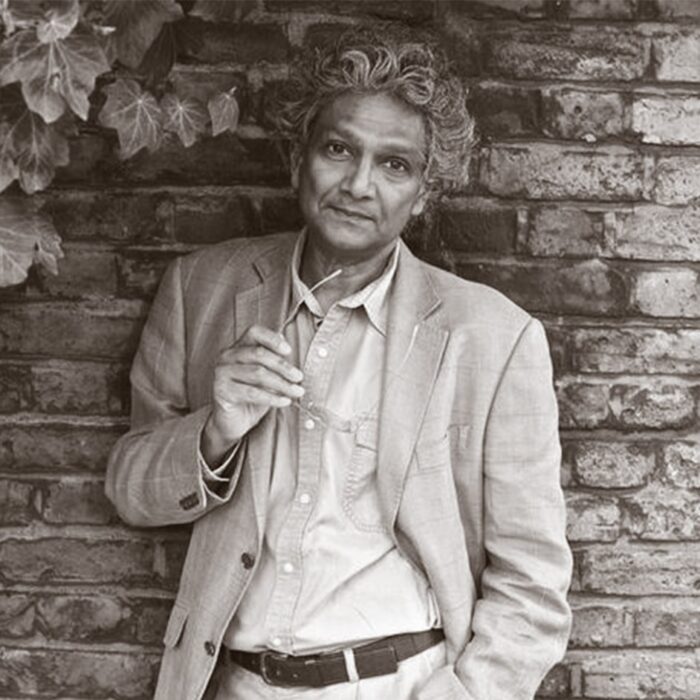
Romesh Gunesekera
Romesh Gunesekera is internationally acclaimed for his novels and short stories, including the Booker-shortlisted Reef and Noontide Toll.
Common world

Common world
Lucy Hannah

Kopuwai
Stefanie Seddon

The green room
Jacob Ross

Raising the dead
Nadifa Mohamed

Fish out of two waters
Monique Roffey

A common world
Gillian Slovo & Kamila Shamsie

Our world
Robert Huggins
WritersMosaic monthly
Get new episodes by email
One email monthly, unsubscribe anytime

Illuminating, in-depth conversations between writers.
Listen to all episodes
SpotifyApple Podcasts
Amazon Music
YouTube
Other apps

The series that tells the true-life stories of migration to the UK.
Listen to all episodes
SpotifyApple Podcasts
Amazon Music
YouTube
Other apps
WritersMosaic interrogates the notion of ‘staying in your lane’ by asking writers how they attempt to think beyond the parameters of their cultural identity.
Listen to all episodes
SpotifyApple Podcasts
YouTube

Marlon James: a Jamaican reckoning
'A return to a home I barely knew'
The name of this wallpaper is ‘Childhood’
A luminescent bubble of memory
What’s in a feminist? Holding on to Gloria Steinem
Is Gloria Steinem's feminism still relevant today?


Pressure
What's missing from the latest 'untold story behind D-Day'?
A Trial
An examination of theatre’s complicity in post-truth politics