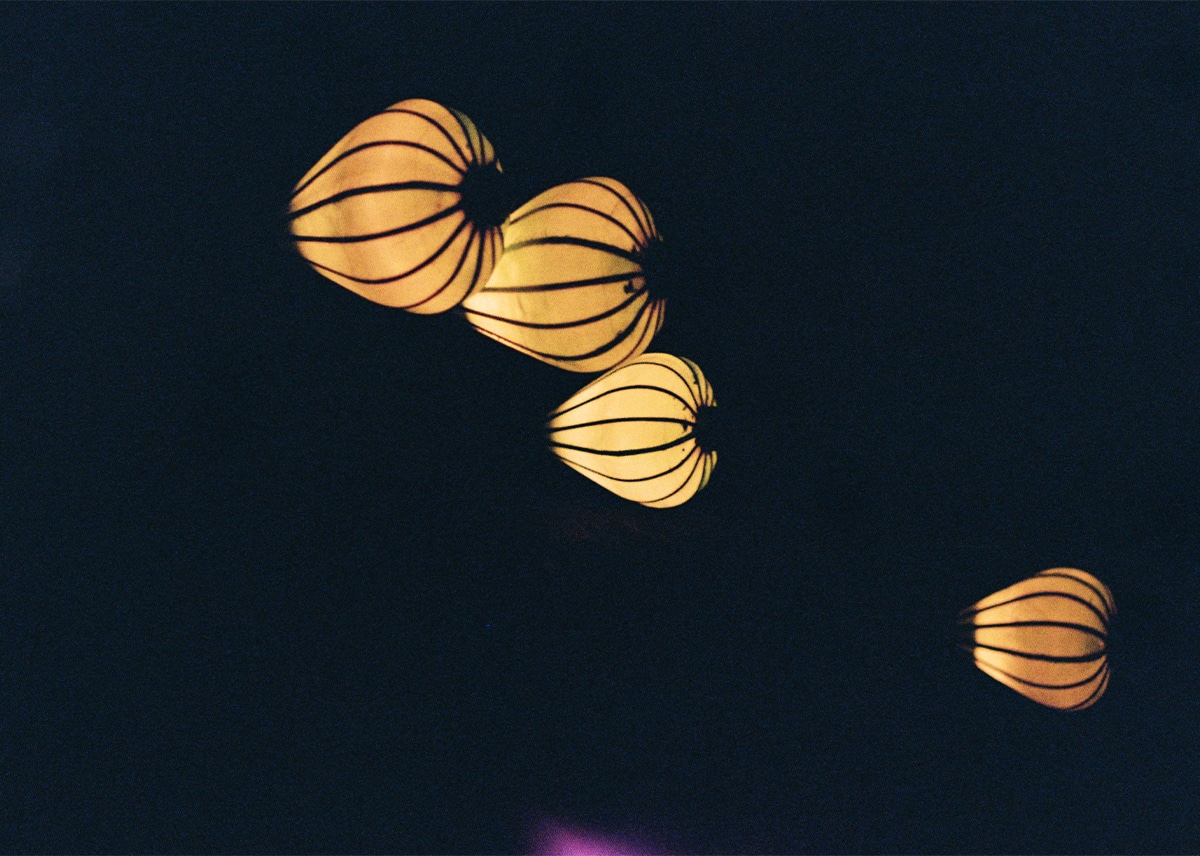
Iranian women's voices
The return of the God of the 1980s


Translated by Sana Nassari
This is not a report.
And today, as I write this note, it is Saturday, the 14th of Tir (5th of July). Night has just fallen.
I record this timestamp because life in Iran is so unstable and unreliable that you practically have no idea what will happen to your life in a day, even an hour’s time – events and shifts over which you have little or no agency, shaped by the mostly misguided decisions of a handful of reckless old men. And these decisions descend upon you like an inescapable fate.
This is the Middle East – land of prophets and oil, the throat of the Silk Road, the crossroads of catastrophe.
And I live in Tehran.
Tehran. Twelve days under missile fire — no sirens, no shelters, full of checkpoints, haunted by the fear that the god of the 1980s might rise again… defenceless Tehran!
And I, a 45-year-old woman, a painter, and a seeker of justice for Nika –Nika, killed during the Woman, Life, Freedom uprising by the mullahs’ regime.
This is how the coordinates of a suffocating, tangled life are marked.
Exactly the sort of coordinates the Israeli fighter jets should have known with precision during the moments they hovered over Tehran – they were supposed to target accurately, to protect civilian lives.
And yet, we saw what that so-called precision, that mastery of reading and striking coordinates, really meant: explosions in ordinary people’s homes, missiles dropped on Tajrish and Evin Prison…
A war we, the people, did not want.
Evin Prison
A place where, for the past 46 years, opponents of the clerical regime have been imprisoned, tortured, and executed. The Khavaran cemetery – site of mass graves of the regime’s political victims – is only one piece of evidence of these crimes among many. And now, in the twelve-day war between two criminal governments, this prison has become the target of yet another crime.
I keep wondering how much agency a person from the Middle East truly has – how much choice, how much capacity to shape their destiny – when I, as an Iranian, know that I am just as caught in the grip of patriarchy and fundamentalism as I am in the chokehold of oil, natural wealth, and the cursed yet resource-rich geography of this region. As long as this land remains strategically valuable to global powers, any talk of personal agency becomes a cruel irony – because every major decision is grounded in money and power, and the world is passed from the hands of one group of reckless old men to another, for whom power and wealth matter more than life, progress, security, or human dignity.
The modern history of my country is full of struggle – struggles to achieve a form of government founded on human rights, equality, and human dignity. From the Iranian Constitutional Revolution (1905-1911) to the Woman, Life, Freedom movement, we Iranians have shed blood and fought for democracy for at least 150 years. And each time, a war, a coup, or a brutal crackdown has pushed civil forces back – until the next turning point, when the young are killed again, and the older ones become the seekers of justice for them… the same suffocating, relentless cycle of repression repeated over and over again.
Even these words I speak now have been repeated so many times in Iran’s contemporary history that they feel tedious. And yet I say them – and so will the generations after me.
I think of the reckless old men in the White House, Tel Aviv, and Tehran.
I think of our rage, our despair, our breathless exhaustion – and how every turning point in my life has been shaped by immense suffering.
The suffering of living in a land where its resources feel more like a curse than a benefit to its own people.
The suffering of living in a land that has seen more prophets than any other. Prophets who have all been men – and whose primary preoccupation has been women, and how to dominate them.
And still, our greatest battle – after the fight for survival – is the fight for equality.
I often ask myself: which one is more essential, when a life without dignity and without equal standing is not worth all the effort it takes just to survive?
This is my lived experience. And my spirit is shaped by it.
By death, and anger, and grief. By wound upon wound, and wounds layered on top of wounds.
So if all I can portray is darkness and injury – what else should I paint?
I am a painter.
And for the past three years, I have been, in a way, under house arrest. The security apparatus of the clerical regime has either cut off all channels of communication between me and those around me, or made them possible only within strict, heavily monitored boundaries. Should I cross any of the red lines, I risk being sent to Evin Prison on charges of ‘acting against national security’.
Since the outbreak of the twelve-day war, any dissenter is arrested under the accusation of spying for Israel. This, in addition to the intensified pressure on civil activists and justice-seekers, the regression of society’s civic aspirations, and the added economic hardship, is among the direct consequences of war. For criminal regimes, war is an opportunity for greater repression; for civil society, it is a blow, a setback – because war entangles people in mere survival. And being reduced to survival erodes humanity itself.
Red!
A colour that, since the beginning of my artistic career, has been the dominant one.
Sometimes the colour of bruised flesh.
Sometimes fire.
Sometimes the colour of fresh blood that doesn’t sink into the earth – but flows across it,
coagulated,
refusing to disappear.
Red.
The red siren.
A siren that never sounded in Tehran.
Footnote: In the original Farsi, the phrase is Khoda-ye Dahe-ye Shast, literally, ‘The God of the 60s Decade’– the 1980s in the Gregorian calendar. This decade was marked by the Iran-Iraq war, post-revolutionary purges, and mass executions. The phrase sparked controversy when the regime’s current Supreme Leader, Ali Khamenei, declared that ‘The God of the 1980s is still the God of today’, a statement widely condemned as evoking one of the regime’s most violent and repressive periods.
© Atash Shahkarami and Sana Nassari
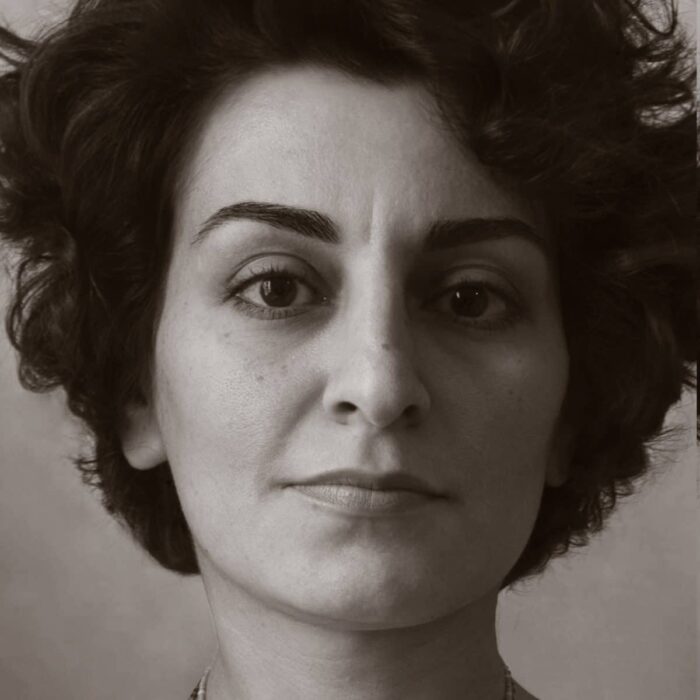
Atash Shahkarami
Atash Shahkarami is an Iranian painter whose work is grounded in her own lived experience.
Iranian women's voices

Iranian women’s voices
Sana Nassari

My bejewelled land
Shara Atashi

Iranian women’s defiant art of resistance
Sana Nassari

Song and Wind
Marjorie Lotfi

A three-act dream
Razieh Khoshnood

Poems of resistance
Forouz Zarei

Flesh
Sepideh Jodeyri

No country for filmmakers
Anahit Behrooz

WritersMosaic monthly
Get new episodes by email
One email monthly, unsubscribe anytime

Illuminating, in-depth conversations between writers.
Listen to all episodes
SpotifyApple Podcasts
Amazon Music
YouTube
Other apps

The series that tells the true-life stories of migration to the UK.
Listen to all episodes
SpotifyApple Podcasts
Amazon Music
YouTube
Other apps
WritersMosaic interrogates the notion of ‘staying in your lane’ by asking writers how they attempt to think beyond the parameters of their cultural identity.
Listen to all episodes
SpotifyApple Podcasts
YouTube

Marlon James: a Jamaican reckoning
'A return to a home I barely knew'
The name of this wallpaper is ‘Childhood’
A luminescent bubble of memory
What’s in a feminist? Holding on to Gloria Steinem
Is Gloria Steinem's feminism still relevant today?
Pressure
What's missing from the latest 'untold story behind D-Day'?
A Trial
An examination of theatre’s complicity in post-truth politics