Iranian women's voices
My bejewelled land


Iranians have their own unofficial national anthem, ‘Ey Irân’, that glorifies the motherland and veils the inglorious truth: O, Iran, you frontier of gems,/ O, your earth the fountainhead of art… Tell me, what can I do without your love?
We are the gems of this motherland, though her bosom is wounded, and her broken arms cannot embrace us. One outstanding ‘gem’ is the poet Forough Farrokhzad, who embraces us in her poem ‘O, you frontier of gems’, using the first line of the anthem as a bitter-sweet, ironic reflection on Iran in a distorted mirror of self-delusion. Nevertheless, as a ‘fountainhead’ of Iranian women’s poetry, the poet left us her free spirit as a guiding light, along with the meaning of her name: light and brightness. Still today, women, young and old, visit Forough’s tomb, sit there and recite her poetry, as if drinking from the ancient wine of our history to find solace for uncurable wounds.
Forough’s poem is in her fourth collection, A Rebirth (1963). I have rarely heard such polyphony in poetry. And within this polyphony can be heard individual voices of generations of women, not only my mother’s and grandmother’s, but also those born before them and after myself. She prompts us to dig into the nature of Iranian identity. It begins:
O, you frontier of gems (Ey Marz-e Por Gohar)
I have won,
I got myself registered,
I’ve adorned myself with a name on an identity card,
And my life is now defined by a number.
Well then, long live 678, resident of Tehran, as issued by precinct 5.
Forough’s distorted mirror reflects the social control in her own time while being prescient about ours. She evokes Iran’s ‘earth, the fountainhead of art’ as the dust of cow dung and the smell of garbage and urine, breathing it 678 times deeply into her lungs. Such realities have never ceased to exist, but are augmented today by the haze-filled air that frequently forces the authorities to impose lockdowns.
Maybe Iranians use more veiled metaphors in their colloquial conversations than people in other cultures: the social and political air chokes us, the hangman’s rope strangles us if we speak out. We have a word for this, khafeghan, encompassing all forms of oppression and suffocation.
Forough was born into an era of pseudo-freedom for women following centuries that formed and cemented misogyny as a form of backwardness in Iran. She was not forced into a chador, the Iranian veil, or even a headscarf. But she had to undergo all of the other traditional and religious humiliations women were exposed to back then, and are still now after the 1979 revolution introduced compulsory veiling. Forced into marriage at a young age, she believed hers was to be a love marriage, but soon had to understand that marriage in Iran has little to do with the expectation of mutual happiness. For Iranian society and her own parents, Forough’s rebellious nature made her an indecent woman whose child had to be taken away from her. Poetry was all she had left to survive the darkness floating over a solitary existence. Poetry – and the rudiments of an ‘official’ freedom prescribed by order of a new king.
I was a free child who grew into a free woman, bypassing all of the humiliations of enforced marriage and those other ‘traditions’ which continued in spite of any official freedom. But a single experience with an Iranian woman – in Germany – who measured me up as a possible match for her son, made me explode with outrage. I was only sixteen and had not expected this could happen to me.
With Iran now forced back to an era before Reza Shah’s gift of freedom, those who take to the streets to challenge the regime, as well as those who only quietly observe, have to dismantle the illusions of our past to see and understand what has gone wrong. Throughout our history, protesters have repeatedly been defeated and sent back to the start, as if we were playing a board game. I can only diagnose the past and present ills of my motherland by turning over in my mind its many layers of poetry. I was born into an era when my motherland was literally governed by poetry – in education, cultural life and politics. And, as a poet’s daughter, I was absorbed by poetry at home, too. This is how I came to perceive Forough as the avant-garde archetype of a true Iranian hero.
My maternal grandfather, a military official, did his best to implement the official freedom for women in backward rural areas, though he only knew the authoritarian way. Often employed to govern such rural places, he forced my mother, when she was still a little girl, not only to dress in shorts but also to cycle around the village. Two ‘sins’ at once! Anonymous figures threatened to cut my mother into pieces. But that was even more reason for the ‘General’ to challenge the cowards, saying, ‘People who write anonymous letters don’t have the courage to act.’ He wanted, by continuing the provocation, to find and arrest them, in the name of the new official freedom. My mother, baptised as a little girl in this fear of death, grew into the bravest woman I have ever met. She was twenty when Forough died in a car accident at the age of 32. I am now looking at my mother’s copy of A Rebirth, eighth edition, 1975, and at the poems she marked with an X, as I think about what she taught me. Her last words to me were, ‘There is a giant in you and a weakling. Don’t let the weakling prevail.’
Our stranding in exile was an oversized trauma, provoking in me a deep crisis of identity. In the past 46 years, my relation to Iran has been a continuous deep grief. It is to the language that I cling as an Iranian woman – both for my identity and to have something to say about the protests by women inside my motherland. The liberal modernity of the West, with its algorithm-led discussions, feels as soulless as the Iran Forough shows in her poem. Perhaps we are only halfway free, though like orphans in need of our mother – in my case, of a motherland. And if my thinking about Iran sometimes seems to me ‘dishevelled’, it may be because the etymology of that word traces back to ‘bare-headed’ and ‘unkempt’, revealing to me that my emotions about my motherland are a mess. Dishevelled, or confused, is a translation of the Persian word parishan, which literally means having a fairy on your shoulder (the Welsh understand this concept). Maybe this fairy on my shoulder, one who tousles my hair, is Forough – or my father, the poet, or my mother who has just left this world. And being fairy-stricken may be, by implication, my desire for a better world.
Both Iran’s unofficial anthem and Forough’s poem capture a cleavage between Iranian identity and women. The key is in the words ‘gem’ and ‘frontier’, meaning also worth and border: a border enclosing the existence of women throughout our history, in an attempt to diminish our worth, our potential, our ‘essence’ (another meaning of the word gohar, or gem). In diagnosing the ills of my society, I imagine Iranian identity as a kinship – a family tree, the branches of which represent our collective subconscious. Women are too often thought of as tainted fruit, spoiling over centuries of patriarchal attitudes in conformity to social and cultural norms. But there are two forces in every individual, the conformist and the creative. And it is the creator who is the rebel, unable to conform, searching to liberate and reshape something pure within the life of the tree. In the hidden depths of our subconscious, it is the creator rebels who cling to life and awaken vigour in their readers.
Forough, the light, emerged in such a way. Her consciousness drove her through limitations and imitations towards something new and unknown. In her writing and filmmaking, where she searched for the joy of being, she was able to awaken the creator in all the conformists and imitators. Forough rediscovered an imaginative innocence, one that could undo the pain of being thought indecent and sinful. She floated free of an entangled identity and represented neither innocence nor purity, but an Iranian woman as a creative force in human affairs.
***
Months before the young Kurdish-Iranian woman Mahsa Amini was killed in police custody for not wearing her hijab properly, another 22-year-old, Mona Heydari, was decapitated by her husband, who then walked the streets of Ahvaz holding the woman’s head and the knife. As far as I am aware, no one took to the streets to protest against this barbarity. This horror only found media attention months after the Mahsa Revolution and its slogan ‘Woman, Life, Freedom’ became popular.
This barbarity, known as an honour killing, could have become Forough’s fate, or my mother’s, or mine. In my dishevelment I ask, why is it so difficult to speak about the ugliest appearances of misogyny? But the situation in Iran should not be seen in a vacuum. Having lived most of my life in the West, I was surprised to read how often honour killings happen here, in the West.
In the poem ‘A Rebirth’ from 1964, Forough ‘planted’ her ink-stained hands in garden soil and believed in them as green and growing. In the winter of 2001, my father Manouchehr Atashi responded, in a poem, that instead of green leaves, rough red amaranths had grown from her hands. Hands stained with blood, raised fists reddened by rage, which I feel on turning the pages of Forough’s books, like the girls who sit around her tomb at Zahir-od-dowleh graveyard, and recite her poems in order to live.
POSTSCRIPT
The Visitor
By Manouchehr Atashi, translated by Shara Atashi
I want to go to the cinema
but a woman from a news cutting
with her severed head
comes to see me
It gets cold
— as if suddenly
it gets badly cold
I ask: what was your sin? Was it love?
She says: no, the knife of hate!
I say: shall we go to the cinema?
– Going for what? –
Says the woman with the severed head from the news cutting
When it turns so cold,
neither will anyone fight, nor will anyone fall in love,
nor will anyone go to the cinema
The woman from the news cutting
– with her head severed from the neck
sleeps by my side.
Tehran, 29 Dey 1379
(18 January 2001)
© Shara Atashi
Shara Atashi
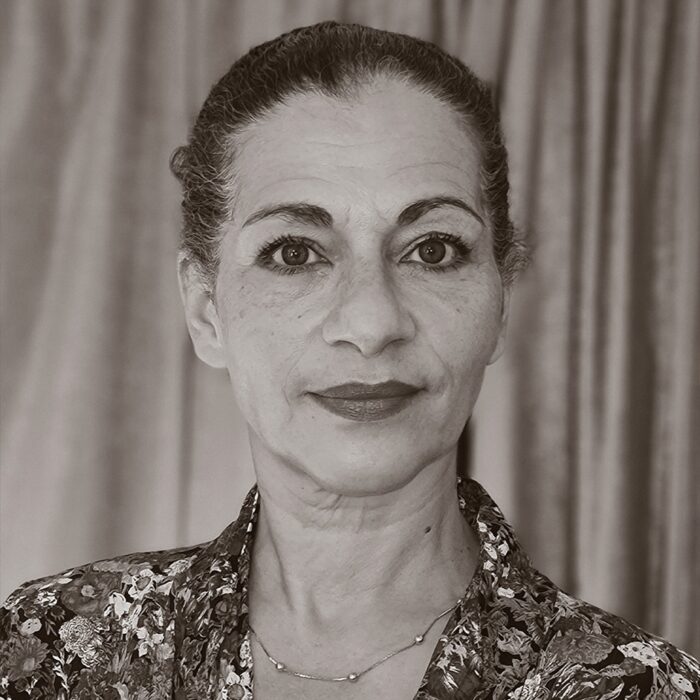
Shara Atashi is an Iranian-born writer and translator now living in Aberwystwyth, Wales.
Iranian women's voices

Iranian women’s voices
Sana Nassari

Iranian women’s defiant art of resistance
Sana Nassari

Song and Wind
Marjorie Lotfi

The return of the God of the 1980s
Atash Shahkarami

A three-act dream
Razieh Khoshnood

Poems of resistance
Forouz Zarei

Flesh
Sepideh Jodeyri

No country for filmmakers
Anahit Behrooz

WritersMosaic monthly
Get new episodes by email
One email monthly, unsubscribe anytime

Illuminating, in-depth conversations between writers.
Listen to all episodes
SpotifyApple Podcasts
Amazon Music
YouTube
Other apps

The series that tells the true-life stories of migration to the UK.
Listen to all episodes
SpotifyApple Podcasts
Amazon Music
YouTube
Other apps
WritersMosaic interrogates the notion of ‘staying in your lane’ by asking writers how they attempt to think beyond the parameters of their cultural identity.
Listen to all episodes
SpotifyApple Podcasts
YouTube


Marlon James: a Jamaican reckoning
'A return to a home I barely knew'
The name of this wallpaper is ‘Childhood’
A luminescent bubble of memory
What’s in a feminist? Holding on to Gloria Steinem
Is Gloria Steinem's feminism still relevant today?
Pressure
What's missing from the latest 'untold story behind D-Day'?
A Trial
An examination of theatre’s complicity in post-truth politics