Blood and Belonging – Traveller Writers
Reporting for Romanistan
I think it was the moment I realised my horse had more human rights than I did, that I realised something had to be done. I had travelled from Scandinavia back to Britain with my mare Sally, my wife Claire, and an old Gypsy wagon I had bought from the Romany poet and relative Eli Frankham.
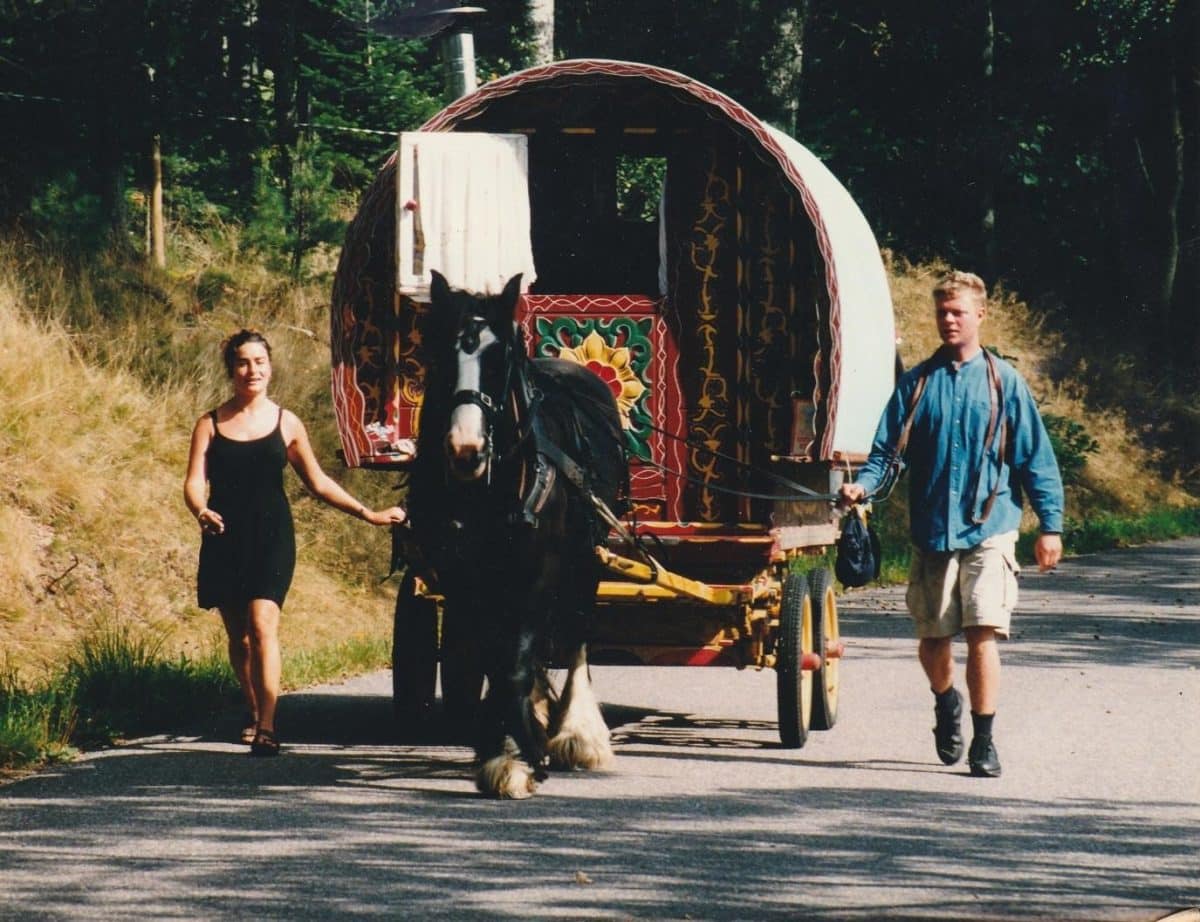
As we travelled further south and west through the home counties, the fear and curtain twitching intensified. Somewhere in darkest Dorset we ran out of stopping places and water, and it was getting dark. I knocked on a farm door, hoping to appeal to a countryman’s better nature.
‘You can have a bucket of water for the horse, but then you had best fuck right off,’ came the curt response to my polite enquiry about a night within the hedges. With water in Sally’s belly, we found a verge five miles further on. We went to bed hungry and tired that night, but a new purpose was forming in my mind.
It was there I decided that if I didn’t tell our story, then who would? My Romany father had taught me to be proud of who we were, but he thought school was for fools. My gorgia (non-Gypsy) mother saw that literacy gave the excluded a voice. They had long since split by the time I came to be on that Dorset verge, but the tension between their two worldviews lived on in me.
I taught myself to tell a tale, weaving his drive for the deal and her passion for politics into a career of sorts. Gradually, I started freelancing for the Big Issue, then the Guardian and then, after being funded to research the feasibility of a Romany radio station, started Rokker Radio, the first and only programme for Gypsies and Travellers on the BBC. I’ve been one of Britain’s few Romani journalists ever since.
In the beginning, I fretted over whether I was Romany enough to tell our story. It was a visit to Auschwitz concentration camp that soon put paid to that. If having just one Romany great-grandparent was enough to have you sent to the gas chambers, I thought that with four out of eight coming from some of the biggest Romany families in southern England, I was qualified whether I liked it or not.
In the 25 years since I left that verge, I’ve travelled the length and breadth of European Romanistan, the cracks in between countries where 12 million of our people live. Romanistan is more of a state of mind than a nation state, but from the Camargue to the Carpathian Mountains, you know it when you see it. For decades, I’ve gone looking for our story and been greeted with the love and respect which Romanipe (Gypsyness) dictates should be given from one Romany to another. The key that opens the most jaded of Romany eyes, hearts and homes is simply to speak some of our beloved Romani language. Far from the dirty, feckless, immoral beings we have long been perceived to be, we reserve the best we have for each other, in the knowledge that our greatest gift will always be each other.
In the spirit of showing and not telling, let me show you inside the life of my community in a series of videos I and others have made over the years, with love and respect.
This Land
This Landexplores and celebrates the Gypsy and Traveller connection to the land.
https://vimeo.com/797428825
Hurjasa (We Will Fly)
A beautiful cinematic portrait of Europe’s largest ethnic minority, Hurjasa features over 30 Roma role models from the Western Balkans, all thriving in their respective professions and homes.
https://www.youtube.com/watch?v=_FeVLLhMIV0
The Last Nomads
This film is about the Drive to Survive Campaign to stop the Police Bill eradicating Gypsy and Traveller nomadic life in Britain.
https://www.youtube.com/watch?v=ZQ8vRk0e_Hk
The Tale of Europe’s Stolen Children
Across Eastern Europe, Romani children face huge barriers. Many are defined as ‘educationally subnormal’ and forced into racially segregated special schools, while others are forcibly taken into care because of the poverty of their parents and widespread discrimination.
This modern fairy-tale animation looks at one child who escaped such a fate to become an advocate for her people.
https://www.youtube.com/watch?v=pXwZ-3FQHdQ
Black Saint – Could You Love Me?
Black Saint’s powerful music video, shot within different Romani communities from Kent to Glasgow, poses a difficult question about Britain’s Gypsy and Traveller communities, ‘Could you love me?’
https://vimeo.com/177114373
© Jake Bowers

Blood and Belonging – Traveller Writers

Blood and belonging
Louise Doughty

Writing spells danger!
Richard O’Neill

I belong to both worlds
Raine Geoghegan

Chicken blood
Jo Clement

Our blood
Damian Le Bas

Objects of love
Rosaleen McDonagh
WritersMosaic monthly
Get new episodes by email
One email monthly, unsubscribe anytime

Illuminating, in-depth conversations between writers.
Listen to all episodes
SpotifyApple Podcasts
Amazon Music
YouTube
Other apps

The series that tells the true-life stories of migration to the UK.
Listen to all episodes
SpotifyApple Podcasts
Amazon Music
YouTube
Other apps
WritersMosaic interrogates the notion of ‘staying in your lane’ by asking writers how they attempt to think beyond the parameters of their cultural identity.
Listen to all episodes
SpotifyApple Podcasts
YouTube

It’s being published I get paid for; the writing I would do for free
‘Any advance [...] for your novel is to compensate you for the horrors of being published'
Complex antihero: an interview with Arthur Hughes
Unravelling Authur Hughes' Richard III
Marlon James: a Jamaican reckoning
'A return to a home I barely knew'
Haunting the Black Air
Poetic freedom across space and time
The Disappearers
A sprawling visceral experience that drops you in head first