Talismans of migration
Summer Wear
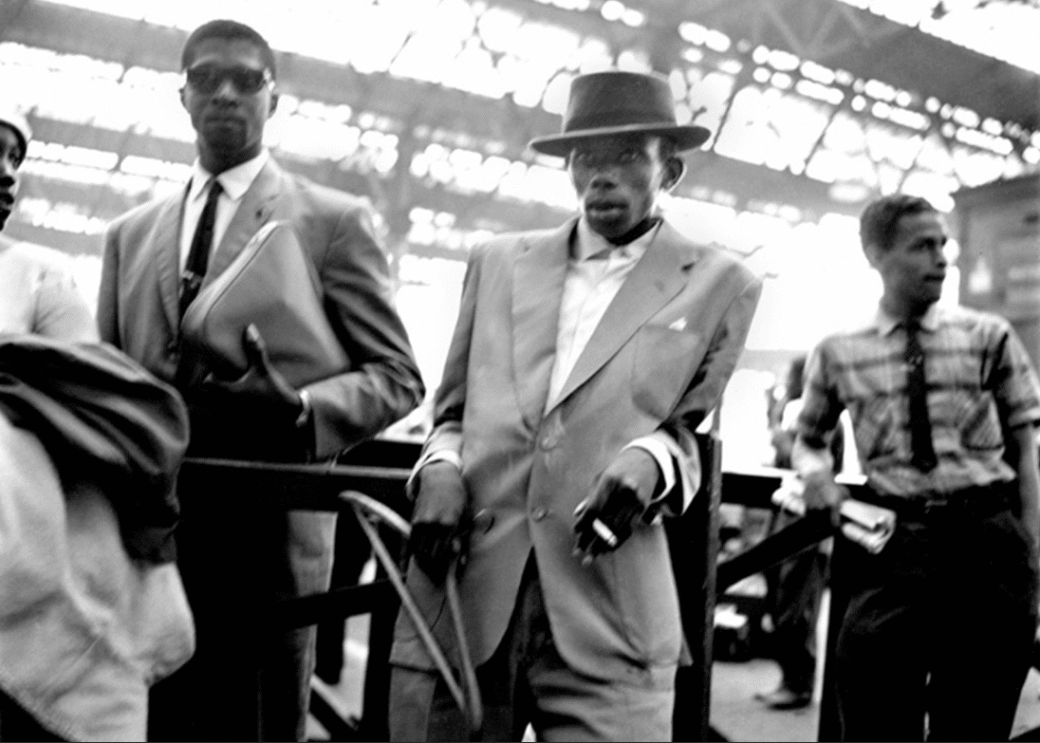
Summer Wear came to Britain from Jamaica in the 1960s. No one seemed to know his real name. He was called Summer Wear because of his predilection for wearing summer suits. Some wag, one of his fellow merchant seamen, gave him the nickname and it stuck. Summer Wear arrived at Southampton with very little luggage and only wearing a light tropical suit, just as autumn was sliding into winter. Apparently, Summer Wear had never owned a heavy winter coat, which would have been more appropriate for the snow which greeted him soon after his arrival.
The tropical suit and nickname gave him that elusive quality, treasured by every West Indian migrant I ever met: style! You could take away a man’s livelihood, turn him out of his home, and his belly could be knocking on his backbone, but you could never deny him his style.
I was always drawn to the romance of the story of Summer Wear’s suit; there seemed such charm and innocence to it and to the man himself. Summer Wear makes me think of the West Indians who descended from the last boat train of migrants from Southampton to Waterloo in May 1962. The suited man holding a coathanger in Howard Grey’s photo from that time is not Summer Wear, but he is a great stand-in for him: glamorous, languid and carefree. He’s dressed with the kind of distinction that would have met with the approval of Summer Wear, my father and his spars.
A few years ago, when composing a book about the Windrush generation, I wanted to focus on those West Indian men and women who were part of the background to my childhood in Luton. Sitting down to write, I could recall Summer Wear because of the familiarity of his name, along with other West Indians such as Tidy Boots, Anxious and Pumpkin Head, but I could not picture him. One day I asked my mum, Ethlyn, ‘Whatever became of Summer Wear?’ Without missing a beat, she answered, ‘Well, soon after coming to Britain, he caught a chill and died.’
Ethlyn said it straight but the poignancy of the story has always remained with me, and perhaps accounts for my lasting affection for a man I hardly knew. Summer Wear, it seems, would never have countenanced being seen wearing a heavy coat, although it might have been practical to do so. After all, he was called Summer Wear; he had to live up to his name. His name and his tropical suit were talismans of migration. It was true of all of those West Indians, including my father whose nickname was Bageye – given to him because of the permanent bags under his eyes. Their nicknames defined them, set them apart, spoke to their individuality, and were a reminder of how they were perceived and how they perceived themselves back home in Jamaica. Even if, as was true of Bageye, they didn’t like their nicknames, they clung to them as badges of honour.
Ethlyn remembers that, for a while after Summer Wear’s death, his friends took to honouring him by wearing suits whenever they gathered, even if it was to go to the West Indian pub, ‘The Checkers’, or to Mrs Knights’ all-weekend poker game.
‘They had style in those days,’ says Ethlyn. She reminds me that back in the day West Indian men didn’t skimp on clothing. ‘The English man would have five collars and one shirt, but a man like Summer Wear, him would have five shirts! True dat!’ I suggest to my mum that surely that can’t be true, that she’s talking about the glamorous, swinging sixties. ‘Glamour?’ She kisses her teeth. ‘There wasn’t much glamour in England then. Summer Wear, Tidy Boots, Anxious, all a-dem had style. You wan’ look for style or glamour now? You have to close your eyes and imagine it.’
I ask Ethlyn if she knows what became of Summer Wear’s suit.
‘Last me see him, he still there wear it in him coffin.’
‘So, he was buried in it?’
My mum fixes me with a long stare.‘Cha, don’t talk foolishness, Colin. The man bury in him suit. Nah Mus?’
© Colin Grant
Talismans of migration
Editorial
Colin Grant
The List
Snežana Ċurčić
The last ritual
Eric Ngalle Charles
The most wonderful object in the world
Maria Jastrzębska
A sick note
Suzanne Harrington
Month One: the source and the poem
Roger Robinson
Haunting melodies
Maggie Harris
Kafan
Ishy Din
Rolling luggage
Amanda Vilanova
WritersMosaic monthly
Get new episodes by email
One email monthly, unsubscribe anytime

Illuminating, in-depth conversations between writers.
Listen to all episodes
SpotifyApple Podcasts
Amazon Music
YouTube
Other apps

The series that tells the true-life stories of migration to the UK.
Listen to all episodes
SpotifyApple Podcasts
Amazon Music
YouTube
Other apps
In the first series of poems commissioned by Hannah Lowe, six poets explore how ritual gives meaning to our lives.
Listen to all episodes
SpotifyApple Podcasts
YouTube

Free Will
Will Harris reads his poem, 'Free Will'. Directed by Matthew Thompson and commissioned by the Adrian Brinkerhoff Poetry Foundation.

Half Written Love Letter
Selina Nwulu reads her poem, 'Half Written Love Letter'. Directed by Matthew Thompson and commissioned by the Adrian Brinkerhoff Poetry Foundation.
Triage
A response to the endless spiral of worldwide conflict and tragedy
My tomorrow is today
'I clasped my hands together, not in prayer but to stop them from shaking'
Ballet Black at 25
Cassa Pancho: 'It’s a miracle that we are still here in some way'



Mahsa Salali’s Naqqāli
'Salali positions the female body... as an active agent'

At Sea
Bearing witness in the face of dismissal