Talismans of migration
The last ritual
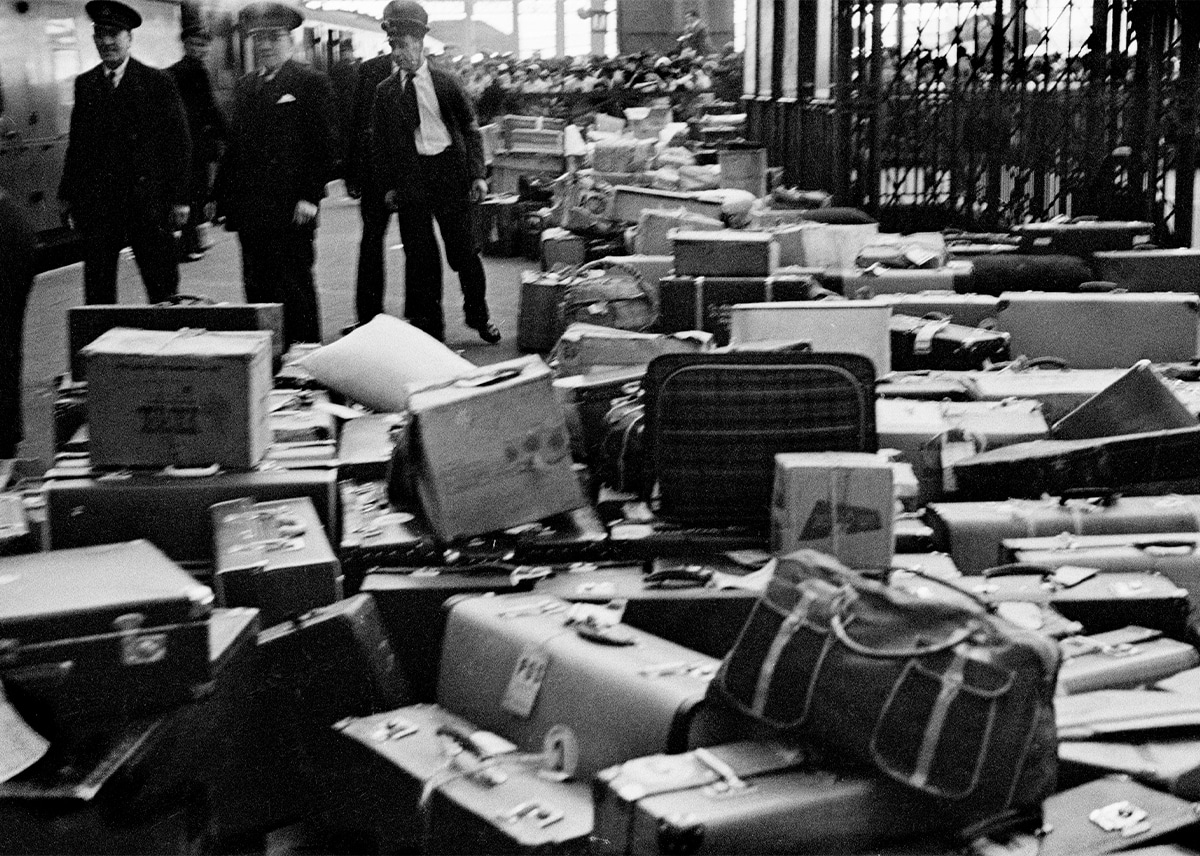
On a breezy evening by the Wouri River, I watched the flickering lights of Douala airport. Its gentle glow cast shadows on the stone walls and reflected on my mother’s face. My mother, Sarah Efeti Kange, or Iya (a term of endearment), sat on a wooden flower box in her blue kabba, her hands folded under her chin. Her yellow-and-black head tie resembled a swallowtail butterfly’s wings. Nearby, my friends Victor and Kulu, and my nephew Collins chatted. My sister’s late husband, Mr Paddy Ndanga, who had played a fatherly role in my life, walked proudly among them. They had all come to the airport to say goodbye to me.
As I wondered what lay ahead, my mother moved towards me like Mami Wata rising from the River Wouri. Her head tie now looked like helicopter blades, propelling her forward. She avoided my gaze, then placed her left hand on my shoulder, drew me closer, and rested her cheek on my forehead. She embraced me, still avoiding eye contact, but I saw her tears mingling with her make-up and running down her face like a black stream. She took my hands into hers and, slowly but steadily, gave each of my fingers a gentle bite, paying tribute to an old village adage, knotting and sealing the fact that as I struggled to climb, the thoughts and prayers of my relatives would be with me, as mine would be with them. And that wherever my travels took me, my ancestors would bring me back to her while she was still alive, and not when she was navigating the corridors of her grave.
That is how I left Cameroon in May 1997, six months before I turned eighteen, carrying the memory of my mother biting my fingers. I didn’t grasp the full significance of her actions that day. Instead, her behaviour evoked two feelings in me: a fear that I might never see her again, and a fear of failure.
One year later, during the harsh winter of 1998, a group of Cameroonians held me hostage in Moscow, Russia, and assaulted me with hot knives to the extent that I begged for death. My ancestors intervened through my mother. She appeared in the room like a ghost and threatened me with the song ‘Agwe Wolo’ by the artist Njoh Ndeley, about a woman mourning the death of her children. My mother altered the lyrics to serve as a warning: ‘If you let them kill you, I will come to Russia, dig you out of your shallow grave, and kill you again.’
By May 1999, I knew my course of action. If I couldn’t leave Russia that year, I was prepared to take my own life. I had already tried that once at Kievskaya train station. A few months later, my ancestors intervened again, and I took a British Airways flight via Heathrow, with my final destination being Zimbabwe. I never arrived in Harare; instead, my ancestors conspired to bring me to Wales.
In October of that year, the Home Office gave me a bedsit at 212A Clive Street in Grangetown, Cardiff. Although my stay was short, 212A Clive Street was my first official UK address. In the summer of 2000, when I opened my bedsit door, six men – two white, two black, and two of mixed race – attacked me with knuckle-dusters and bicycle pumps. They shouted, ‘Go back home,’ but I had no idea what they meant. A few days later, I woke up at Heath Hospital in Cardiff and found that my attackers had broken my nose. Now I live in Leckwith, and I have to walk past Clive Street on my way to the train station. Every day, I am transported back to the memory of the men attacking me.
At the hospital in Heath, I remember closing my eyes and seeing my mother arranging mangrove wood in the fire, her eyes red from the smoke, and I wondered if the ancestors would one day take me back to her, and I pulled my blanket over my head.
No one visited me.
My world was condensed into a square of pale linen, where day and night blend. In the slow rhythm of heartbeats and distant footsteps, my bed and sheets became a vessel of waiting, a raft adrift on a sea of uncertainty. I kept waking in a fright and asking myself, ‘Where am I? What brought me here?’
In 2017, after receiving the Creative Wales Award – the Arts Council of Wales’s highest honour, recognising my work on migration, memory, and trauma – I decided to visit Cameroon for the first time in 20 years. The night before leaving, I sat with my sixteen-year-old daughter, Iya Efeti, named after my mother. I held her hands, trying to mimic what my mother did at the airport. I nibbled her little finger, and she giggled. When I reached her index finger, she burst into loud laughter, saying, ‘Dad, I will remember you. You don’t have to be so dramatic.’
I sat on my mother’s veranda, sharing how my daughter reacted when I attempted to pass on her ancestral knowledge. My mother chuckled and said, ‘You don’t only bite the fingers; you should first chew seven alligator pepper seeds.’ I smiled briefly, wondering whether my mum’s tears at the airport in 1997 were caused by the burning sensation from biting into alligator pepper seeds.
© Eric Ngalle Charles
Talismans of migration
Editorial
Colin Grant
The List
Snežana Ċurčić
The most wonderful object in the world
Maria Jastrzębska
A sick note
Suzanne Harrington
Month One: the source and the poem
Roger Robinson
Haunting melodies
Maggie Harris
Kafan
Ishy Din
Rolling luggage
Amanda Vilanova
Summer Wear
Colin Grant
WritersMosaic monthly
Get new episodes by email
One email monthly, unsubscribe anytime

Illuminating, in-depth conversations between writers.
Listen to all episodes
SpotifyApple Podcasts
Amazon Music
YouTube
Other apps

The series that tells the true-life stories of migration to the UK.
Listen to all episodes
SpotifyApple Podcasts
Amazon Music
YouTube
Other apps
WritersMosaic interrogates the notion of ‘staying in your lane’ by asking writers how they attempt to think beyond the parameters of their cultural identity.
Listen to all episodes
SpotifyApple Podcasts
YouTube

It’s being published I get paid for; the writing I would do for free
‘Any advance [...] for your novel is to compensate you for the horrors of being published'
Complex antihero: an interview with Arthur Hughes
Unravelling Authur Hughes' Richard III
Marlon James: a Jamaican reckoning
'A return to a home I barely knew'

Haunting the Black Air
Poetic freedom across space and time
The Disappearers
A sprawling visceral experience that drops you in head first